
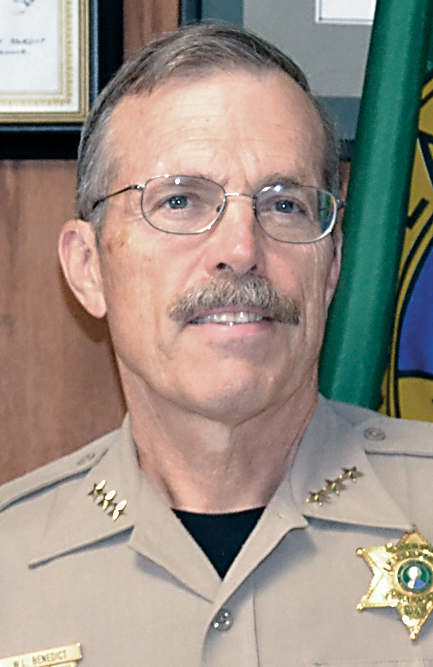
PORT ANGELES — About 300 heroin users in Clallam County spend a combined $9 million to feed their addictions every year, Sheriff Bill Benedict said Wednesday.
At least 200 pounds of black tar heroin arrives in Clallam County from Mexico to satisfy that demand, Benedict told about 50 members of the Port Angeles Regional Chamber of Commerce at their luncheon.
“I’m going to offer to you that our reliance on the criminal justice system to fix this problem might be just a little overrated,” Benedict said at the gathering at the Elwha Klallam Heritage Center.
“We cannot restrict the supply. As hard as we try, it’s going to get in.”
About half of the heroin users served by the Clallam County syringe exchange program are “well known to the criminal justice system,” Benedict said.
“There is a strong connection with heroin use to crime, particularly property crime,” Benedict said.
“They are some of our prolific burglars. It’s a revolving door.”
In response to the growing heroin and opioid drug problem, the Sheriff’s Office-sponsored Olympic Peninsula Narcotics Enforcement Team has shifted its focus to target large-scale dealers.
The Clallam County jail has begun an innovative medical program to help opioid users come down from their highs with Suboxone, Benedict said.
The Clallam County Health and Human Services syringe exchange program provides about 300,000 clean needles to heroin users annually.
“There is a huge body of abuse of opiates that doesn’t get reflected here,” Benedict said of the syringe exchange data.
“There are those that use pills. There are some that smoke heroin, a fairly significant group.”
Opioids include heroin, morphine, codeine, OxyContin, oxycodone, Percocet and other painkillers, not to mention powerful synthetic derivatives.
While highly effective in pain management, prescription opioids are extremely addictive and easily abused, Benedict said.
“Clallam County over the last five years has been No. 1, 2 or 3 in the rate of opioid overdose deaths in the state of Washington,” Benedict said.
“That’s a dubious distinction to say the least.”
Benedict said there has been a “very significant and substantial rise” in unintentional drug overdose deaths nationwide since 1980s.
Opioids, he said, were “idly overprescribed in the ’80s and ’90s and early 2000s.”
“A lot of people developed dependencies on them,” Benedict said.
“Keep in mind, a number of our heroin addicts are out of that subset.”
He noted that many heroin and opioid drug users can maintain productive lives.
Between 8 and 14 percent of health care professionals nationally have use opioid drugs illegally, Benedict said.
“This is not a problem of some poor people and some criminals,” Benedict said.
“This is a problem that covers the entire spectrum.”
Virtually all of the heroin in Clallam County is brown or black tar heroin smuggled up the Interstate 5 corridor from Mexico, Benedict said.
White powder heroin, more common on the East Coast, is processed from poppy plants in Afghanistan, China and Burma, he said.
To put the opioid problem into perspective, Benedict displayed a slide showing the number of people who died from tobacco, second-hand smoke, alcohol and opioids in 2013.
In Clallam County, 116 died from tobacco or second-hand smoke, 20 died from alcohol and 11 died from opioids.
Statewide, 11,780 died from tobacco or second-hand smoke, 1,990 died from alcohol and 615 died from opioids.
Benedict disclosed that he would interject his “somewhat libertarian” views during his presentation.
“I have a hard time putting people in prison for something they want to do to their own bodies,” Benedict said.
“But I also recognize the fact that people that are addicted to drugs exhibit behaviors that have a negative impact on themselves, society, the culture, as well as it is a huge crime problem.”
________
Reporter Rob Ollikainen can be reached at 360-452-2345, ext. 56450, or at rollikainen@peninsuladailynews.com.
