
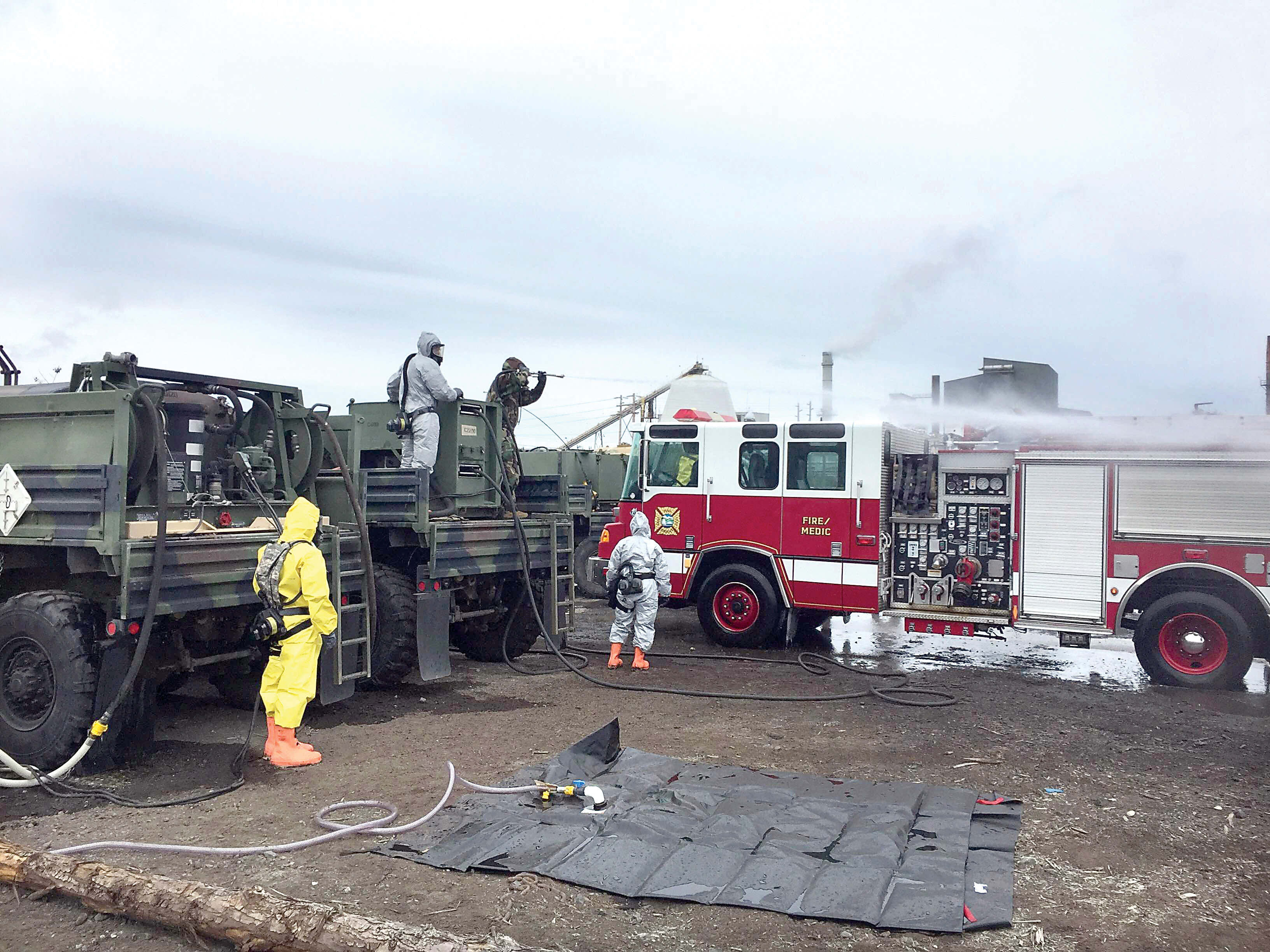
PORT ANGELES — Should a massive 9.0-magnitude earthquake and subsequent tsunami rock and drown the coastal areas of the North Olympic Peninsula, residents likely would be cut off from emergency responders and would have to rely on themselves to survive, emergency personnel said.
Such a situation would be “really life-threatening,” said Penny Linterman, Clallam County Sheriff’s Office joint information manager for the Cascadia Rising exercise, on Friday.
“If you don’t have a plan and know how to take care of yourself, you aren’t going to make it.”
During the exercise, which concluded Friday, organizers assessed how city, county, state and federal emergency responders would handle the inevitable tsunami, loss of power and broken landscape a massive earthquake from the Cascadia Subduction Zone would cause in coastal communities throughout Washington, Oregon and British Columbia.
Mock air rescue
Friday saw mock air rescue operations at the Fire District No. 3 maintenance yard at 255 Carlsborg Road near Sequim and the landing of a Black Hawk helicopter at the Bob Bates Little League Fields in Port Hadlock.
The exercise — which involved participants throughout Washington state, Oregon and British Columbia — was conducted in anticipation of a quake in the Cascadia Subduction Zone.
The 800-mile fault, which stretches from southern British Columbia to Northern California, spawns massive earthquakes an average of once every 200 to 500 years, with the last in about 1700.
Immediately following the onset of such a catastrophe, area residents most likely would have to look to themselves and their neighbors for help.
The expectation is that telephone lines and roads would be heavily damaged or completely destroyed.
Without the ability to call 9-1-1, or even for 9-1-1 dispatchers to send emergency aid if a call came through, residents would have to have a Plan B, Clallam County Undersheriff Ron Cameron, incident commander for the local exercise, said Friday.
One option would be to travel to the nearest fire department station, where law enforcement are directed to gather following the cessation of a big earthquake and tsunami.
“That is where I would recommend people try to report emergencies — physically, if they can’t get there any other way,” Cameron said.
“My instructions to the deputies at the Sheriff’s Office are ‘take care of your family first and when you are capable, respond to your closest fire station when you can.’
“We just need to identify a post, and at that point, we can figure something out.”
Getting supplies
For most, the only food, water and medicine residents would have access to immediately following a big quake would be what was already in their homes, or in the homes of their neighbors, drill organizers have said.
So what happens if some — after running out of essential supplies — become desperate enough to loot or steal from other residents such as was reported in the aftermath of hurricanes Katrina and Sandy?
Cameron said he doesn’t believe that will be the case. He has faith in the altruistic nature of humanity.
“Maybe I am optimistic,” he said.
“Look out for each other. We encourage that.”
However, if such a situation were to arise, the Peninsula could expect an influx of law enforcement personnel to help keep the peace from State Patrol, Cameron said, although they would be limited by their ability to travel to different areas cut off by collapsed roadways.
Distribution centers
Distribution centers where residents could obtain food, water and medicine “would be established within 24 hours,” Jim Borte, Clallam County public information officer, said Friday.
“We would establish community points of distribution, and they would have law enforcement presence there and they would give each vehicle that came there enough food for three days for three people,” Borte said.
“It would be a very orderly distribution system in a place where everybody could get to easily.”
Getting news
With phone lines down and no cellphone or Internet service, giving or receiving information from the outside world would be exceedingly difficult, Linterman said.
In Clallam County, both KSQM and KONP radio stations have generators that would allow them to provide radio bulletins based on the availability of fuel, assuming they survived the quake.
But, Linterman said, the best option is to purchase a ham radio in advance and become familiar with the way it works.
“Get your ham radio license,” she said.
And while authorities would discourage unnecessary communications to keep the airwaves cleared for emergency traffic, “you can at least listen and know what is going on,” Linterman said.
More on the horizon
While an official sequel to Cascadia Rising is yet to be organized, entities in both Clallam and Jefferson counties will schedule smaller drills in the near future to continue honing their skills.
“There will be much in the way of follow-up drills,” Cameron said.
“I’ve already got in my mind some mini-drills that we can build to kind of get ready for Cascadia 2.”
________
Reporter Chris McDaniel can be reached at 360-452-2345, ext. 56650, or cmcdaniel@peninsuladailynews.com.
