
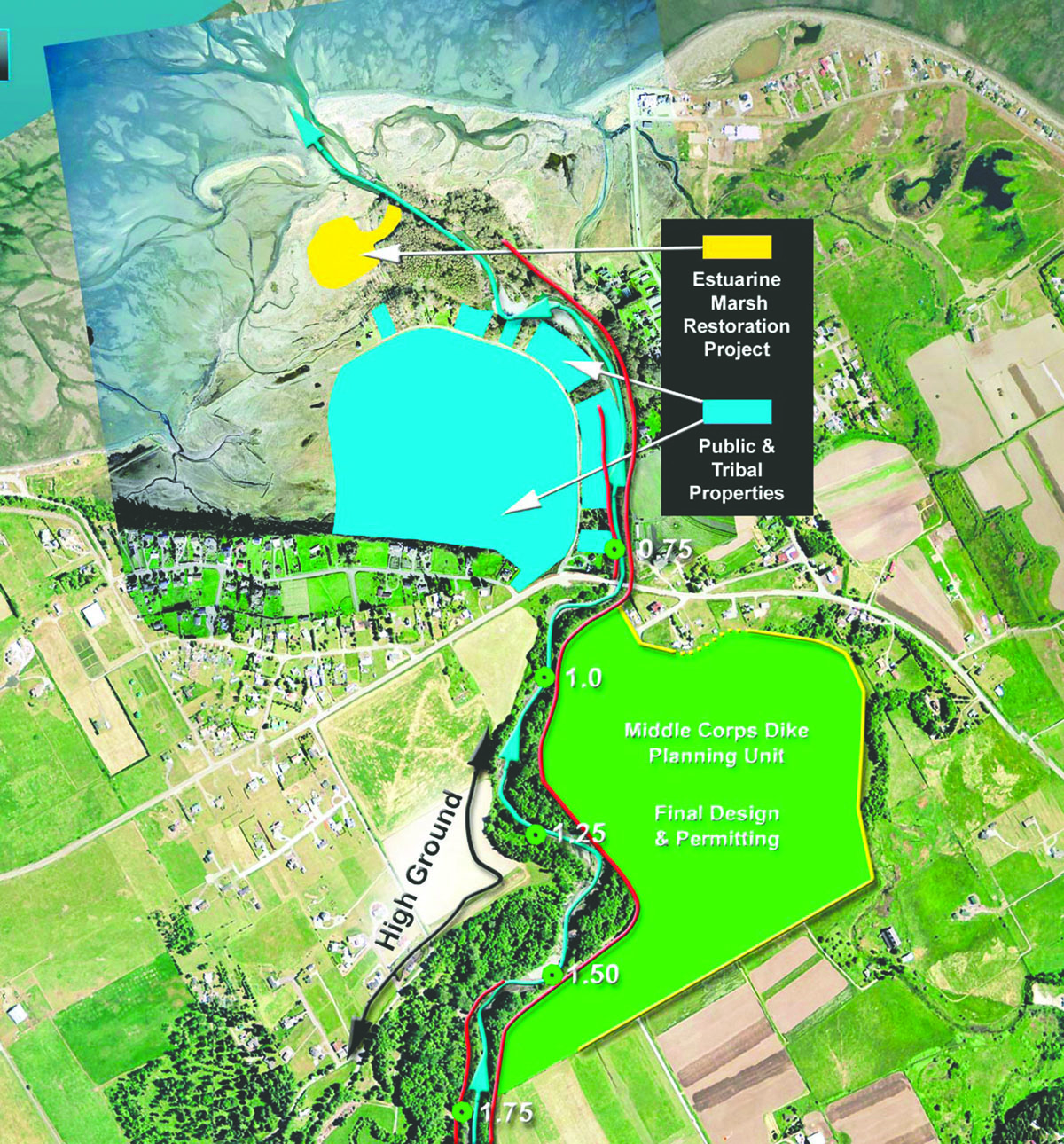
DUNGENESS — As the U.S. Army Corps of Engineers studies the feasibility of relocating a dike on the east bank of the Dungeness River, Clallam County is preparing to remove two buildings within a 117-acre tract that will eventually be restored as a natural floodplain.
Moving the dike away from the river will abate flood hazards and improve fish and other wildlife habitat in the lower Dungeness River and Dungeness Bay, Clallam County natural resources planner and project coordinator Hannah Merrill said.
The multi-agency, county-coordinated project will affect a milelong stretch of the river south of Anderson Road.
“It’s a huge, cooperative effort,” Merrill said.
The Corps of Engineers lists the project as not to exceed
$5 million, with most of the funding coming from state Recreation and Conservation Office coffers earmarked for salmon recovery.
Merrill said the levee setback project targets chinook salmon and bull trout, although other species stand to benefit.
Earlier this month, the three Clallam County commissioners called for bids for the deconstruction, salvage and demolition of two buildings in the project zone: a house at 2755 Towne Road and an old barn at 2137 Towne Road.
“We’ve gotten some calls,” Merrill said in a briefing to commissioners last week.
Salvageable materials from the old buildings will be made available to those who qualify for a local historic barn program.
Three property owners — including state Rep. Steve Tharinger — and one renter have had to move as a result of the project.
Tuesday, county commissioners approved a letter asking the Salmon Recovery Funding Board to add the state Department of Fish and Wildlife as a co-sponsor to a county grant from the Recreation and Conservation Office.
The addition would reportedly enable Fish and Wildlife to hold title and manage 8 acres of property within the footprint as a part of the lower Dungeness Unit of the North Olympic Wildlife Area.
“If we update [the grant] with this letter, I can work with Fish and Wildlife and acquire this parcel and then put it into title and we’re done,” Merrill told commissioners.
But since the project involves local, state, federal and tribal interests and property, the relocation of the dike may not occur for another five years.
“Hopefully sooner than that,” Merrill said.
Commissioner Jim McEntire, whose district covers the Dungeness watershed, questioned whether the county “gives anything up” by adding Fish and Wildlife as a grant partner.
He said the public should be able to walk their dogs and ride their bikes on the new dike “without a need for a Discover Pass,” referring to the State Park system’s $30 annual user fee.
“I just want to make sure that we don’t induce any marginal cost for our citizens to have access to their land,” McEntire said.
Merrill responded by saying the county will lose nothing if Fish and Wildlife is added as a co-sponsor.
“They also want this to be accessible for the public,” Merrill said.
“It will remain as it is now, which is people can access the levee and walk and bike, and that’s how it will continue.”
Built in 1963, the Army Corps dike constricted the river and resulted in increased flows.
Sediment confined to the channel has caused the riverbed to rise. The bottom of the river is now perched above the surrounding floodplain, and county officials have said the dikes are at risk of failing in a flood.
The decades-old effort to restore wildlife habitat in the lower Dungeness is considered to be a top priority of the North Olympic Lead Entity for Salmon and other groups, Merrill said.
The project is about a year behind schedule because of the pending Corps of Engineers’ feasibility study, a draft of which may be made available next month.
“They are committed to getting it done,” Clallam County Planning Manager Steve Gray said.
Reporter Rob Ollikainen can be reached at 360-452-2345, ext. 5072, or at rollikainen@peninsuladailynews.com.
