
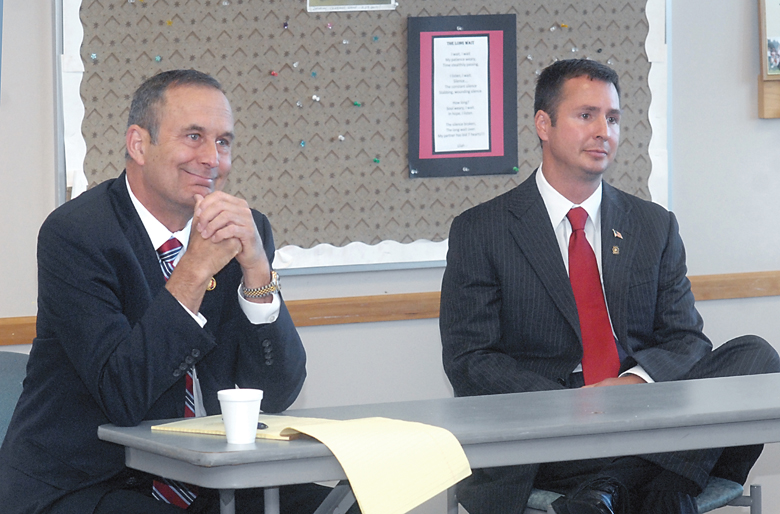
PORT ANGELES — Clallam County Prosecuting Attorney William Payne and challenger Mark Nichols touted their respective experience, discussed the intricacies of the state marijuana law and agreed there is “no silver bullet” for curbing drug use in a respectful political forum last week.
The two Republicans are vying for the prosecuting attorney’s post in the Nov. 4 election.
Payne was appointed by two of three county commissioners in January to serve the final year of retired prosecutor Deborah Kelly’s term.
Nichols, a co-finalist in the selection process, had served as Kelly’s second in command for 7½ years as chief deputy prosecuting attorney. He now serves as county hearings examiner.
About 35 people attended the 45-minute forum Thursday hosted by the Port Angeles Association of Realtors and moderated by association President-elect Doc Reiss.
Marijuana questions
The two candidates were questioned repeatedly about Initiative 502, which legalized recreational marijuana for adults 21 and older.
“It’s been brought up that people in the county think that it’s going to cause an increase in crime in the area where these grows are going in,” Payne said.
“We don’t know, because we haven’t had that happen yet.”
Since the 2012 initiative became law, Clallam County has applied its existing zoning rules to marijuana, requiring a would-be cannabis producer or processor to obtain a conditional-use permit through the hearings examiner.
Last month, Nichols affirmed a planning department decision to deny a conditional-use permit for a marijuana growing and processing facility in a rural neighborhood west of Carlsborg.
Other applicants have received conditional-use permits.
County commissioners Tuesday will consider issuing a notice of a Sept. 23 hearing on an ordinance establishing interim zoning controls for the production, processing and sale of legalized recreational marijuana.
“It is a very complex issue,” Payne said.
“How it’s going to directly impact the county? Overall, I don’t think we have an answer, but we do know it’s impacting local neighborhoods.
“I think it’s just a such a new area that you don’t have a good handle on every single way it will impact the community.”
Law enforcement
The legal landscape has become “a bit more blurry” in the aftermath of Initiative 502, Nichols said.
“For local law enforcement, the question that they started asking me prior to my stepping down [as chief deputy] had to do with how do we go about articulating probable cause,” Nichols said.
“Even though marijuana is now recreationally legal, that doesn’t mean you can have bales of it in the back of your car.”
State law allows adults 21 and older to possess up to 1 ounce of marijuana.
“It is still a crime if you have enough of it, but because it’s now legal to possess, you can no longer, as a law enforcement officer, simply rely upon the odor of marijuana to articulate probable cause to effect an investigative approach,” Nichols said.
If elected, Nichols said he would “send a very strong message to our youth that just because Mom and Dad can use marijuana recreationally, that doesn’t mean it’s OK that they can.”
“Again, it’s legal recreationally in limited quantities and amounts, but that doesn’t mean that the whole world is going to pot,” Nichols said.
Payne and Nichols agreed that Clallam County Drug Court has proven to be a highly effective diversion program for people addicted to harder drugs like methamphetamine and heroin.
When Payne became prosecutor Jan. 27, he immediately began charging felony-possession-of-a-controlled-substance cases as felony.
In speaking with law enforcement, Payne said he has anecdotal evidence that charging heroin and meth possession as felonies has resulted in a reduction in property crimes.
“The fact is this year, I’ve charged over 90 cases of possession of controlled substance as a felony,” Payne said.
“Last year, those cases were being sent down to the city for either possession or drug paraphernalia or not charged at all. I’m charging those, and that is a quick solution to directly impact the neighborhoods in this community.”
Payne, 57, shifted staff in the office to hire an extra felony deputy without asking for new money. He carries a criminal and civil caseload while managing the office.
Legal experience
A former assistant state attorney general who once worked as a felony deputy in the office he now leads, Payne touted his legal experience and the leadership skills he developed as a Marine Corps captain.
Nichols, 42, said he “got bit by the prosecution bug” while working in the King County Prosecutor’s Office during his third year of law school at Seattle University.
He said he chose to plant his roots in Clallam County for the quality of life and because he could “affect change” in a smaller jurisdiction.
As the county’s chief deputy, Nichols said he “dealt with virtually every issue that the county elected prosecutor is required to touch on.”
He is running on a three-part platform: public safety, public justice and public service.
“What you need is a person who is going to do what’s right, a person who’s going to do what’s lawful, what’s ethical, what’s just and what’s needed to protect our community and preserve our quality of life,” Nichols said in closing.
“I’m deeply committed to that.”
Said Payne: “I would submit that you have direct evidence of what I’ve done, and I’d like to continue to do that.”
Ballots will be mailed to registered voters Oct. 15.
________
Reporter Rob Ollikainen can be reached at 360-452-2345, ext. 5072, or at rollikainen@peninsuladailynews.com.
