
PORT ANGELES — Dealing with depression? Confronting chemical dependency? Avoiding anxiety?
There’s an app for that, and for that, and for that. And soon, for maybe even more.
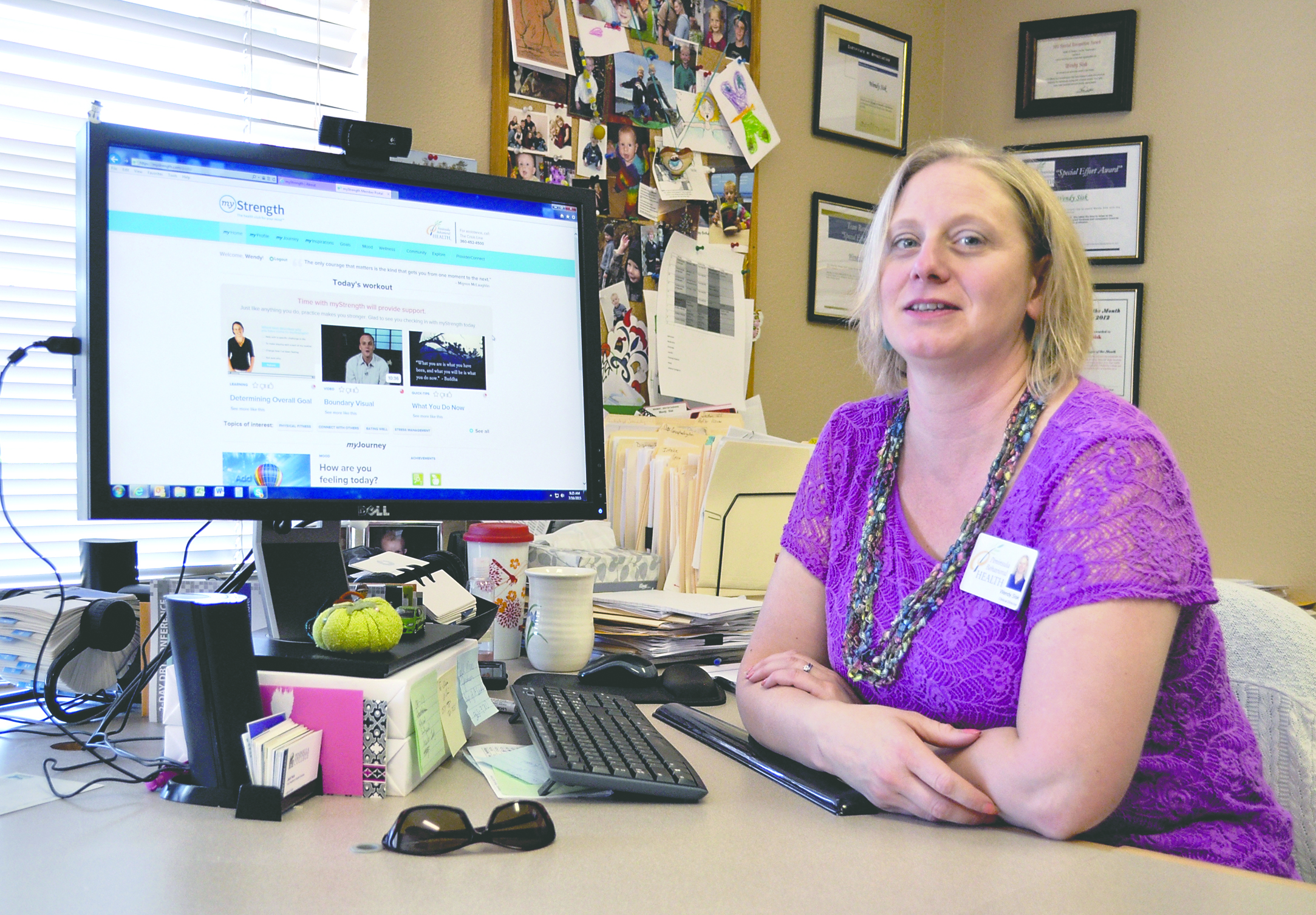
MyStrength, an Internet-based application that’s accessible from home computers and mobile devices, offers on-the-spot support to clients of Peninsula Behavioral Health, Clallam County’s public, nonprofit mental wellness agency.
It’s free to clients. Interested persons can phone 360-457-0431.
“We’re always looking for ways to extend treatment outside the therapy sessions,” said Wendy Sisk, the agency’s clinical director.
When a client signs into MyStrength, the clinical evidence-based program offers an individually tailored combination of verbal and video information, coping advice, inspiring images and more.
Not the least important, it assures the person that he or she isn’t alone to face a challenge, Sisk said.
Thirty-five clients have signed up so far for MyStrength, which was introduced in late June.
Clients who start the program can continue to use it even if they cease seeing a clinician.
Peninsula Behavioral Health is the only agency to offer it in Washington state, although Colorado-based MyStrength is used throughout half the United States, Sisk said.
It cost the organization an initial $4,000 fee plus an annual $11,000 fee.
MyStrength uses what psychologists call cognitive behavioral therapy.
In layman’s terms, that means altering how you perceive yourself, situations or people around you.
That sounds simple, but most of us need help putting the concept to use.
That’s when people can boot up their home computers, tablets or iPads and log on to MyStrength — wherever they are, whenever they want.
A newcomer begins with a wellness assessment that, like all of the program, is confidential — although Peninsula Behavioral Health will receive quarterly measures of how many patients are facing what kinds of problems, “sort of an aerial view of the clients,” said Peter Casey, the agency’s executive director.
“It will help us make adjustments in where we need to work with patients.”
The initial assessment asks clients to rate their responses to such statements as:
■ “I find it hard to wind down.”
■ “I am aware of dryness in my mouth.”
■ “I feel I am using a lot of nervous energy.”
The program also might inquire if the client has missed work and if so, what was the reason and if anxiety or depression caused the absence, Casey said.
From these answers and others, MyStrength creates a treatment plan that’s designed — but not required — for daily use.
A single “workout,” Sisk said, lasts 20-30 minutes and might include an article about a person’s disorder, a work sheet or activity, a video interview with an expert or any of a variety of ways to help the client through the day.
Users can post to the site encouraging ideas or inspiring images that MyStrength administrators will screen.
Its library includes 30 pages listing articles and videos about depression and 12 pages of resources on panic attacks.
Peninsula Behavioral Health therapists can assign “homework” they feel will be helpful to clients.
“I can assign readings so you can work on some cognitive behavioral techniques to change the ways you think about difficult situations,” Sisk said.
“Many of them are from books we clinicians give to our clients to take home,” Sisk said.
Besides its main modules on depression, anxiety and addiction, MyStrength hopes by the end of the year to add a program for managing chronic pain.
MyStrength has optional strategies for stopping smoking and for managing stress.
Sisk said the program also graphs a user’s emotional and energy levels.
“It lets me track my mood,” Sisk said, “so I can tell it, ‘Yeah, I’m pretty happy today, but I’m mildly anxious because Peninsula Daily News is coming in to interview me.’”
Typically, a client intensively uses the program for a couple of weeks, then less frequently unless he or she encounters a challenge.
That’s just how it should be, Sisk and Casey said.
“If you find yourself hitting a rough spot, you can go back to MyStrength,” Sisk said.
If a person’s concerns are serious, crisis referral information always appears at the top of the page.
“There’s always a lot of people who need our services whom we’re unable to see that day,” Casey said.
Sisk added, “This is something people can do on their own. If I’m having a tough day, I can log on and get a little pick-me-up.”
Sisk and Casey said MyStrength will be especially helpful to people who are phobic or who feel reluctant to ask for help.
“Folks can carry it with them out into the community,” Sisk said.
“It’s our hope it will be one more tool to expedite getting well.”
_______
Reporter James Casey can be reached at 360-452-2345, ext. 5074, or at jcasey@peninsuladailynews.com.
