
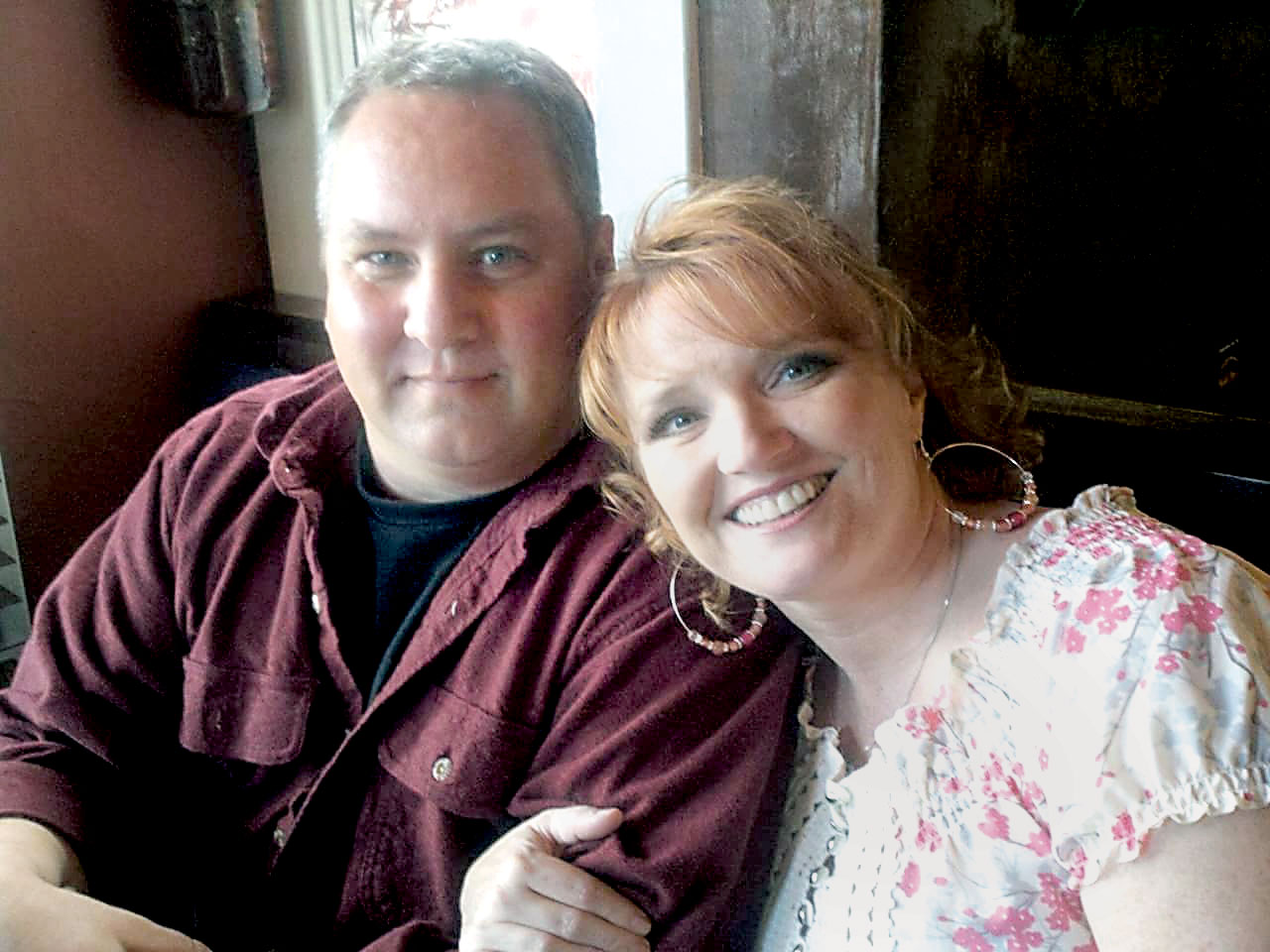
PORT ANGELES — A Clallam County corrections deputy has been diagnosed with a rare disease and is seeking help to be able to qualify for a potentially life-saving treatment.
Steve Brooks, 48, a U.S. Army veteran who joined the Clallam County Sheriff’s Office 15 years ago, has Stiff Person Syndrome, a nervous system disease that causes fluctuating muscle rigidity in the trunk and limbs.
The disease is extremely rare, according to John Hopkins Medicine, which says on its website at www.hopkinsmedicine.org that although it isn’t possible to determine the exact prevalence, “it may occur in fewer than 1 per million.”
A heightened sensitivity to noise, touch, and other stimuli can lead to sudden muscle spasms that can be strong enough to break a femur or crush a ribcage.
Brooks was diagnosed four years ago, according to his wife Valerie Brooks, a program manager for the Clallam County Court Appointed Special Advocate Services.
“Some people with SPS never leave the house because someone might honk a horn,” she said.
Brooks, a Port Angeles resident, has been working as a chain gang deputy, guarding those who work outside the jail, and the couple believes his being outside has been helpful and might have delayed the onset of some of the more severe symptoms.
Until recently there has been no cure for the disease, only medications that can delay the onset of new symptoms or reduce symptoms — many of which he cannot take while he works, Valerie said.
Clinical trial
A stem cell transplant treatment still in clinical trials is the only treatment that is likely to help Brooks avoid a painful, bedridden, inevitable death, she said.
Valerie said she was told that there have been three people with Stiff Person Syndrome in Denver, and Brooks will be the second person accepted to a clinical trial in Seattle for a treatment that will kill his immune system using chemotherapy — then rebuild it from Steve’s own stem cells, she explained.
The family’s medical insurance will cover the treatment, but the family must pay to live in transplant housing — apartments designed to protect patients from contact with all kinds of infections — and must be within 20 minutes of the University of Washington Medical Center in Seattle.
The housing is expensive — as much as $2,400 per month, she said.
He will not be accepted into the clinical trial until he can show he can cover the cost of living in special housing, Valerie said.
The couple must move to Seattle by Jan. 14, where Valerie will provide round-the-clock care for Steve during his treatment and recovery.
Valerie said that both she and Steve will need to take a leave of absence from their jobs to take part in the clinical trial.
“We know at some point we will probably lose our home,” she said.
Valerie said her husband hopes to return to work about a year after he begins his treatment.
The couple has a son, Cody Brooks, 15, a sophomore at Port Angeles High School. Steve Brooks has two adult daughters from a previous relationship.
Fundraisers
Two fundraisers are set for the Brooks family.
A GoFundMe site has been set up to raise $50,000 for the family to cover their living expenses while in Seattle, at www.gofundme.com/bd6jkc.
As of Sunday morning, $19,362 had been donated at the site.
On Jan. 7, Next Door Gastropub, 113 W. First St., Port Angeles, will donate portion of its profits earned throughout the day.
A “friends and family” evening, open to the public, will be held from 7 p.m. to 9 p.m. at the Gastropub.
________
Reporter Arwyn Rice can be reached at 360-452-2345, ext. 5070, or at arice@peninsuladailynews.com.
