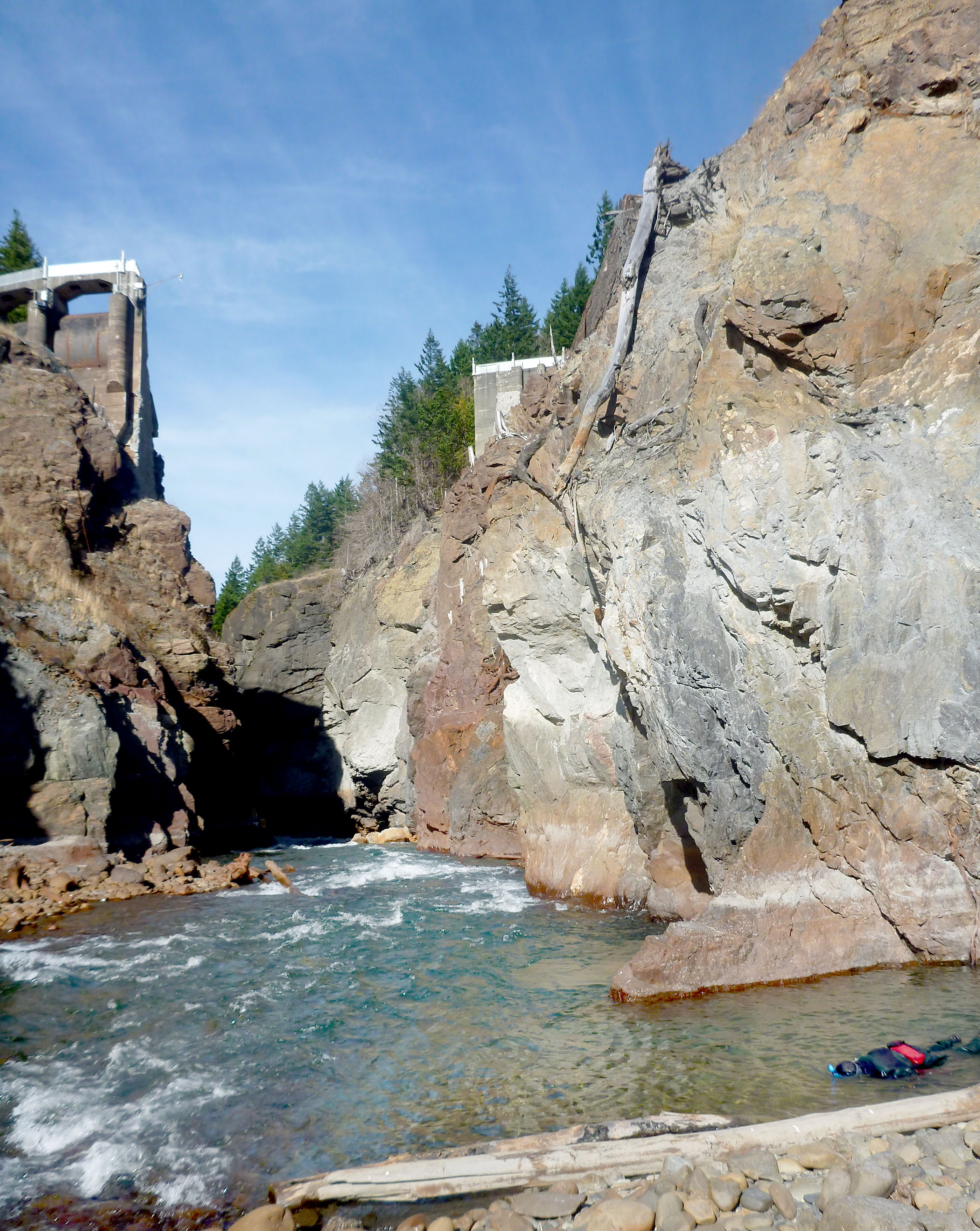
Olympic National Park biologist Heidi Hugunin
Chinook salmon seen in upper Elwha River for first time in 102 years
OLYMPIC NATIONAL PARK — The sight of a chinook resting quietly by the bank of the Upper Elwha River was one that Mel Elofson had awaited for 56 years and worked toward for 20.
It was the first sighting of a salmon above the Glines Canyon Dam site in 102 years.
“It was awesome,” he said.
EDITOR’S NOTE — See related story today, “Raft trip on Elwha River shows its newly untamed nature,” https://giftsnap.shop/article/20140914/NEWS/309149956%3C/i%3E%3Cdiv class='code-block code-block-17' style='width: 655px; white-space: nowrap; max-width: 100%;'>
The river’s once-legendary salmon runs had been blocked by construction of the 108-foot Elwha Dam without fish ladders in 1912, blocking access to spawning grounds.
The 210-foot Glines Canyon Dam also was built without fish ladders in 1927.
Both of the dams, which once provided electricity for a growing Port Angeles, were demolished in a $325 million project that began in September 2011 as part of the nation’s largest river restoration project.
Elofson, assistant habitat manager with the Lower Elwha Klallam tribe, saw the chinook, also known as king salmon, while he was conducting a juvenile fish study for the tribe and for the National Oceanic and Atmospheric Administration.
It was Sept. 2, a mere week after the last 30 feet of the river’s last dam — Glines Canyon — had been blasted out.
So he was surprised by what he saw.
“I just happened to walk up to the edge of the stream about 100 meters above the dam, and there it was, sitting right next to the bank,” Elofson said.
“It was female, probably 20 to 25 pounds. It was in really good shape.
“It was exciting,” he said.
He notified Olympic National Park officials, and biologists confirmed Elofson’s sighting last week.
Snorkeling above the dam site, they found three adult chinook, all between 30 and 36 inches long, in the lakebed, said Heidi Hugunin, who explored the water along with her colleague, Anna Geffre, on Tuesday.
“She spotted the first one,” Hugunin said. “She jumped out of the water, and she’s waving her arms frantically. She starts pointing at the river.
“We did some victory dancing.”
The biologists began their snorkel survey in Rica Canyon 3 miles above the Glines Canyon dam site, which is some 13 miles from the mouth of the Elwha River, and swam downstream through the former Lake Mills to a point just above Glines Canyon.
The salmon were spotted between Windy Arm, a spot halfway down the former lake on the east side of the river, and Glines Canyon.
The biologists saw two resting near submerged stumps of ancient trees, while a third was found in a deep pool.
“The river has scoured away all the sediment,” Hugunin said. “The banks of the river as it once was is reappearing, and so we are seeing a lot of the pre-dam stumps.”
The summer/fall run of chinook began in June and will taper off late this month or in early October.
“These are the returning chinook salmon, coming from the ocean,” said Barb Maynes, park spokeswoman.
“We’ve been seeing quite a few below Glines Canyon Dam, but these are the first seen in 102 years above the old dam site.
“The chinook are coming back into the river.”
In addition to the three chinook, biologists counted 27 bull trout, nearly 400 rainbow trout and two small sculpin during their survey above Glines Canyon.
Two weeks ago, park biologists had confirmed that two radio-tagged bull trout had migrated through Glines Canyon and were in Rica Canyon.
The three chinook observed last week were not radio-tagged.
The following day, biologists counted 432 live chinook in a 1.75-mile section of river just downstream of Glines Canyon but still above the old Elwha Dam site.
Biologists hope to do another survey this week, Hugunin said.
Now that the river has been freed, Elofson, who grew up playing on the banks of the river and is now 56, said he is elated to see the results.
“All they had to do was open the river, and the fish are drawn to it,” he said.
The Klallam people, who have lived beside the Elwha River for thousands of years, devoted years to advocating the removal of the dams until Congress passed the Elwha River Restoration Act in 1992.
Elofson’s first task when he was hired by the tribe in the 1990s was to help map out Lake Mills delta topography in what he said was a pilot project in preparation for taking the dams down.
“I worked for the tribe for 20 years or so, and I was waiting for that day to be able see them above both dams,” Elofson said.
The sightings of chinook s in the upper river confirm that the dam demolition so long-sought has had its intended result.
“It’s definitely showing that the salmon are resilient,” Elofson said.
“Open it up, and they’ll go there.
“It’ll be great to see them come back in a few years in numbers,” he said.
He expects those numbers to match the stories of more than a century ago.
“It’s going to take awhile, but they will get there,” Elofson said.
“There’s nothing blocking them.”
________
Managing Editor/News Leah Leach can be reached at 360-417-3531 or at leah.leach@peninsuladailynews.com.

