
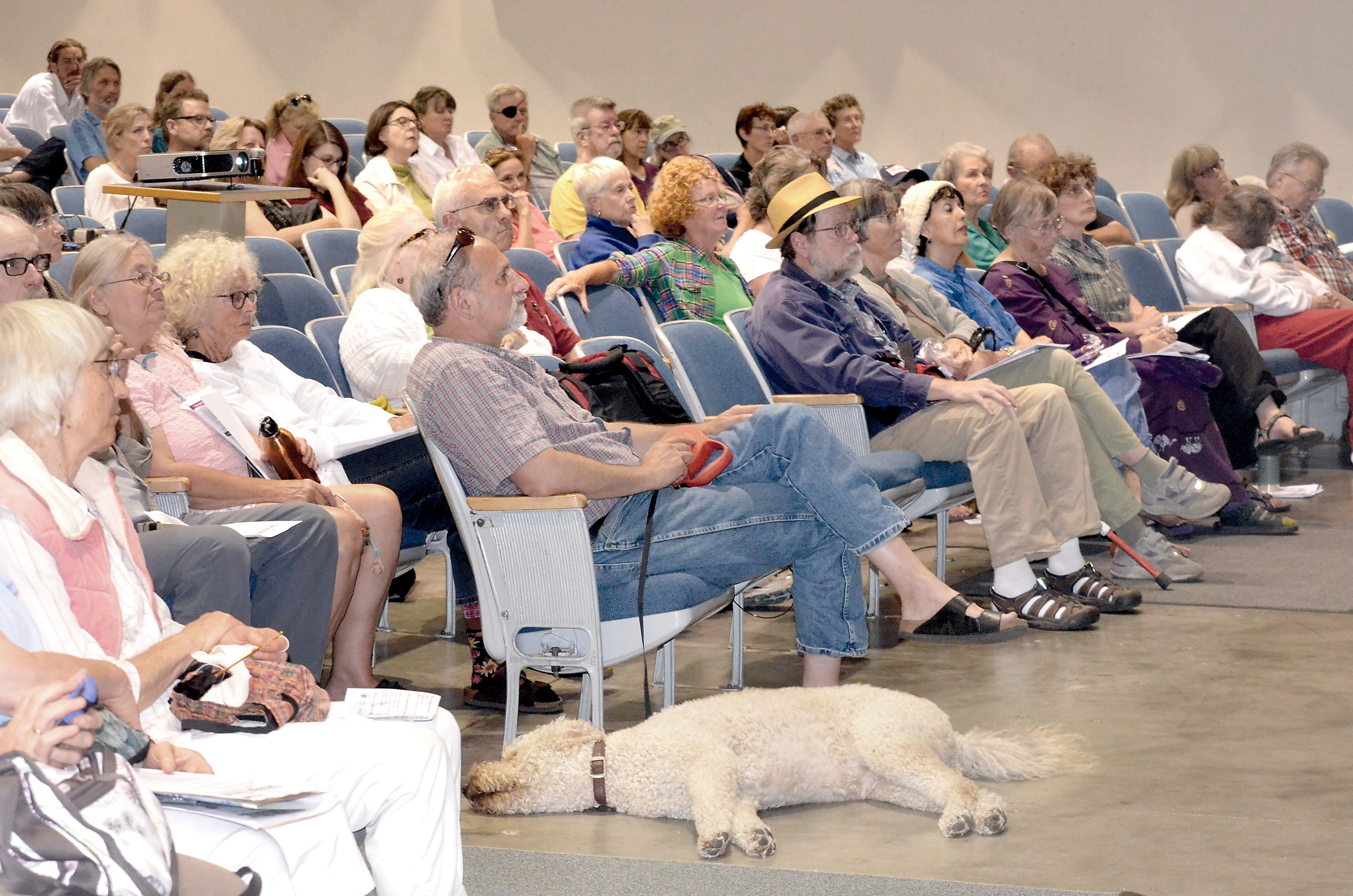
CHIMACUM — East Jefferson County residents can prepare for drought conditions both on their own and with the help of government agencies, experts said.
“You want to pay attention to how much water that you use,” Susan Porto, a water specialist with the Jefferson County Department of Environmental Health, told about 175 people at a forum in the Chimacum High School auditorium Tuesday night.
“Meters are a great tool, and many people think of them as a utility billing tool, but if you have a meter, you should measure your own water use,” she added.
Gov. Jay Inslee declared a statewide drought May 15 after the state’s snowpack declined to less than 20 percent of normal. The Olympic Mountain snowpack is at zero.
Speaking at the forum were representatives of the state Department of Ecology, North Olympic Development Council, Washington State University Extension Service of Jefferson County, city of Port Townsend, Jefferson County Public Utility District, Local Investing Opportunities Network/Local 20/20 and Port Townsend Paper Corp.
Bill Graham, the PUD’s resource manager, said water in East Jefferson County comes from three sources in equal amounts: one-third from surface water administered by the city of Port Townsend, one-third from the PUD and one-third from private wells.
“In East Jefferson County, the water isn’t where the people are, and the people aren’t where the water is,” Graham said.
The city draws its water from the Big Quilcene and Little Quilcene rivers, using the Lords Lake and City Lake reservoirs in drought conditions.
The PUD gets its water from 12 sources in the county.
Porto said the county distributes tools that allows residents to test the efficiency of water fixtures and showerheads that can pinpoint leaks and show how much water can be saved when the leak is fixed.
She said there are several conservation methods available, adding that they require special attention to sanitation.
Rainwater collection is also a possibility to get residents though the dry season, although this requires a sanitary storage system, she said.
“Gray water” that is recycled from household uses can be used for irrigation, with the caveat that it contains impurities, Porto said.
“You can use gray water a number of ways, but you need to be mindful that it contains bacteria,” she said.
The city uses less than 2 million gallons of water a day, while Port Townsend Paper Corp. — the county’s largest private employer — has in the past used as much as 15 million gallons daily and is now at about 10 million gallons, according to Kevin Scott, the company’s director of sustainability.
The mill is working to lower usage to about 7 million gallons daily through a series of water recycling methods, Scott said.
“On the average, the mill uses each gallon of water seven times,” Scott said.
“Paper processing is water-intensive,” he said. “The water is used over and over again before it goes into the treatment pump and [is] released.”
Scott said many of the recycling processes are costly with regard to money and energy but that the pursuit of conservation measures is the cost of doing business.
Although much of the reprocessing equipment will be in place and in use during the drought, once the water supply increases, the mill could suspend conservation measures, he said, adding that some could become standard operating procedures depending on cost.
“Some of the measures are very expensive and really don’t buy you anything if there’s an excess of water,” Scott said.
“When it gets tight, we will spend the extra money to preserve a little bit of water.”
While water conservation by home users may seem insignificant when compared to the mill’s water use, such measures are helpful, according to Bob Simmons of the WSU Extension Service.
“This may not be the best time to put in a new landscape because any new landscape requires a lot of water,” he said.
“Down the road, there are some plants we can use that are more drought-tolerant, and putting the right plant in the right place can also save water,” Simmons added.
He said people can plan more-efficient irrigation systems and advised them not to clean walkways with a hose.
“A hose can use 5 to 10 gallons a minute, so it makes sense to clean walkways using some elbow grease and a broom,” he said.
“When you wash your car, consider a commercial car wash that recycles its water, or do it an area near your lawn, which will appreciate the extra water,” he added.
Forum organizer Kate Dean said the forum presented many worthwhile ideas.
“We were able to reach a lot of people, but this is just the beginning,” she said.
“Gathering citizen input can be challenging, but we have the framework to do that in the future and will need to create the channels to do that.”
________
Jefferson County Editor Charlie Bermant can be reached at 360-385-2335 or at cbermant@peninsuladailynews.com.
