
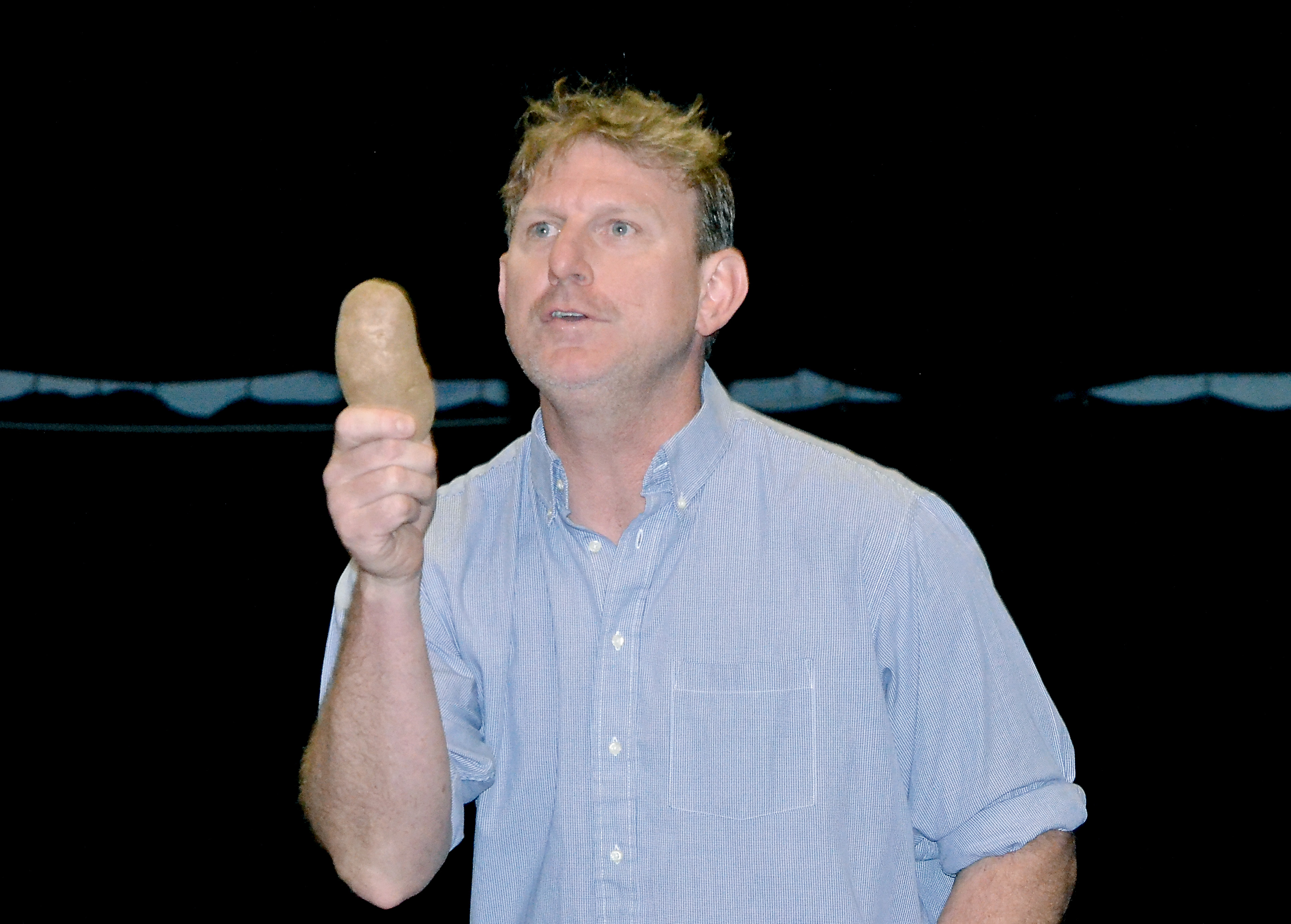
PORT TOWNSEND — The lowly potato was the star of a presentation Wednesday and will be the featured food at a dinner later this month.
The potato is a dietary staple but also has tremendous historical and cultural importance, Port Townsend High School students were told.
“Almost none of us would be here if not for the potato,” said Peninsula College professor Wes Cecil, who conducted the assembly program along with Jefferson Healthcare hospital chef Arran Stark.
“Before the potato was introduced in Europe in the early 1800s, the population growth in Europe was microscopic because if the population grew, there wasn’t enough food to feed them, and they would starve,” Stark said.
“The coming of the potato allowed populations to grow that otherwise would have just died,” Stark said.
The presentation was a dry run for a series of four “Food for Thought” dinners by Cecil and Stark where the history and importance of a specific food is discussed before a meal featuring that particular food is served.
The potato will be featured March 27, followed by quinoa April 24, cabbage May 22 and salmon June 19.
All of the dinners will take place from 6:30 p.m. to about 9 p.m. at the Northwest Maritime Center, 431 Water St.
The cost will be $50 per ticket except for the salmon dinner, which will cost $65.
Proceeds will cover expenses and support future programs, Stark said.
About 250 students attended Wednesday’s presentation, nearly identical to what March 27’s will be, although absent the fancy meal.
Cecil said food shortages were common in Europe until the 18th century, when Spanish explorers brought several varieties of potatoes to Europe from Peru.
That changed the dietary habits of the entire continent in about 40 years, he said.
Cecil said the Irish potato famine that began in 1845 was a result of the entire country relying on a single type of potato that was wiped out by a blight.
Widespread hunger led to massive emigration to the United States.
The two offered historical trivia, saying a pope was among the first Europeans to eat potatoes and that Thomas Jefferson first served a potato dish — French fries — in the White House in 1802.
Stark said the creation of great food is the highest art form.
He cited the fajita as an example of food stimulating all the senses.
“What is the first thing you notice when you’re served a fajita?” Stark asked.
“Sound,” a student responded.
“Sound. You hear those doors flop open, followed by ‘Shhhhhhhh.’ What’s the second one?”
“Sight.”
“‘Omigod, there they are, my fajitas coming right toward me.’ What’s number three?”
“Smell.”
“You smell them and say, ‘Those are mine.’ This is the tricky one. What’s number four?”
“Touch.”
“Before you taste something, your lips touch it, right? So you take that first bite, and you feel it in your mouth and feel that texture.
“And it all culminates with number five, taste, and then you have that euphoric feeling all buzzing in your head, and it’s pretty cool, right?”
Cooking a great meal, Stark said, provides its own reward.
“When you present a meal and put your heart and soul into that dish and put it in front of your mother or your girlfriend, you get instant gratification,” he said.
“You don’t have to die and wait 100 years before [your accomplishments are] realized,” he added.
“There’s no cutting off your ear,” he said, alluding to the painter Vincent Van Gogh, who, according to legend, cut off his ear in 1888.
Stark, 45, and Cecil, 48, who have known each other for several years, developed the program at the suggestion of their wives, who are close friends and thought the two could provide complementary knowledge.
Before Wednesday’s presentation, the two men both said they expected to learn from each other.
“Our big plan is to teach people about food and get them excited about the idea of healthy eating,” Cecil said.
“The idea of a healthy community is based on healthy food,” he added.
“If you have good food, you have a better day at school. Athletes perform better when they eat well.”
Said Stark:
“It’s all about the kids. If we can get kids excited about good local food, it will make this worthwhile because they are the ones who will be steering this boat after I retire.”
For more information about “Food for Thought,” email wesandarran@gmail.com.
Tickets are available at www.brownpapertickets.com by searching for “Food for Thought.”
________
Jefferson County Editor Charlie Bermant can be reached at 360-385-2335 or cbermant@peninsuladailynews.com.
