
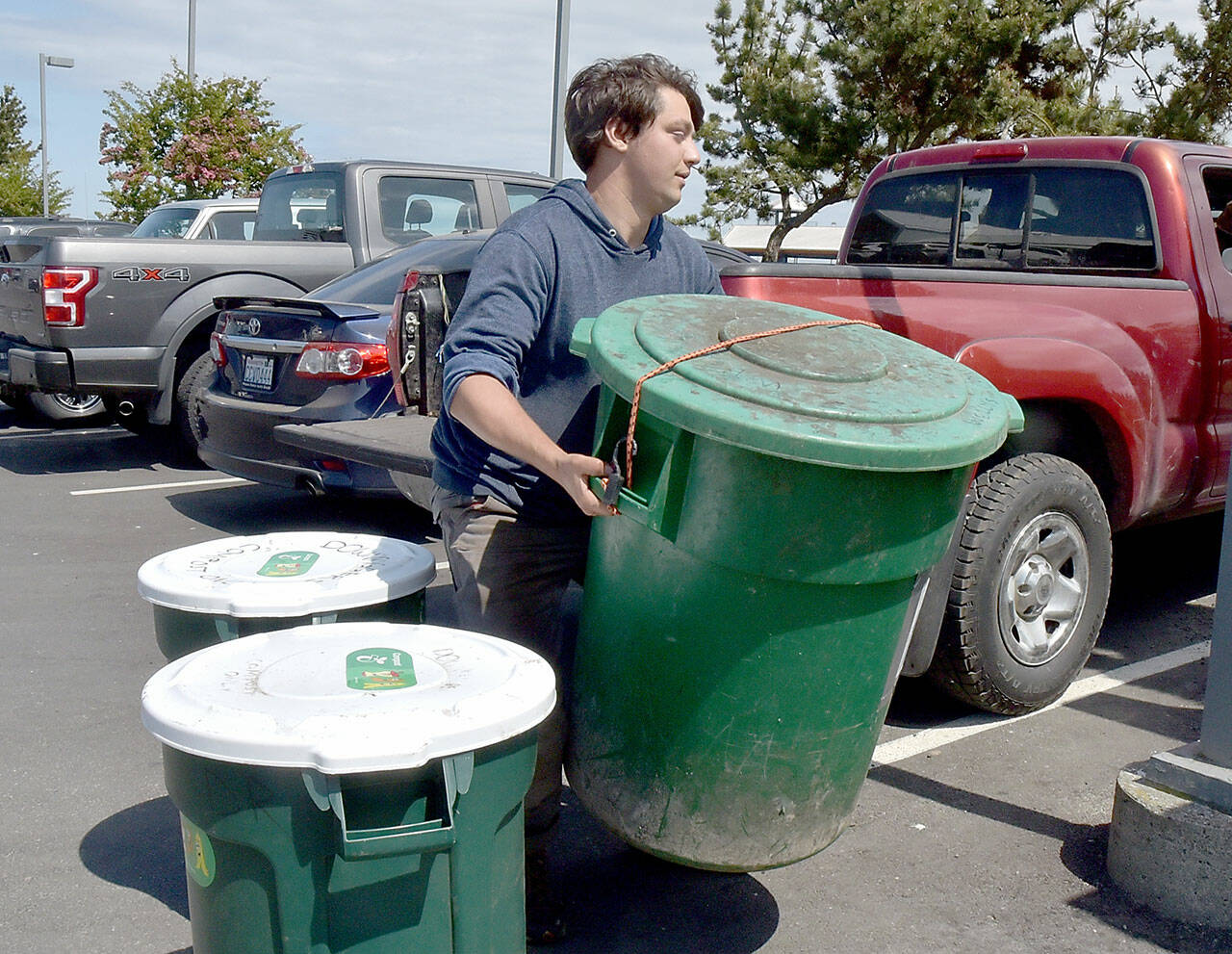
PORT ANGELES — Look around Welly’s Real Fruit Ice Cream and you’ll see bins for glass and metal, recycling and compostables, but no bins for trash.
That’s because Welly’s doesn’t produce much of it.
Welly’s is one of five local businesses so far recognized with a Green Wheel certification, a new program initiated by SisterLand Farms, the City of Port Angeles and The Wharf to encourage sustainable practices that divert waste from landfills and into productive use, like composting.
Welly’s and Downriggers on the Water located at The Wharf, Rabbit Food on Eighth Street, Carol’s Vegan Kitchen and the Composites Recycling Technology Center at the Port Angeles Airport Industrial Park will receive a Green Wheel badge to display at their place of business, use on their websites and reproduce on their promotional materials to make customers and the public aware of their contributions to reduce waste and for setting an example for other businesses.
Food is the single most common material sent to landfills, making up 24 percent of solid waste in municipal sites, according to the Environmental Protection Agency. Add in lawn clippings, wood and paper and the organic materials comprise 51 percent of solid waste.
Mike Healy, director of Port Angeles Public Works and Utilities, said the idea for the Green Wheel program came out of a meeting in March with the city, SisterLand Farms owner A. Jenson and Erik Marks, owner of The Wharf. The goal was to find a way for businesses to better manage organic waste to reduce the amount that ends up in landfills.
“We realized the synergies of being able to grow this program,” Healy said. “From a solid waste perspective, I enjoy the positive diversion of usable materials.”
While the city’s regional transfer station on 18th Street still accepts yard waste, it no longer produces compost for sale.
Marks, who purchased The Wharf in 2018, said he wanted to start a demonstration project that could expand as more businesses saw how they could make a difference by changing their waste management practices.
“I saw all the garbage going out and I thought I should probably look into what’s going on here, and I found there was no [commercial] composting,” he said.
Creating an incentive was important so businesses would be encouraged to buy into the certification program, Healy said.
“Businesses that participate in the Green Wheel Program can promote their environmentally friendly manner, can attract more ecologically conscious patrons and project a positive image,” Healy said.
Green Wheel certification is free and available to any business or nonprofit that meets the reporting standards. The standards and application can be found on SisterLand Farms’ website, www.sisterlandfarms.com.
For its compost production, SisterLand accepts fruit and vegetable scraps, bread and paper products but no meat, seafood, dairy, grease or oils. It plans to slowly phase in those items as it scales up the variety and amount of organic material it collects.
Jenson said the question is always asked: won’t the organic material that’s collected smell bad? No, actually. The rinds, peels and other trimmings that are separated from the other waste would still need to be hauled away if they weren’t destined to become compost.
Every Friday, Benji Astrachan, SisterLand’s compost operations manager, picks up the large plastic garbage bins from businesses and takes them to the farm. There, the contents are added to one of six compost piles in various stages of decomposition. SisterLand uses the composts for the garden spaces on its 1.5-acre farm.
SisterLand charges commercial customers by the gallon and the price can vary based on how well the material is sorted.
The Green Wheel certification program operates under SisterLand’s nonprofit Wagon Wheel Fund, which supports programs in waste diversion, accessible education and the creation of community spaces.
The goal is for Green Wheel certification to pay for itself, not to make a profit.
“We’re hoping to energize commercial businesses to compost,” Jenson said. “We have no intent to ever sell it.”
It’s not just restaurants that produce compostable waste. The waste produced by CTRC’s thermal modification service that uses Western hemlock, for example, becomes the brown ingredient in SisterLand’s compost.
Welly’s had originally reached out to SisterLand for assistance following its first summer of operations in 2021, when it was serving its New Zealand-style ice cream out of a trailer and had yet to move into its current location at The Wharf.
“We didn’t realize how much trash we were generating,” co-owner Lillie Phillips said. “We knew going into a storefront, we would generate even more.”
Welly’s already used some compostable materials — paper, cups, straws — but it wanted to close loop of a cycle that turns organic material over to composting so that it can re-enter the food supply chain rather than being sent to a landfill.
Jenson helped Welly’s set up a waste management system and trained staff on how to sort compostable material. Jenson also suggested using wooden spoons, rather than compostable plastic ones, which don’t break down in composting systems like SisterLand’s. (Plastic utensils labeled “compostable” are usually intended for commercial composting facilities because they require higher temperatures and different conditions than those found in backyard compost bins.)
Phillips said sorting the compostable materials and taking them out to The Wharf’s dumpster area every day is not time-consuming or bothersome. And, when customers ask where the waste bins are, it is an opportunity to talk to them about the composting program.
The little wooden spoons are a hit, too, Phillips said.
“People always comment on them,” she said.
Businesses interested in participating in the Green Wheel program can contact SisterLand Farms at sisterlandfarms@gmail.com.
Organics Management Law
The Legislature passed a bill in March expanding the state’s 2022 Organics Management Law that aimed to reduce by 75 percent the amount of organic material that ends up landfills by 2030. By 2025, the amount of edible food disposed in landfills must be reduced by 20 percent.
Starting on April 1, 2027, cities with populations of more than 25,000 must offer single-family residences the option of enrolling in year-round curbside organics collection. Starting April 1, 2030, those living in single-family residences will be required to enroll in the service.
Businesses in Business Organics Management Areas (BOMAs) around the state are now required to manage their organic material waste by arranging for collection. BOMAs are areas that have year-round curbside organic waste collection that is delivered to a commercial composting or digester facility that have the capacity to accept and process the volume of waste generated by the businesses.
No city on the North Olympic Peninsula has a large enough population — yet — to meet the residential mandate, and there is no commerical collection of or facility for handling a critical mass of organic waste.
