
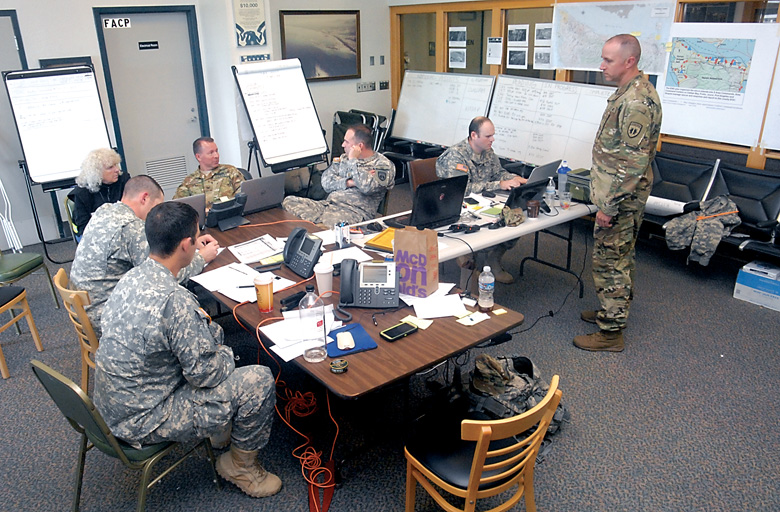
A 9.0-magnitude earthquake would rearrange the landscape in Clallam and Jefferson counties, law enforcement and emergency management personnel said in mock briefings during the third day of the Cascadia Rising exercise.
The mock briefings were on the third day of the regional drill that began Tuesday.
Organizers of the drill are assessing how city, county, state and federal emergency responders would handle the inevitable tsunami, loss of power and broken landscape a massive earthquake from the Cascadia Subduction Zone would cause in coastal communities throughout Washington, Oregon and British Columbia.
“The exercise is operating under the assumption that we suffered a 9.0 earthquake followed by a tsunami,” said Bob Hamlin, director of the Jefferson County Department of Emergency Management.
“From a global perspective, the county would have 7,000 homeless people and some serious food, water, sanitation and security problems.”
The death toll three days after a massive quake would stand at an estimated 500 in Clallam County, according to Clallam County Undersheriff Ron Cameron, incident commander for the local exercise, with at least another 900 injured and in need of medical attention.
That does not include the patients in long-term care admitted to the hospital or in retirement homes when the earthquake struck, he said.
Jared Keefer, Jefferson County Environmental Health and Water Quality director, said the biggest health hazard would be the recovery of dead bodies before their deterioration.
Cameron, incident commander for the county exercise, said that utilities would be out.
And while public utility districts most likely would have identified the damaged portions of the power grid in need of repair, even if such repairs were made, it would be up to the Bonneville Power Administration to ensure power was actually getting to the Peninsula, Cameron said.
Depending on the extent of damage to the BPA power grid, service might not be restored for weeks or even months, he said.
Additionally, many of the bridges connecting the various municipalities would be impassable, he said.
Officials would set into effect gasoline rationing and encourage residents to shelter in place, said Jim Borte, Clallam County public information officer.
Other essentials such as food, water and medicine also would be in short supply, Borte said, adding planners are in the process of effecting plans “to ensure sufficient supplies will be available.”
Chief Mike Evans of the Port Townsend Police Department said a massive quake would essentially destroy the waterfront, eliminating the downtown area, docks and the Boat Haven.
A “tsunami river” would split the city along San Juan Avenue, with water blockage from the Boat Haven to North Beach, although the Mountain View Community Center would not be expected to sustain serious damage, Evans said.
Bluffs between Chetzemoka Park and Fort Worden and above the Larry Scott Trail would wash away, causing serious property damage and loss of life, Evans said.
Jefferson County Undersheriff Joe Nole would expect some looting and unruly crowds and predicted that some people with guns would approach local merchants and offer protection for their property.
The Jefferson County Jail would be emptied of nonviolent inmates who were judged to not be a threat to society due to low food supplies and discipline issues.
The Hood Canal Bridge likely would be destroyed, Noles said, and several roads would be closed.
He envisioned a collapsing bluff on Highway 20 between Port Townsend and Discovery Bay and floods making U.S. Highway 101 impassable.
Cameron said participants have identified several areas that need to be streamlined, thanks to the drill.
Two major considerations are communications when phone, cell and internet services are down, and how to keep track of financial obligations such as payroll and the cost of fuel, food, water and other items.
Without traditional methods of communication, organizing emergency response is a daunting task, officials said.
“Clallam Bay is an island all unto itself,” Cameron said. “Forks is an island all unto itself. Even from here [in Port Angeles] to Sequim is an island unto itself.”
As such, “getting that communication established” is a priority, he said.
That would be accomplished via ham radio operators and through military assistance, Cameron said.
“We are working at it and have learned a lot in the last three days.”
Hospitals in Port Angeles and Port Townsend would be operating, but officials would expect serious damage to Olympic Medical Center in Port Angeles.
The patients at the hospital would most likely need to be relocated to a safe location, Cameron said.
One option, he said, would be to relocate them to Civic Field where a MASH unit can be set up in cooperation with the military, he said.
Although Jefferson Healthcare in Port Townsend likely would not sustain serious damage, law enforcement would be required to prevent an expected influx of people seeking food, perhaps by force, Jefferson County officials said.
Evacuating patients off the Peninsula would most likely be impossible in most cases, Cameron said.
“Harborview [Medical Center in Seattle] is not going to be there,” he said.
“Everybody has got their own problems. We’ve got to solve our own.”
Three days after a quake, the federal government would most likely enter the fray, said 1st Sgt. Kent Keller, Army National Guard public information officer, at the Clallam County briefing.
“It is important to remember this Cascadia Rising [drill] is actually just part of a much larger picture,” he said.
“We also are running [Operations] Vigilant Guard and Ardent Sentry. These are going to be the types of responses that we will be transitioning into as the focus of the training moves from a local level to federal level.”
That most likely would include a formal declaration of disaster from the sitting U.S. president, and the activation of federal troops deployed to support “the civilian emergency response,” he said.
The Jefferson County briefing was over a video link between city and county officials in the Port Townsend Fire Station and the county Department of Emergency Management in Port Hadlock.
The Clallam County briefing was at the William R. Fairchild International Airport.
The four-day regionwide Cascadia Rising drill winds up today.
Visible to the public — although not open to the public — will be a mock air rescue operation at 9:30 a.m. the Fire District 3 maintenance yard at 255 Carlsborg Road near Sequim and the landing of a Blackhawk helicopter at the Bob Bates Baseball Field in Port Hadlock at 11 a.m.
________
Jefferson County Editor Charlie Bermant can be reached at 360-385-2335 or cbermant@peninsuladailynews.com.
Reporter Chris McDaniel can be reached at 360-452-2345, ext. 56650, or cmcdaniel@peninsuladailynews.com.
