
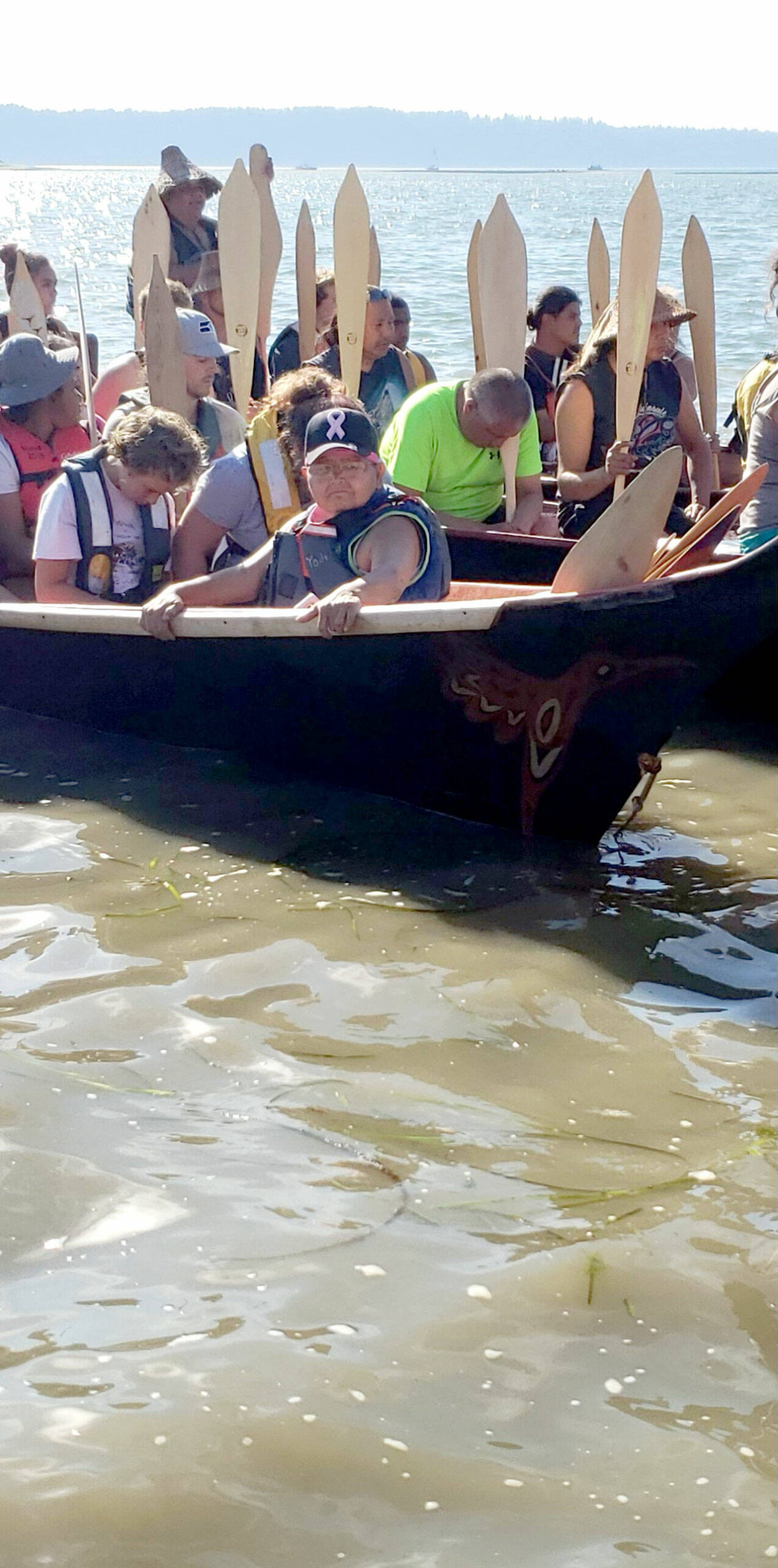
PORT ANGELES — The Lower Elwha Klallam Tribe is getting ready to welcome on Sunday hundreds of visitors, many of whom will be arriving by canoe, as part of the 2023 Paddle to Muckleshoot canoe journey.
“We know 16 (canoes) for sure are coming from Canada,” said Frances Charles, chair of the tribal council. “We have another five that are coming from the west side” of the North Olympic Peninsula.
Canoes can hold up to 40 people and the tribe is preparing to host both the canoe pullers and their support teams that travel overland to provide camping equipment, food and other amenities.
Support teams from Canada were expected to start arriving via ferry on Friday, Charles said, and the tribe had allocated camp space specifically for them.
Tribal representatives will be at Pillar Point today to welcome canoes from the West End — tribal paddlers who gathered at the Quileute Tribe in La Push, and Makah paddlers — but the bulk of the canoes, which are crossing the Strait of Juan de Fuca from Vancouver Island, are expected to arrive at the Lower Elwha Klallam Reservation on Sunday.
Charles said most of the canoes will arrive at the beach at the end of Charles Road on the reservation, but a few may go to Hollywood Beach on the Port Angeles waterfront, where tribal welcomes often have been conducted in the past.
The landings will be open to the public.
A shuttle will run between the Billy Whiteshoes Memorial Park baseball field, which is off Lower Elwha Road, and lower Charles Road starting at about 10 a.m. Visitors can park at the field or along Lower Elwha Road.
Charles could not pinpoint when the first canoes would arrive because of the weather, currents and the nature of traveling by canoe. The tribe is expecting to receive people all day.
Tribal members plan to use powered support boats to help guide canoes across the Strait, Charles said, and make sure the paddlers are safe.
“Once they arrive here at Elwha, we will take them ashore, bring them to the tribal facility, and we’ll be eating dinner at 6 p.m.,” Charles said.
“A lot of them will get together, and in no particular order, there’ll be singing and dancing in the tribal gym, which will probably go to almost midnight.”
Canoe teams will remain at the reservation on Monday, Charles said, and then continue their journey Tuesday.
On Tuesday, Lower Elwha will have their own two canoes — Beautiful Sister and the Lightning — join the journey, which will expected to stop on the North Olympic Peninsula at Jamestown Beach that day and in Port Townsend on Wednesday.
The entire journey, which gathers tribal paddlers from throughout Canada and Washington state, will end at Alkai Beach in West Seattle on July 30. From there, hundreds of canoe teams will travel overland to the Muckleshoot Indian Nation near Auburn for several days of celebration.
Elwha’s own canoe teams — which includes cancer survivors — have been training and practicing for the journey, Charles said, and they’ve been trying to get younger generations more involved.
“We’re going to be meeting with a group of them, have a discussion with younger generations about cultural sensitivity with respect to water and to the environments that are out there,” Charles said.
Spiritual experience
Canoe journeys are an intensely spiritual experience for indigenous people, said Carmen Watson-Charles, who remembers attending the first “Paddle to Seattle” in 1989 when she was eight years old.
“It was a spiritual awakening in all of us, it helped us all come together,” Watson-Charles said. “I remember everybody hugging and crying in joy, singing and dancing on the beach.”
In the years following, Watson-Charles said she worked on ground crews and remembers staying up late at night making sandwiches and peeling potatoes until her fingers hurt. She started paddling, or “pulling” when she 12 but had to quit after she broke her ankle.
Watson-Charles said she attends the landings when she can but she nor her daughter are have been able to participate in the journey itself.
“Unfortunately over time, being Native America, we live in two worlds and we have to choose sometimes,” Watson-Charles said. “That’s really hard. Many who work outside of the tribe, you don’t always get that time off; some people feel torn;some people quit their jobs so they can attend.”
Watson-Charles said her daughter wasn’t able to participate in the journey this year because of other obligations for youth sports which are important for her daughter’s future.
“That is the hard part for me, I have to choose between two worlds. My canoe journeys do not get my kids scholarships to go to college,” Watson-Charles said. “You have to participate in summer programs in order to do good in high school.”
Watson-Charles said she hopes that getting her daughter into college means she’ll have the kind of life that will afford her time off to participate in future journeys.
“I think as indigenous people all the way from Alaska, California and the Hawaiian Island, all the nations in the pacific, for all of us to open our watery highways has truly helped us grow in a positive way,” Watson-Charles said.
“It’s the best thing I think our people have decided to do at the turn of the century for our people,” she said.
Wendy Sampson — who teaches Klallam language for Port Angeles School District — said her 16-year-old daughter Malena Marquez will be pulling on one of Lower Elwha’s canoes this year.
“She’s actually has been attending canoe journeys since she was a fetus,” Sampson joked, saying she attended the land side of canoe journeys when she was pregnant.
“She began pulling only about 2018, that was her first time,” Sampson said. “Just legs of it here and there.”
Sampson said she herself first started pulling at 15 and that her last full journey was in 1997. The last time Sampson said she did any pulling herself was 2002, but she’s regularly been part of ground crews when her mother was a puller.
Sampson said she hoped her daughter would pull for the entire journey to Muckleshoot, and that she and her 14-year-old son would be traveling along as ground crew.
Sampson said she was excited to get back to the journeys after the two-year hiatus for the COVID-19 pandemic and to see young people get involved.
“I’m really proud of not just my kids but all the kids to put their knowledge to use,” Sampson said. “Canoe journeys are one of the few places where we’re on a free schedule where we practice our culture, sing our songs, speak our language.
“There’s really not a lot of places that kids have an opportunity to use all those songs and those dances that they’re learning,” she added.
The Lower Elwha Klallam Tribe has participated in the canoe journey every year that it has run since 1989, Charles said, and the tribe is planning to host the canoe journey in 2025. It will be 20 years since the tribe last hosted the journey in 2005 and the first time since the two dams on the Elwha River were removed.
“I live on the Lower Elwha reservation and I’m really excited that we get to welcome canoes here on our new beach,” Sampson said, referring to the new beach that has formed by the sediment released in dam removal.
“I’m really excited to have people back in our homelands again, to be introducing our kids to all the relatives that they don’t know,” Sampson said.
________
Reporter Peter Segall can be reached at peter.segall@peninsuladailynews.com.
