
By Phuong Le
The Associated Press
SEATTLE — As counties across Washington respond to a far-reaching state Supreme Court decision involving water rights, angry and frustrated property owners are finding they cannot depend on groundwater wells to build new homes as they have in the past.
In October, the court sided with four residents and the group Futurewise who argued that Whatcom County failed to protect water resources by allowing new wells to reduce flow in streams for fish and other uses.
The court said counties must independently ensure water is legally available before granting new building permits.
The decision is likely to affect thousands across the state and represents the latest struggle to balance competing needs of people and wildlife for limited water.
“We have counties all across the state trying to figure out what’s the answer going to be at the permit counter when someone comes to build their home,” Laura Berg with the Washington State Association of Counties told lawmakers this month.
“They are also interpreting it differently.”
Moratorium extension
On Tuesday, Whatcom County extended for three months an emergency moratorium on certain development that relies on permit-exempt wells. County officials estimate about 7,000 to 8,000 dwelling units would have relied on such wells.
Spokane and Okanogan counties have also adopted interim rules in response to the court decision, and Pierce County now requires a hydrogeologic study showing a well doesn’t affect stream flows or senior water rights before a building permit can be issued.
The changes have upset many who say it would be too expensive and nearly impossible to meet the new conditions. Many say they’ve spent thousands of dollars to prepare their lots to build only to discover they now can’t get a permit because they can’t necessarily rely on those wells.
“I can’t do anything with this property. I’m still making payments on it,” said Bud Breakey, who spent $13,000 to dig a well on a 10-acre lot outside Bellingham. “I’ve got all my money and the world wrapped up in this. This is my whole future.”
He wants the emergency moratorium to be lifted until new regulations are in place. He and others are looking to the Legislature for a fix. Several state lawmakers say they plan to address the ruling in the upcoming session.
Jean Melious, an attorney who represented the four residents in the case, said the Supreme Court has consistently protected instream flows — water kept in rivers for fish, water quality and other uses.
“You can plan so that new development goes in areas where water is available,” said Melious, environmental studies professor at Western Washington University. “The task for local government is to say where do we have water available?”
Futurewise’s Tim Trohimovich called the decision a common sense interpretation of state law.
“Requiring new lots and new buildings to have legally and physically available water is just basic consumer protection,” he said. “Many counties plan and zone for way more lots than there’s water to support.”
Across the state, about 300,000 permit-exempt wells serve 1 million people. Between 2,000 and 8,000 new wells are added each year though drilling a new well does not guarantee legal access to water, according to the Department of Ecology.
Water pulled from these wells represents only about 1 percent of the water consumed in the state, because water is returned to the ground through septic systems.
While that amount is small, it’s not zero, U.S. Geological Survey’s Matt Bachmann told House lawmakers this month.
“If you pull water out of the ground, there will be an impact somewhere,” he said. “That impact is commonly too small to measure for an individual domestic well, but it’s not too small to measure cumulatively if you look at all the domestic wells in a basin.”
Because of the connection between groundwater and surface water, property owners will find it hard to show that a domestic well wouldn’t impact streams at all, said Ecology’s Dave Christensen.
Some have suggested water banking — where those with water rights sell to those who need it — cisterns or water conservation measures as possible solutions to meet new water needs. But others say not all of those aren’t practical or possible.
Lives upside down
In the meantime, property owners say their lives have been turned upside down.
Olga and Gennadiy Skachkov say they worked hard throughout the years and bought a 15-acre lot near Ferndale in 2004 as part of their retirement plan.
The Russian immigrants put in a new road and made other improvements but now can’t sell it because of the moratorium.
“There’s an existing well. But people can’t use the well so no one can build on it.
“All the money we put into it is lost,” said Olga Skachkov. “We feel betrayed. We hope our voice will be heard.”
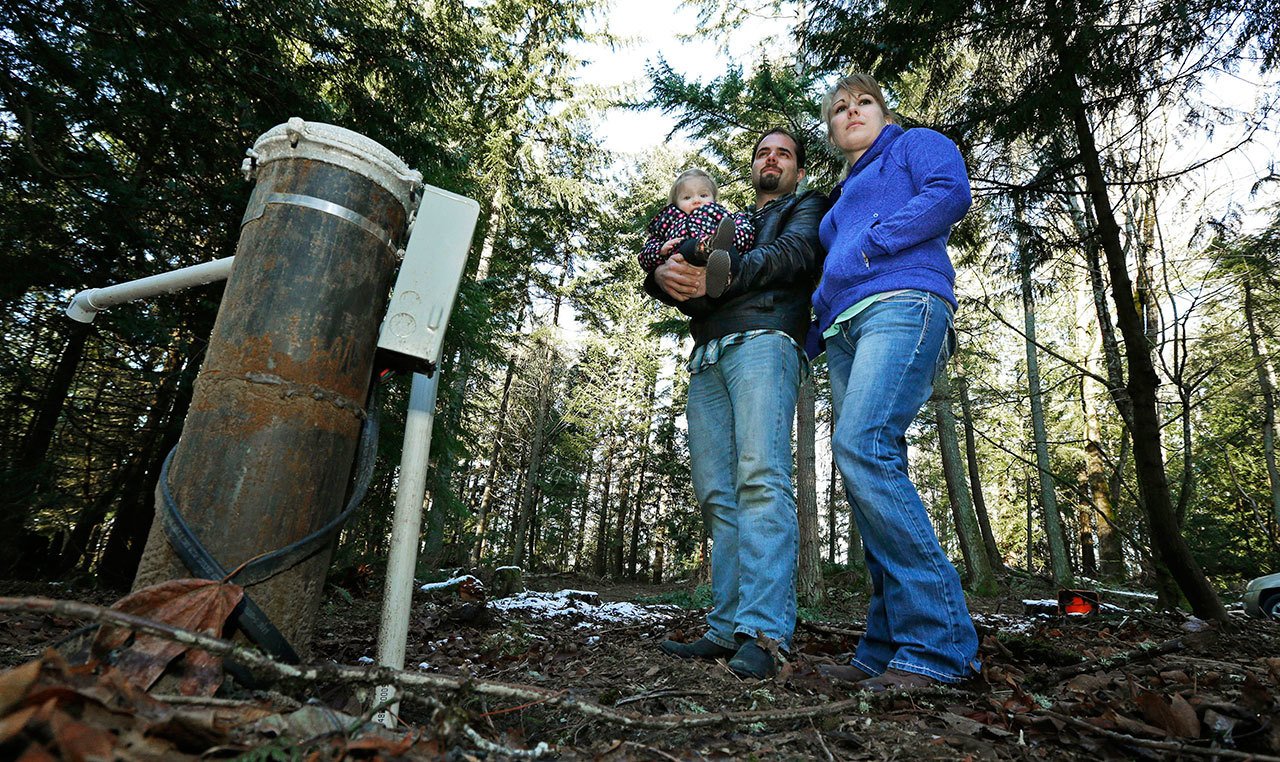
Jenny and Darren Proben had hoped to break ground on their dream home outside of Bellingham in February.
“It’s our lifelong dream to have a tiny bit of land and build a home for our family,” Jenny Proben said. “We didn’t think it would be a problem.
“No one saw this coming. It has huge ramifications financially for our family.”
