
Peninsula Daily News
and news sources
OLYMPIA — As they adjourned a second overtime session and prepare to start a third one, House and Senate leaders worked Saturday to finalize details on a new two-year state operating budget that must be adopted within the next few days to avoid a partial government shutdown.
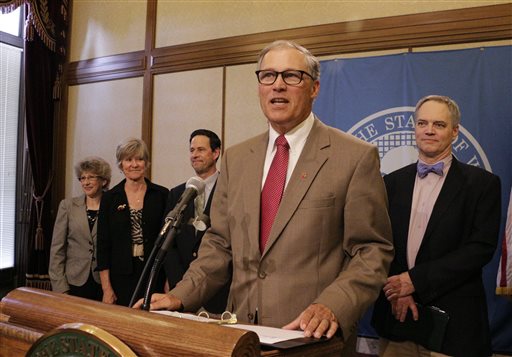
Inslee and legislative leaders from both chambers held a new conference Saturday afternoon to address news of an agreement on the framework of the budget.
They offered few specifics, however, saying that numerous details have not been resolved, but promising that the state will not face a government shutdown Wednesday.
An outline of the agreement provided Saturday says that the budget is about $38 billion, that it spends an estimated $1.3 billion on K-12 basic education, and that it will reduce the cost of tuition at the state’s colleges and universities and community colleges.
The outline also says the budget will fully pay for collective bargaining agreements for state employees and raises for teachers.
Rep. Steve Tharinger, D-Sequim, said Friday that most major issues, including funding for public education required by the state Supreme Court’s McCleary decision, had been resolved.
The education-funding increase will be covered by additional revenue that’s been forecast, he said.
“McCleary funding is pretty well settled,” Tharinger said.
Inslee said that even though “hundreds of details” have not been resolved, he has been assured by leaders in both chambers that none of those details would prevent a final budget from passing early next week.
“All of us here are highly confident that this framework will be adopted, our state will continue in business Wednesday morning and we’re going to make great progress in the state,” he said.
A new two-year budget must be signed into law by midnight Tuesday to prevent dozens of state agencies and other offices from closing completely or partially.
Thousands of state workers had received notice that they would be temporarily laid off starting Wednesday if a budget wasn’t adopted in time.
Lawmakers had struggled for months on the two-year state budget, expected to be in the range of $38 billion, because of differing ideas on how to address a state Supreme Court mandate to put more money into the state’s basic education system.
They adjourned a 105-day regular session two days early and a 30-day special session last month without a deal because the politically divided chambers had differing ideas on how best to address the court.
Democrats initially sought a new capital-gains tax, while Republicans insisted that no taxes were needed because of increasing state revenues.
Within the last week of the current second 30-day special session, Democrats dropped the new tax idea and instead sought additional revenue through closing or limiting several tax exemptions.
In a counter offer, Republicans offered up a few different tax exemptions to be closed.
The framework of the current agreement includes the closure of tax exemptions, but officials haven’t said which ones.
Tharinger and other legislators representing the 24th District, which covers Clallam and Jefferson counties and a portion of Grays Harbor County, agreed on Friday that a third special session was likely.
“We are not going to shut down the state,” said Rep. Kevin Van De Wege, D-Sequim.
Sen. Jim Hargrove, a major budget negotiator, said late Friday afternoon he was hopeful a budget compromise could be reached by Monday.
“We’re all working like crazy to get done before the end of the month so that the state of Washington can operate like it should,” he said Friday in a voice message.
“It looks like we’re on track to maybe make that happen, but there are some difficult decisions and compromises yet to be made in the next 24 hours, and hopefully that will happen and we’ll be ready to wrap up probably early [this] week, Monday, hopefully Sunday, maybe Monday.”
The House and Senate both adjourned Saturday afternoon and will return today for the start of a third special session that gives them the extra days needed to get all of the bills that need to be passed off both chambers’ floors before the end of the current fiscal year on Tuesday night.
Also Saturday, House and Senate transportation leaders expressed renewed optimism on a 16-year, $15 billion transportation revenue package that includes an incremental increase in the gas tax.
The Legislature has struggled to pass a new plan for the past few years, but House Transportation Chairwoman Judy Clibborn said this year is the closest they’ve come to agreement.
The Senate passed the plan earlier this year and has been in negotiations with the House for months.
After a one-day halt of negations earlier this month tied to developments on the operating budget, Clibborn said she and Sen. Curtis King, the chairman of the Senate Transportation Committee, have been meeting regularly.
She and King both said final negotiations were taking place with the governor’s office on a few outstanding issues, including one related to a low carbon fuel standard.
________
Peninsula Daily News Senior Staff Writer Paul Gottlieb and Associated Press writer Rachel La Corte contributed to this report.
