
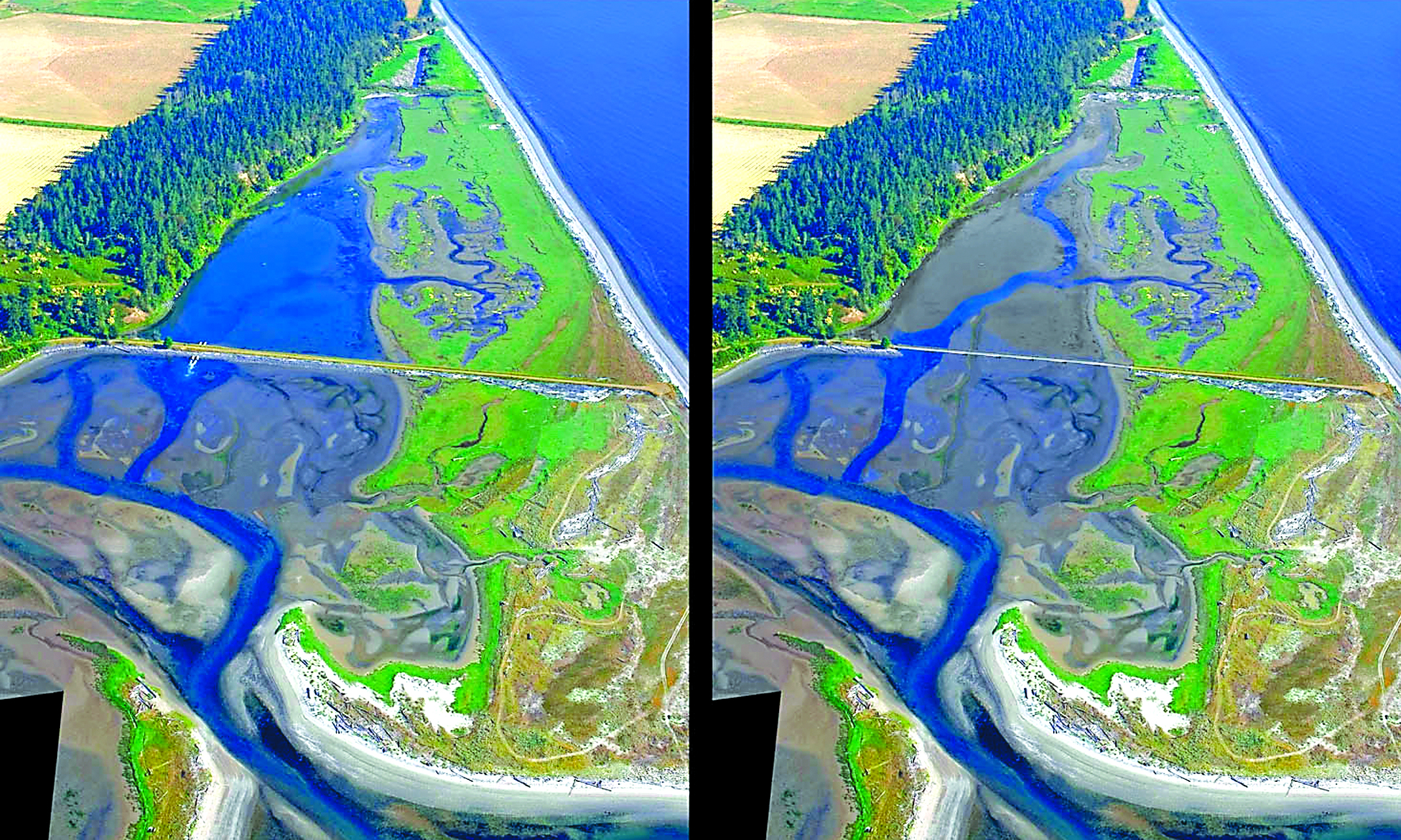
SEQUIM — A $1.86 million government grant-funded project to replace a berm with a bridge will restore fish passage into the northern 37 acres of Washington Harbor estuary marsh and tide flats on West Sequim Bay.
The project is planned to begin in June and be completed in October, said Randy Johnson, Jamestown S’Klallam tribe restoration planner.
The access road to be replaced by the bridge runs across property owned by Mark Burrowes, a Seattle-area developer and descendant of Sequim pioneers.
The harbor is a 118-acre barrier estuary formed by Gibson and South sand spits. Sequim’s Bell Creek flows into Washington Harbor from the west. The project involves construction of a 600-foot-long, low-lying bridge span, replacing the dike-road access.
The road leads to the city’s outflow pipe, which releases treated water leading from its sewage treatment and water reclamation plant off Schmuck Road and into the Strait of Juan de Fuca.
The project’s goal is to restore unimpeded fish access — accomplished by the removal of two 6-foot culverts that now limit fish passage into the estuary.
The bridge will restore a natural tidal channel bed at the road crossing; allow for natural tidal hydrology and the movement of sediment, wood and nutrients; and will allow a natural wave flow into the area, Johnson said.
Located in the Strait of Juan de Fuca near Sequim and adjacent to the entrance of Sequim Bay, the estuary lies 5 miles from Sequim Bay’s Jimmycomelately Creek at Blyn, 7.5 miles from the Dungeness River and 16 miles from Salmon and Snow creeks in Discovery Bay, all sites of past fish restoration projects.
The 1,300-foot-long roadway crosses the estuary and disrupts salmon access, tidal hydrology and habitat-forming processes in Washington Harbor’s northern 37 acres.
Johnson calls the Washington Harbor project “the biggest and baddest” because not only is it the largest of the Sequim Bay salmon-habitat restoration projects overall, but it also will affect the largest amount of marsh habitat.
It also has the largest marsh/estuary ratio, has the largest amount of eelgrass coverage for protection of migrating juvenile salmon, has the most diverse habitat types and “the highest degree of connectivity” with the salmon migration corridor, he said.
“This area historically provided the finest tidal marsh and eelgrass habitat in the estuary,” Johnson said.
“The impact of the roadway appears to have destroyed the eelgrass beds, and evidence indicates that the estuary marsh has been deprived of sediment and is eroding,” he added.
“These problems will be corrected by removing the 6-foot culverts and 600 feet of roadway-dike and replacing them with a 600-foot bridge.”
Grant funding for the project primarily comes from the Estuary and Salmon Restoration Program — about $1 million — a protection and restoration funding opportunity developed by the Puget Sound Nearshore Ecosystem Restoration Project.
The balance of the funding comes from the Environmental Protection Agency — $131,000 — and the state Salmon Recovery Funding Board, about $635,000.
Johnson said restoring unrestricted fish access and habitat processes will benefit summer chum salmon — especially those originating from Jimmycomelately Creek and possibly Discovery Bay — and Puget Sound chinook.
A similar project at the Pitship Point pocket estuary near John Wayne Marina in 2010 replaced old culverts impeding fish passage with a far smaller bridge span on West Sequim Bay Road.
Two other Sequim Bay restoration projects have been completed a Jimmycomelately Creek.
Johnson said coastal cutthroat, bull trout and pink salmon also will benefit from the restoration project.
He presented the project’s plans to the Sequim City Council on Feb. 27, and the council recessed into closed executive session.
After the closed session, the council reconvened in open session to authorize City Manager Steve Burkett to execute all agreements, permits and easements needed to proceed with the construction and operation of the Washington Harbor bridge and outfall line reconstruction project.
Among the agreements are that the city would share maintenance costs. The contribution from the city has not been decided.
The action passed 6-1 with Councilman Erik Erichsen opposed, saying he believes parties outside the city are making their problem the city’s problem.
By approving, he said, the council was obligating the taxpayers, and he was against it.
________
Sequim-Dungeness Valley Editor Jeff Chew can be reached at 360-681-2391 or at jeff.chew@peninsuladailynews.com.
