
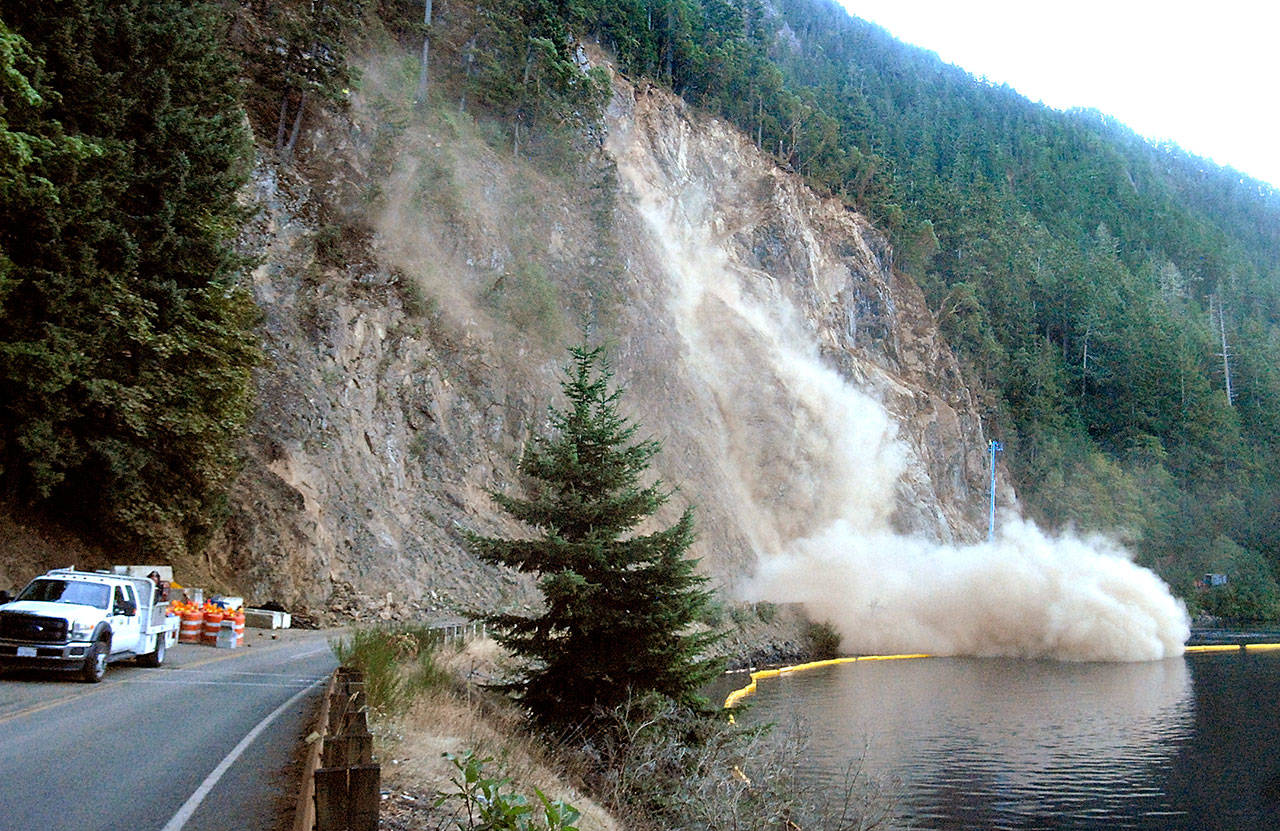
OLYMPIC NATIONAL PARK — Rocks of all shapes and sizes were cast off a 275-foot cliff near the base of Mount Storm King on Wednesday.
Large boulders bounced off U.S. Highway 101 with a thud and slammed into the calm waters of Lake Crescent, leaving a cloud of dust east of Barnes Point.
“When you’re down here on the ground, you don’t know where the rock is going to land,” said Cindy Ryan-Duke, construction manager/inspector with RockSol Consulting Group Inc., which is helping two federal agencies rehabilitate the highway.
“It’s like, which way is the football going to bounce?
“It doesn’t just roll straight down the hill.”
Rock scaling along U.S. Highway at Lake Crescent from Peninsula Daily News on Vimeo.
Crews had begun scaling the marine basalt rock shortly after dawn Wednesday — the third day of a planned four-day closure of U.S. Highway 101 near milepost 229.
Olympic National Park officials said Wednesday the work might require one additional daylong closure.
“After evaluating the scaling left to complete at this point and the time necessary to clear the road and replace the concrete barriers, reopening the road may need to wait until Friday,” park spokeswoman Penny Wagner said.
“Highway 101 will reopen as soon as possible, but travelers should plan ahead for the potential that it may last until Friday at 6 p.m.”
The National Park Service and Federal Highway Administration began July 10 a three-year project to rehabilitate 12 miles of U.S. Highway 101 and 4 miles of East Beach Road at Lake Crescent.
Slope scaling originally was scheduled to be done during four-hour delays of the highway Sept. 7, as well as Tuesday and Wednesday and today of this week. But after the first four-hour closure, reports of property damage to vehicles prompted the Federal Highway Administration to completely close the highway during the work.
It was announced last Friday that the highway would be closed this week to safely complete the rock scaling at the exposed cliff near milepost 229.
“It got to the point where we were getting traffic so close to the rock itself that we weren’t able to protect the cars from the rocks,” Ryan-Duke said.
“Instead of waiting until somebody got hurt, we shut it down prior to.”
State highways 112 and 113 are the detours during the weeklong shutdown of the federal highway.
“We look forward to completing the slope scaling work on U.S. 101 along Crescent Lake while ensuring safety remains a top priority,” Federal Highway Administration spokeswoman Nancy Singer said in a Wednesday email.
A crew of nine rock scalers, including three who were flown in from Colorado to expedite the work, were scattered atop the 275- to 300-foot-tall cliff beginning early Monday.
Some used bars with a tapered wedge on one end — others used their hands and feet — to dislodge loose rocks and let gravity do the rest.
Other crew members prepared air bags made of a heavy vinyl-like material that were inserted into cracks and filled with air from an air compressor. The pillow-like bags were used for larger, stubborn boulders that couldn’t be moved by human force.
“The rock scaling is taking a little bit longer than we’ve anticipated,” Ryan-Duke said while driving to the project site.
“Basically, the reason is the upper portion of that particular rock hasn’t been scaled in decades.”
Water seeping into cracks has weakened the rock throughout the years by freezing and thawing, Ryan-Duke said.
After the loose rock is removed, crews will use tension bolts and dowels to reinforce the basalt, prolonging the effectiveness of the slope scaling.
A pair of geologists and a project superintendent stood in a 125-foot-tall manlift Wednesday to plot a layout for the bolts and dowels.
Meanwhile, other workers took advantage of the weeklong highway closure by attacking other projects such as culvert replacements.
Ryan-Duke emphasized that the rock scaling was the “No. 1 priority.”
Some of the boulders that have been dislodged from the mountain were too large for a loader to handle, Ryan-Duke said. They were broken up with an excavator and trucked to a quarry about 4 miles from the site.
Last Thursday, crews were stymied by a boulder of about 40 feet across, 30 feet tall and 20 feet deep, Ryan-Duke said.
Because blasting is not permitted in the contract, it took a five-member crew about three hours to break the rock into smaller pieces using air bags.
“It was a big undertaking,” Ryan-Duke said.
Crews spent about 40 minutes Tuesday trying to move a 10-foot-tall boulder that sat precariously on the side of the cliff, she said.
“You couldn’t see anything that was holding it there,” Ryan-Duke said. “That, again, was part of the reason that we shut the road down.
“The more we got into it, getting rid of the smaller stuff around the bigger stuff, that just makes the bigger stuff so unpredictable and unmanageable to a point.”
After the scaling is complete, crews will clear the boulders and loose rock from the road surface and install a concrete barrier to separate the road from the lake.
A yellow boom has been placed in the water around the site to keep boaters and kayakers from venturing too close to the crumbling cliff, Ryan-Duke said.
Once the barriers are installed, Highway 101 will reopen to single-lane, alternating traffic through the area.
Temporary traffic signals will be in place through the weekend and after-hours with short delays.
Beginning Monday, flaggers will control traffic during work hours for the installation of rock bolts and dowels.
“This work will require half-hour delays,” park officials said in a press release.
________
Reporter Rob Ollikainen can be reached at 360-452-2345, ext. 56450, or at rollikainen@peninsuladailynews.com.
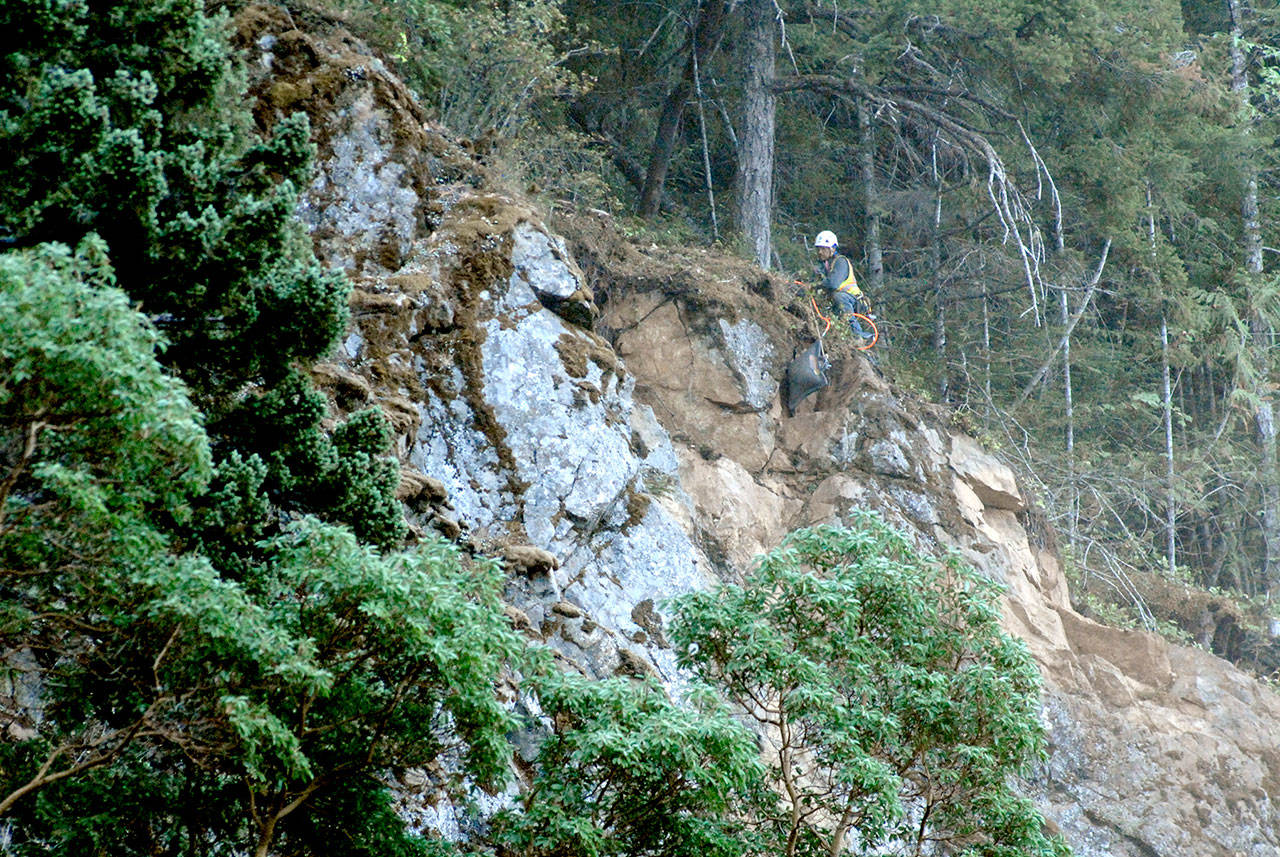
A worker uses an air bag to push rocks away from a rock wall above U.S. Highway 101 at Lake Crescent on Wednesday. (Keith Thorpe/Peninsula Daily News)
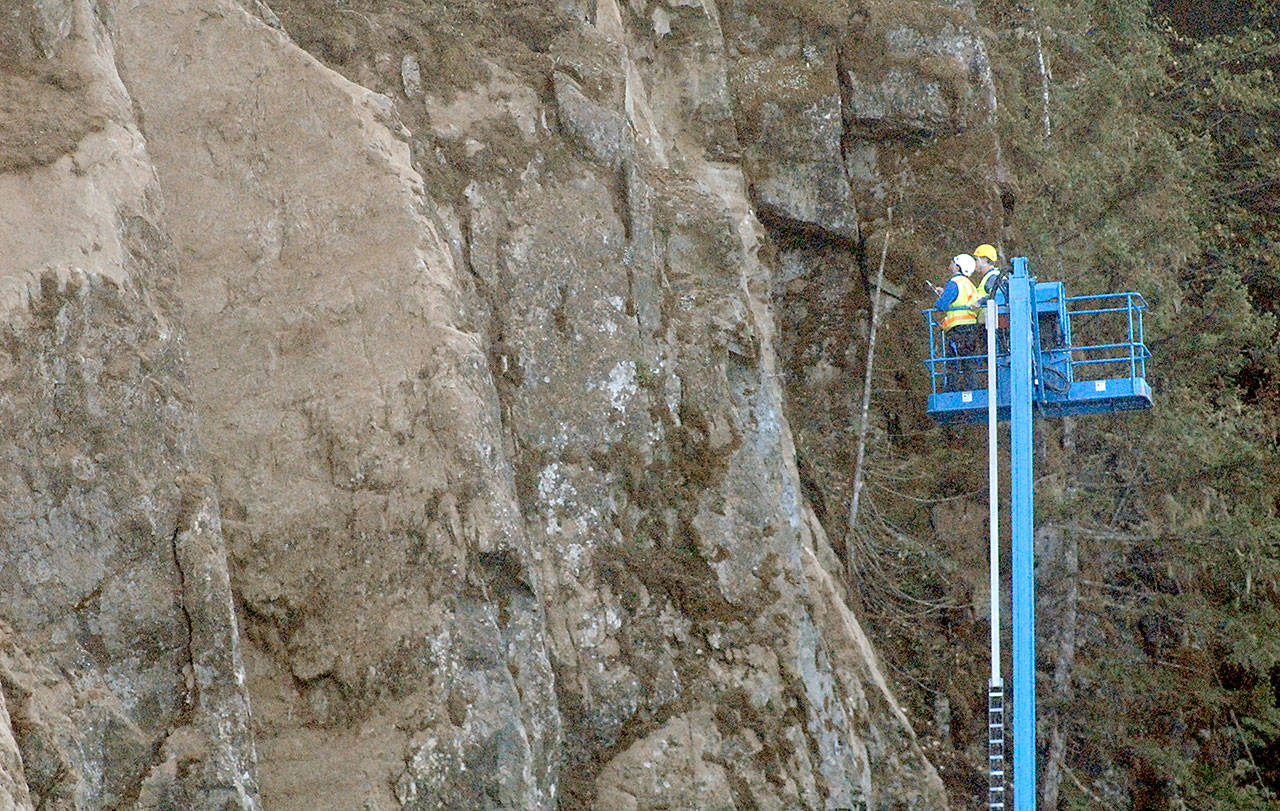
A crew inspects and photographs a rock wall above the highway to determine placement of retaining bolts that will be used to secure the rock face. (Keith Thorpe/Peninsula Daily News)
