
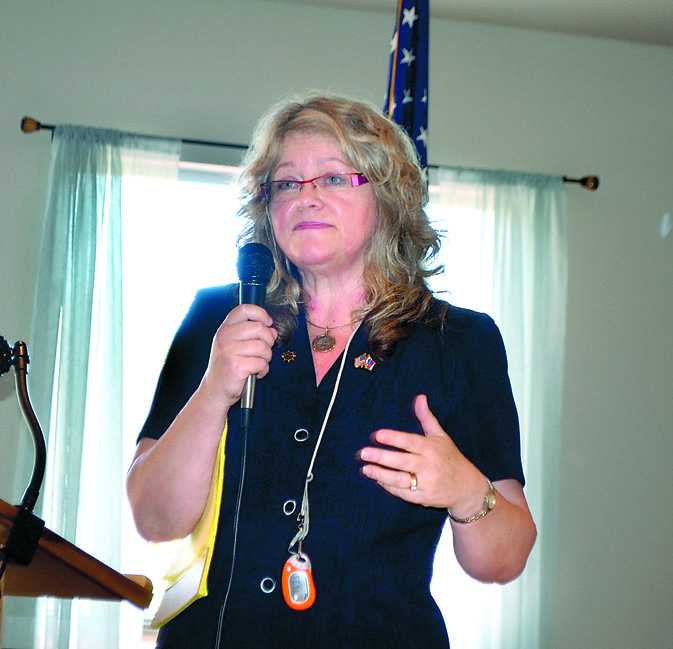
PORT TOWNSEND — Transmitters installed on boats to notify other vessels as well as those on land are a valuable safety tool, according to information presented to the Jefferson County Chamber of Commerce on Monday.
“When you are at sea, it is important to know who is out there with you and where they are going,” said Judy Johnson, CFO of Shine Micro Inc.
“This shouldn’t be a secret.”
Pleasure-boaters who choose to install an automatic identification system, or AIS, have the option to “buy local,” as the devices manufactured by the Port Ludlow-based company are available wherever such equipment is sold, Johnson told the audience attending Monday’s Jefferson chamber luncheon at the Port Townsend Elks Lodge.
All commercial vessels and those longer than 60 feet are required to have an onboard AIS system. The transmissions over a standard radio frequency are monitored by the Coast Guard.
Johnson said Shine Micro has about 5 percent of the worldwide AIS market.
Manufacturing is not allowed in Port Ludlow, so the component parts are built elsewhere and shipped to Port Ludlow for assembly, she said.
An AIS system can prevent a collision as boats can identify the size and type of any vessel in their vicinity.
It can also aid in search and rescue, as the missing vessel can be located through the radio signals it emits for a distance of 50 nautical miles.
“A lot of times, a dozen kayakers might go out, and one of them doesn’t come back right away.” Johnson said.
“If the missing boat has an AIS, they can be located right away.”
Johnson said the Coast Guard will pay attention to two small boats who meet up in the middle of a body of water for a short time, with the appearance of passing contraband from one to the other.
In that case, the Coast Guard will be waiting for the boat when it reaches port.
Someone intent on smuggling might not install an AIS system, but that can be a red flag in and of itself.
“The Coast Guard pays a lot more attention to boats that don’t have AIS systems than to those who do,” Johnson said.
An AIS system for a small pleasure craft costs $500 or $600, while the commercial versions are more expensive, Johnson said.
There are no additional usage charges because the units use standard radio frequencies and do not hook up to satellites to transmit their data.
“This is more like a CB radio that people had in their cars many years ago,” Johnson said.
“The extra charges came in with cellphones.”
Johnson said that her company employs about 15 people and will be expanding.
“Many of the people who work for us weren’t real technical when they stated,” she said,
“We do a lot of on-the-job training.”
Jefferson County Reporter Charlie Bermant can be reached at 360-385-2335 or at charlie.bermant@peninsuladailynews.com.
