
By Phuong Le
The Associated Press
SEATTLE — Federal biologists are weighing a range of emergency options to save an emaciated endangered orca, including possibly feeding it live salmon at sea dosed with medication.
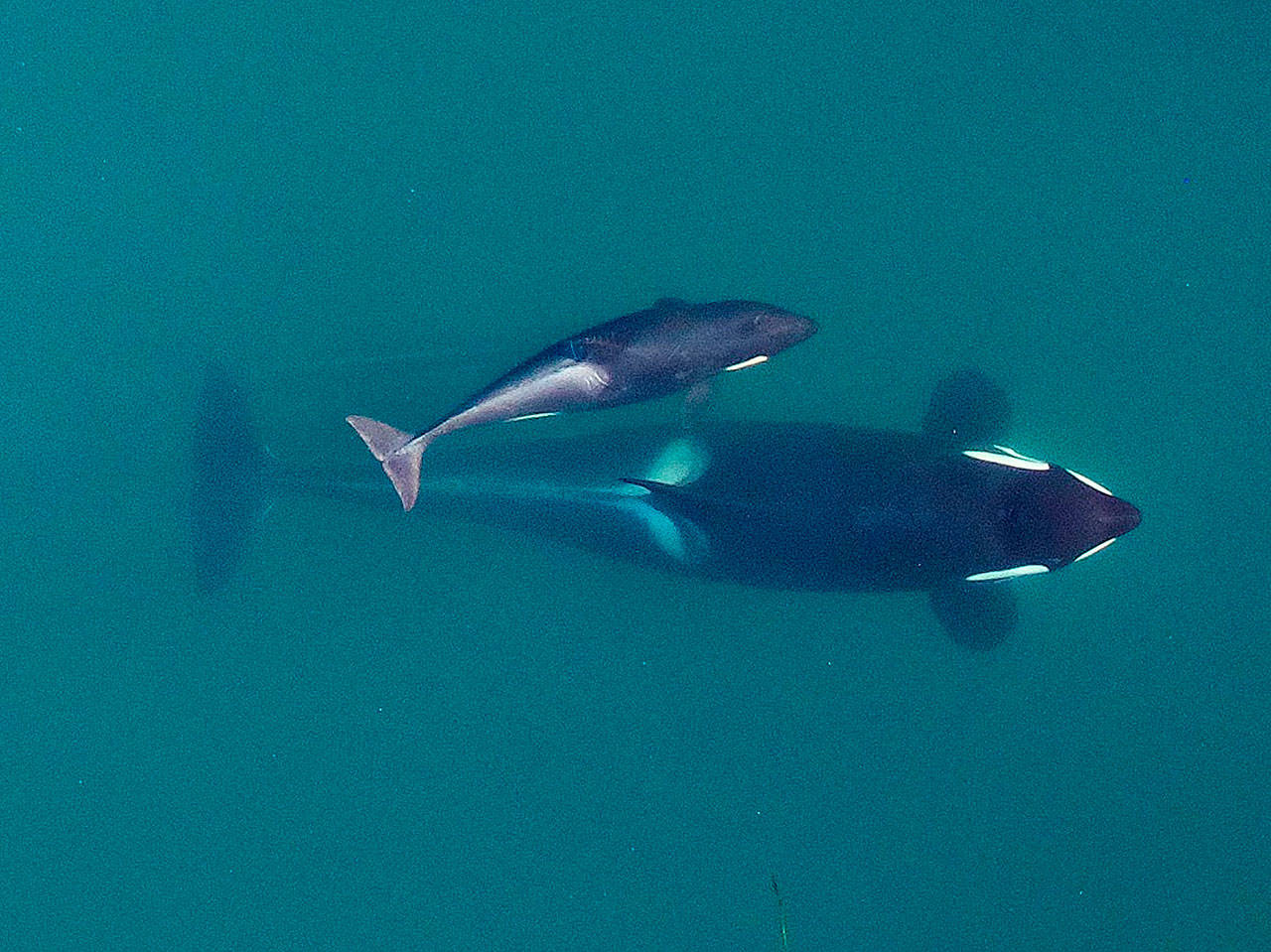
Whale researchers are worried about the survival of the 4-year-old female orca known as J50, a member of the dwindling population of southern resident orcas that spends summer months in the inland waters of Washington and British Columbia.
Another female orca from the group of just 75 animals, known as J35, has attracted global attention throughout the past two weeks as she has tried to keep her dead calf’s body afloat while swimming miles.
Federal biologists are weighing whether and how to intervene for the young emaciated female.
The options range from doing nothing to using a boat to give the orca supplemental fish to increase her hydration and nutrition.
“Everything is on the table. We’re working on every possibility to help,” said Michael Milstein, a spokesman with National Oceanic and Atmospheric Administration Fisheries, the agency responsible for protecting marine mammals.
“The feeling is it’s quite urgent given the whale’s condition.”
NOAA Fisheries would still need federal approval from another division of the agency before it moves ahead with an intervention plan.
Whale experts are focused now on collecting breath and fecal samples and taking aerial drone photographs of the whale to assess her health and figure out what’s wrong.
Veterinarians hope to get out on a boat and visually do a check-up and take a sample of the white patch on the back of her head that could be a sign of an infection.
“If we come up with more evidence that she’s suffering from pneumonia or a fungal infection or other disease, that might be an opportunity to provide her with medication,” said Michael Ford, director of the conservation biology division at the Northwest Fisheries Science Center in Seattle.
He said no decision has been made.
A team of top veterinarians and whale experts are exploring ways to deliver live fish — and oral medication — to the orca and doing so in such a way that won’t prompt the orca to become accustomed to people or boats, said Joe Gaydos, a wildlife veterinarian and science director of SeaDoc Society.
“We don’t want a situation where we’re trying to help the animal but end up hurting it,” he added.
Gaydos said helping J50 is important because she will be the future of the population, but at the same time no one is losing sight of broader efforts to help the entire population recover.
The orcas face nutritional stress because of a lack of Chinook salmon, their main diet. They also face threats from toxic contamination and vessel noise and disturbances that disrupt their ability to communicate and forage.
The whales are listed as endangered in the U.S. and Canada. Individual whales are identified by unique markings or variations in their fin shapes, and each whale is given a number and name.
Ford said the orcas are intelligent animals and can quickly understand where their food source is coming from and that could create a danger for the animals. “It’s not a good long-term solution,” he added.
Feeding the animal fish also won’t be easy logistically and it would be a long shot. “I’m not aware of previous efforts to feed killer whales traveling with its family in the wild,” Ford said.
The fish-eating whales swim about 60 miles a day, and navigating close to them is tricky and risky, he said. The orca could be fed salmon by using an underwater pipe from a boat so that the animal doesn’t associate the boat with food.
The black-and-white orca has appeared lethargic in recent days but has been eating, defecating and swimming with her small pod of whales, Milstein said.
J50 is much skinnier and her body condition has gotten a lot worse, said John Durban, who flew a drone high above the whale Wednesday to capture images that help detect changes in the orca’s body. He leads the cetacean health and life history program at NOAA’s Southwest Fisheries Science Center.
He said “it’s concerning” that she’s skinnier compared to last year and the year before.
She has a depression on the back of her head, or “peanut head,” a sign of emaciation.
Gaydos said there’s evidence that 11 of 13 orcas found with “peanut head” have died, so there’s a sense of urgency.
“It’s not a time where you’re going to say, ‘Let’s keep watching,’ ” he said. “We know it’s not going to end well if we don’t try and do something.”
