
By Dan Elliott
The Associated Press
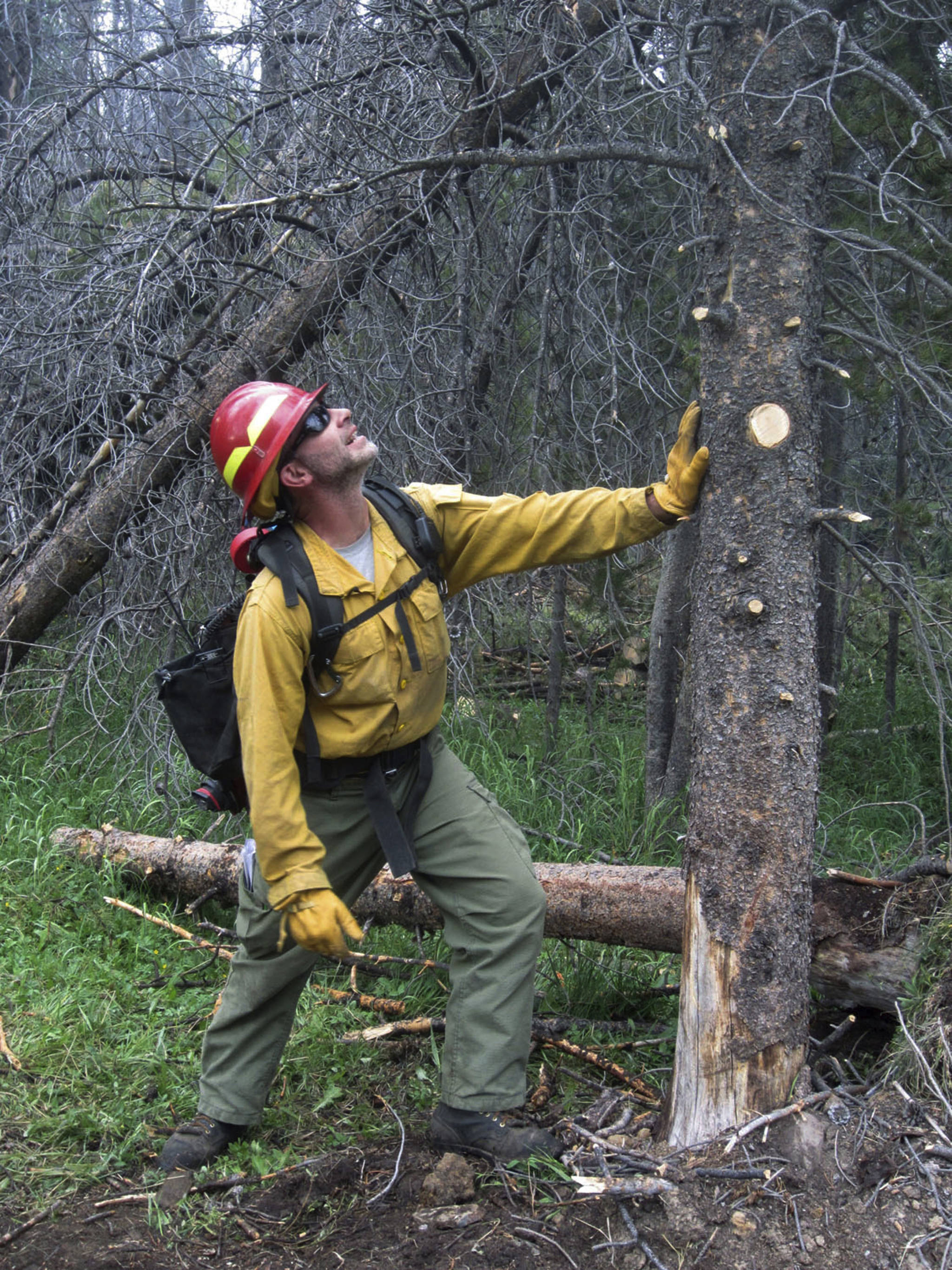
ALBANY, Wyo. — Vast stands of dead timber in the Western U.S. have forced firefighters to shift tactics, trying to stay out of the shadow of lifeless, unstable trees that could come crashing down with deadly force.
About 6.3 billion dead trees are still standing in 11 Western states, up from 5.8 billion five years ago, according to U.S. Forest Service statistics compiled for The Associated Press.
Since 2010, a massive infestation of beetles has been the leading cause of tree mortality in the West and now accounts for about 20 percent of the standing dead trees, the Forest Service said. The rest were killed by drought, disease, fire or other causes.
Researchers have long disagreed on whether beetle infestations have made wildfires worse, and this year’s ferocious fire season has renewed the debate, with multiple fires burning in forests with beetle-killed trees.
But no one disputes that dead trees — snags, in firefighter parlance — present an unpredictable threat, prone to blowing over onto people or getting knocked down by other falling trees. Amid the noise and distraction of a fire, firefighters sometimes get little warning.
“That’s the scary thing about snags,” said Ben Brack, a firefighter and public information officer on the Keystone Fire, which burned across a forest full of beetle-killed trees around the tiny communities of Albany and Keystone in southern Wyoming in July and August. “You don’t always see them coming.”
To avoid broad stands of beetled-killed trees, firefighters sometimes have to cut containment lines farther from the flames. That allows the fires to gobble up more forest before they’re brought under control.
“When we do that, fires get bigger, and often they burn longer,” said Bill Hahnenberg, a veteran Forest Service incident commander who helped corral last year’s Beaver Creek Fire in beetle-killed trees in northern Colorado and southern Wyoming. “So that’s one of the trade-offs fire managers have had to go to.”
Firefighters used that tactic on both the Beaver Creek and Keystone fires. They’re also using it on two big fires currently burning in beetle-killed trees in western Montana.
“I’m very much in favor of it,” said Mark Gunnerson, whose family owns three cabins in Keystone, one dating to 1870. “I would rather start over than one person get hurt.”
This summer’s fire edged to within 40 feet of one of his family’s cabins, but none was damaged.
Other factors, such as rugged terrain or drought-baked forests, can prompt fire managers to take a safer, less aggressive approach to minimize the danger. They say it’s impossible to know how much bigger fires grow because of that.
The Beaver Creek Fire scorched nearly 60 square miles and burned for about four months. The Keystone Fire was discovered July 3 and contained in mid-August, after blackening 4 square miles.
No deaths or injuries were reported in either fire. But since 1987, at least 13 U.S. firefighters have been killed and five injured by falling dead trees, according to reports gathered by the National Wildfire Coordinating Group, a coalition of federal, tribal, state and professional firefighting organizations.
Massive forest die-offs have occurred before, researchers say, and even healthy forests have standing dead trees. John Shaw, a Forest Service analyst, said the percentage of dead trees can vary widely over decades.
About 17 percent of all standing trees in 11 Western states are dead, roughly double the proportion in the 1990s, but that was a time of above-normal precipitation, Shaw said.
Since 2000, two dozen species of beetles have killed trees on nearly 85,000 square miles in the Western U.S. That’s an area about the size of Utah. Beetles have killed nearly 80,000 square miles of forest in Western Canada.
The outbreak stems from a combination of factors, including crowded, aging forests, drought-stressed trees and warmer temperatures that allow the pests to survive the winters, researchers say.
The bugs bore under a tree’s bark, where they lay their eggs and release a blue fungus. The newly hatched larvae eat away a thin layer below the bark that the tree needs to transport nutrients, and the fungus cuts off the flow of water.
In the past 18 months, more than a dozen Western wildfires have burned in forests with some beetle-killed trees, blackening a total of 570 square miles. At least five of those fires are still burning.
Some wildfires in British Columbia this summer were also in beetle-infested areas, Canadian officials said.
The spike in dead trees in the past five years, both from beetles and other causes, probably did not lead to an increase in the number of wildfires, said Matt Jolly, a Forest Service research ecologist. Weather, lightning strikes and human blunders all play a role, as well as dry trees.
“Weather kind of trumps everything,” he said.
An individual beetle-killed tree doesn’t burn differently than a tree killed by other causes, Jolly said. But a beetle infestation can leave behind a staggering expanse of dead forest.
“The big thing is just the sheer number of dead trees we get,” he said.
“We know once a beetle attacks a tree, it dries out,” Jolly said. “We know the burn rate increases as the fuel dries out.”
Other researchers say it makes little or no difference whether fires are burning in a forest full of beetle-killed or a forest with more healthy, living trees.
Fires move quickly and burn only the outer layers of trees, pine needles and small twigs, said Chad Hanson, a research ecologist and principal scientist for environmental group the John Muir Project.
“On the surface, it makes so much sense to believe that dead trees would burn more easily,” he said. “The problem is, it’s not true. It’s been tested over and over again in real fires, and it’s not happening.”
