
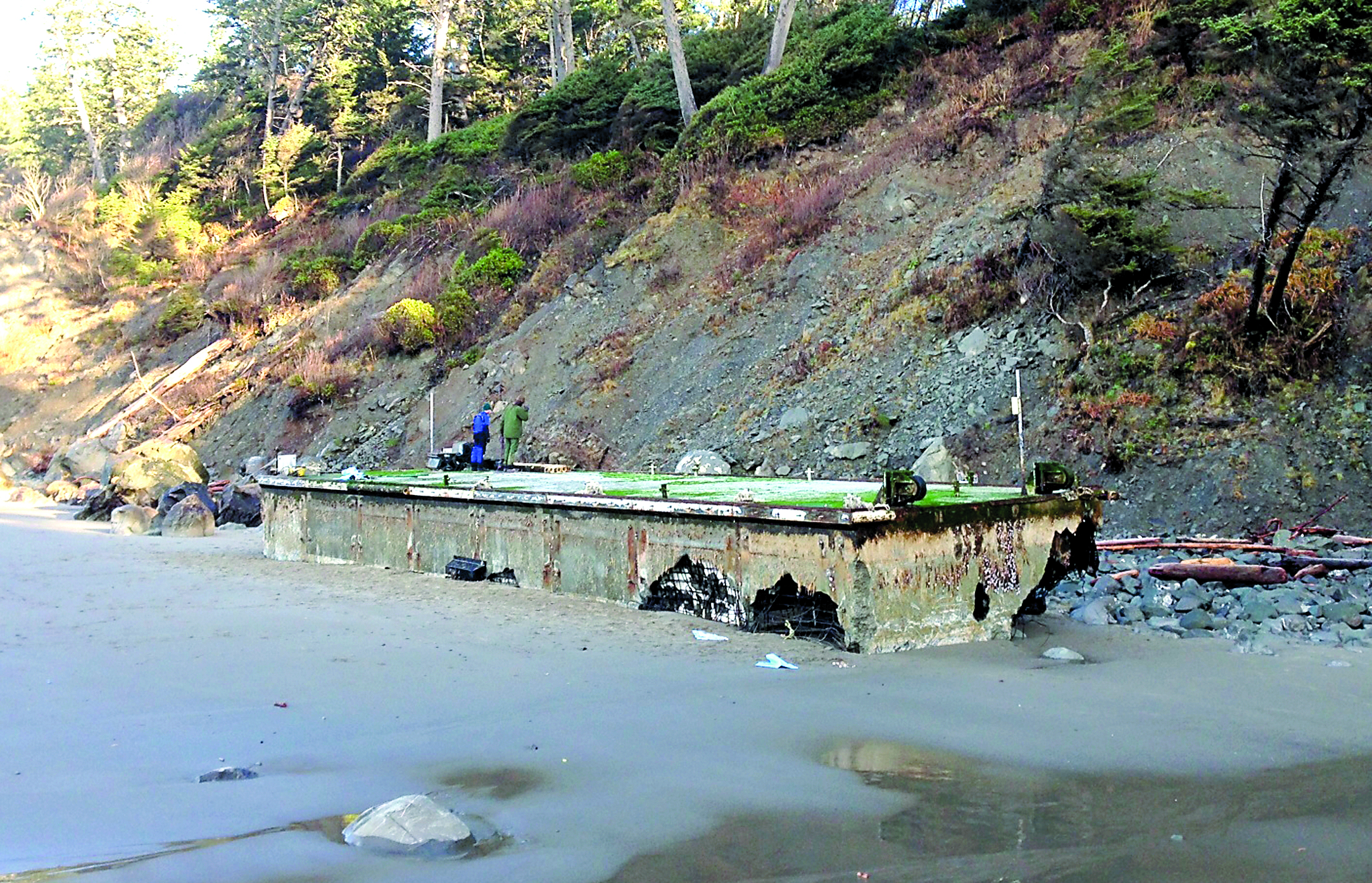
LAPUSH — Staff members from state and federal agencies have finished removing more than 400 pounds of non-native plant and animal life found clinging to a 64-foot dock that washed up on a remote Olympic National Park beach, the state Department of Ecology said.
Experts are now analyzing marine life samples taken from the structure, believed to be from the 2011 Japanese tsunami, to determine what specific species made their home there, said Bill Tweit, invasive-species specialist and special assistant to the director of the state Department of Fish and Wildlife, on Friday.
A team of six researchers and invasive-species experts from the park, the Washington Sea Grant Program and the state Department of Fish and Wildlife hiked on more than 3 miles of old logging roads and maneuvered down a steep bluff Thursday and Friday to get to the dock between LaPush and the Hoh River.
The workers cleared the dock of non-native animal life, most of which was found on 150-pound rubber bumpers that ringed the top portion of the dock, Tweit said.
Crew members removed the bumpers and stored them for the time being in plastic bags inside the hollow spaces of the dock itself, which Tweit was confident would kill any organism left alive after the bumpers were unbolted from the dock.
“I was just relieved that everyone [got back] safe and sound and that yesterday was as successful as it was,” Tweit said Friday.
“They really decreased the risk [of contamination], and they really got a lot [of organisms] off.”
Crews also took special care to recover or destroy any remains of the removed organisms so as to minimize native animals’ exposure to the non-native species.
“We’re always keenly aware of where things go when we scrape off something,” Tweit said.
Ecology said teams also used a diluted bleach solution to wash the entire dock, a method approved as environmentally safe by the National Park Service and the Olympic Coast National Marine Sanctuary.
State and federal officials say the dock is a remnant of the estimated 5 million tons of debris swept into the ocean by a tsunami that struck Japan on March 11, 2011, though confirmation has not been received from the Japanese government.
It was spotted by fishing crews Dec. 14 off the coast and was located on the beach 15 miles southwest of Forks on Dec. 18 by a Coast Guard helicopter crew.
Since the dock washed ashore, waves have pushed it some 50 to 100 yards from its original spot just north of the Hoh River, Tweit said, and shifted it so it was parallel with the shoreline.
The repositioning helped crews reach sections of the dock previously submerged, Tweit said.
In initial samples, 30 non-native species were found. None was of the five potentially ecologically damaging species found on a dock section that washed up in Oregon earlier in 2012.
The 66-foot-long Oregon dock was cut up and hauled away after volunteers scraped off 2 tons of seaweed and creatures clinging to it and ran blowtorches over the surface to sterilize it.
On Friday, the state Department of Ecology said between 30 and 50 species of marine plants and animals not found in the United States but native to Japan had attached themselves to the dock on the Washington coast.
Crews have not had the chance to identify any of the individual species found on the dock, Tweit said Friday, adding that this detective work will continue in the coming weeks.
Crews were able to identify marine invertebrates — animals without a backbone — such as mussels and barnacles, Tweit said, but have not found any large marine crustaceans, such as crabs, or larger vertebrates, such as fish.
Ecology also announced Friday that the team was able to attach a new satellite tracking buoy to the dock after the batteries on the first one wore out.
The consensus at a Wednesday meeting of agencies dealing with the dock was that the state needs to take care of any invasive species first, then the National Park Service should work out funding for removing the dock from the beach, said Virginia Painter of the state Parks Department.
As agency staff advance work on the dock, Tweit said, state and federal officials plan to glean as much information from the newly beached Washington dock as they can to prepare themselves for yet-to-come additional debris potentially connected with the Japanese tsunami.
“We’re assuming we’ll have more [beached debris], probably not at this scale, that will need decontamination from an invasive-species perspective,” Tweit said.
“These are all learning experiences for us.”
For more updates on the beached dock removal efforts, visit Ecology’s Web page dedicated to the project at http://tinyurl.com/ForksDock.
Anyone sighting other significant debris that may be from the tsunami is asked to report it to DisasterDebris@noaa.gov.
There are two government websites with information on tsunami debris: www.marinedebris.noaa.gov/tsunamidebris and http://marinedebris.wa.gov.
________
Reporter Jeremy Schwartz can be reached at 360-452-2345, ext. 5074, or at jschwartz@peninsuladailynews.com.
