
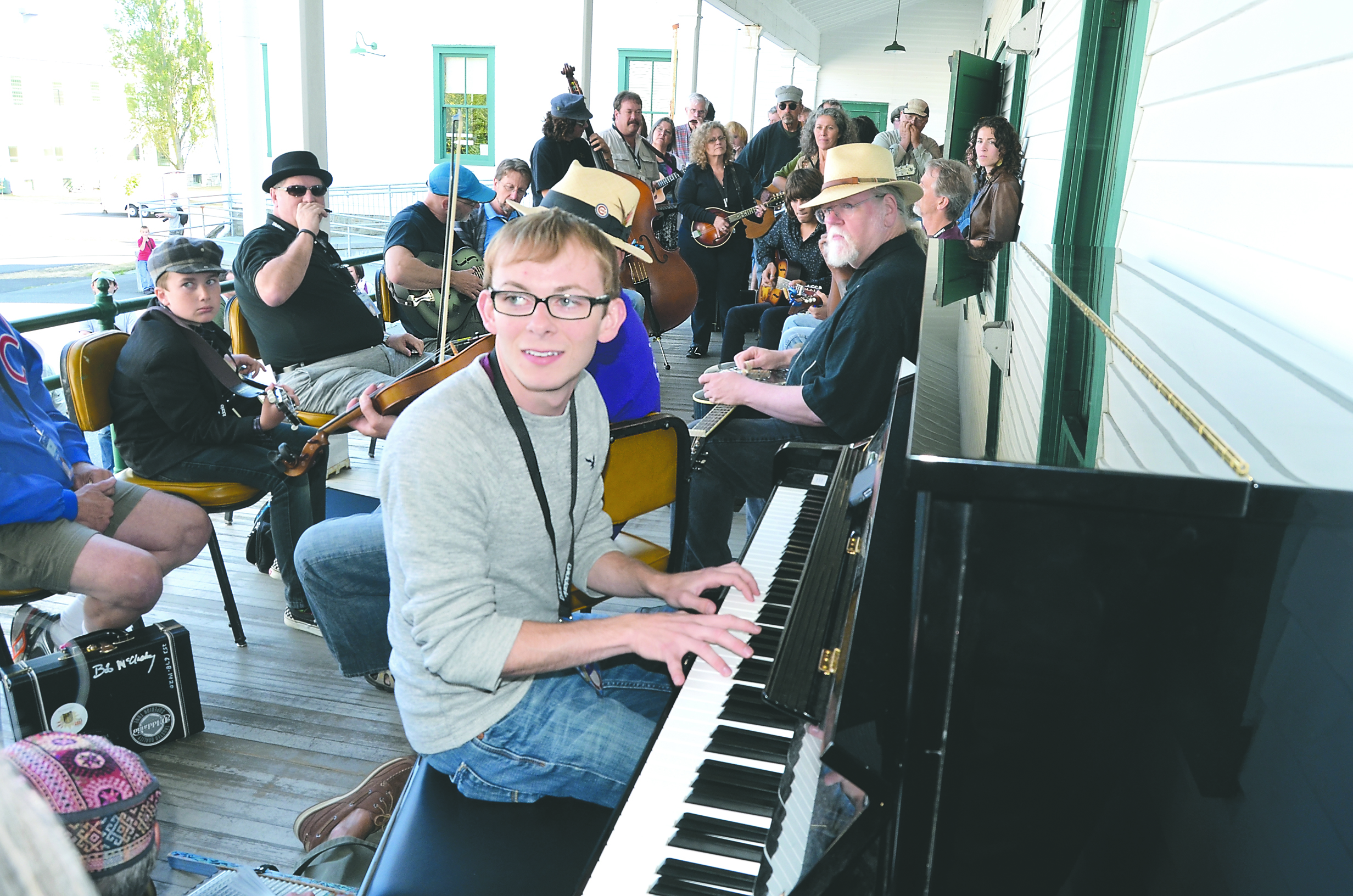
PORT TOWNSEND — A love of music and the desire to participate are the primary requirements for taking part in the Acoustic Blues Festival.
“The number of people who really understand old-time country blues is phenomenal, impressive and inspiring,” said Lauren Sheehan, who has attended all 24 iterations of the festival, first as a student and now as faculty.
“There are always surprises here — people who have an interesting, unique style that you wouldn’t know about otherwise, that I’d never have a chance to see live otherwise.”
The weeklong workshop at Fort Worden State Park, which ends Saturday, includes instruction in a variety of styles and instruments, all in a relaxed environment, culminating every day in a raucous back-porch jam in which 40 people at a time participate in a long exploration of basic blues riffs that ends only when the bandleader says so.
Unlike Jazz Port Townsend, which took place the previous week, no audition tape was required; instead, attendees needed only to bring an instrument, enthusiasm and $550 tuition.
The big public portion of the festival begins Friday and continues Saturday with performances in Port Townsend clubs from 8 p.m. to midnight and a special concert at 1:30 p.m. Saturday at McCurdy Pavilion.
General admission to the clubs is $25, with one ticket each night covering all venues. A processing fee applies.
Seating is reserved at the McCurdy Pavilion concert, which costs $20 to $40. A processing fee applies.
“This is amazing music,” said Felicia Jangerd Neilson, who traveled from Stockholm to participate.
“It is so close to your heart and close to your feelings. Nothing else makes me feel like the blues does.”
Jerron “Blind Boy” Paxton, a faculty member who is attending his fifth festival, talked about magic.
“The good music flows in like the mist,” Paxton said.
“There is something magical about having a group of friends who are familiar with each other but haven’t seen each other in awhile.
“And it ends up like this: You get up and start to go somewhere, but you’re stopped by someone who wants to talk or jam, and an hour later, you say to yourself, ‘Hey, I needed to go to the bathroom.’”
Donna Schmidt, a fiddle player from Seattle, said students learn to improvise.
“These are skills you can use in any jam session, in any style of music,” she said.
She added that “a lot of the people don’t want to solo because it isn’t their groove, so they just play rhythm.
“A good bandleader will make eye contact and cue someone to take a solo, and when that starts, they’ll find the next person to solo,” she said.
Daryl Davis, in his second year as musical director, said that fewer, shorter classes this year give the students more free time to jam, which many consider the most rewarding part of the week.
Chase Garrett, a 24-year-old pianist from Iowa City, Iowa, didn’t follow the same long path as Sheehan to the faculty. He was recruited as a last-minute replacement last year for another performer who had fallen ill.
“Teaching blues requires a feeling that comes from inside; you need to have it in your head, your hands, your heart,” Garrett said.
“I teach by showing my students how the music affects me and tell them if they love the music, they’ll be able to play it.”
Garrett has built an easy familiarity with the participants.
While he is talking, Neilson walks past Garrett and slips him a Swedish 20-krona note (worth about $3). A few minutes later, a woman walks by, asks to borrow money and goes away with a $20 bill.
Garrett doesn’t acknowledge any age-related divisions.
“We learn from each other. I can learn from a teenager in the same way that a 60-year-old can learn from me,” he said.
“And after the class, there is no student, no teacher and no hierarchy.
“We are all friends.”
Jefferson County Editor Charlie Bermant can be reached at 360-385-2335 or cbermant@peninsuladailynews.com.
