
By Rachel La Corte,
Gillian Flaccus
and Michael Sisak
The Associated Press
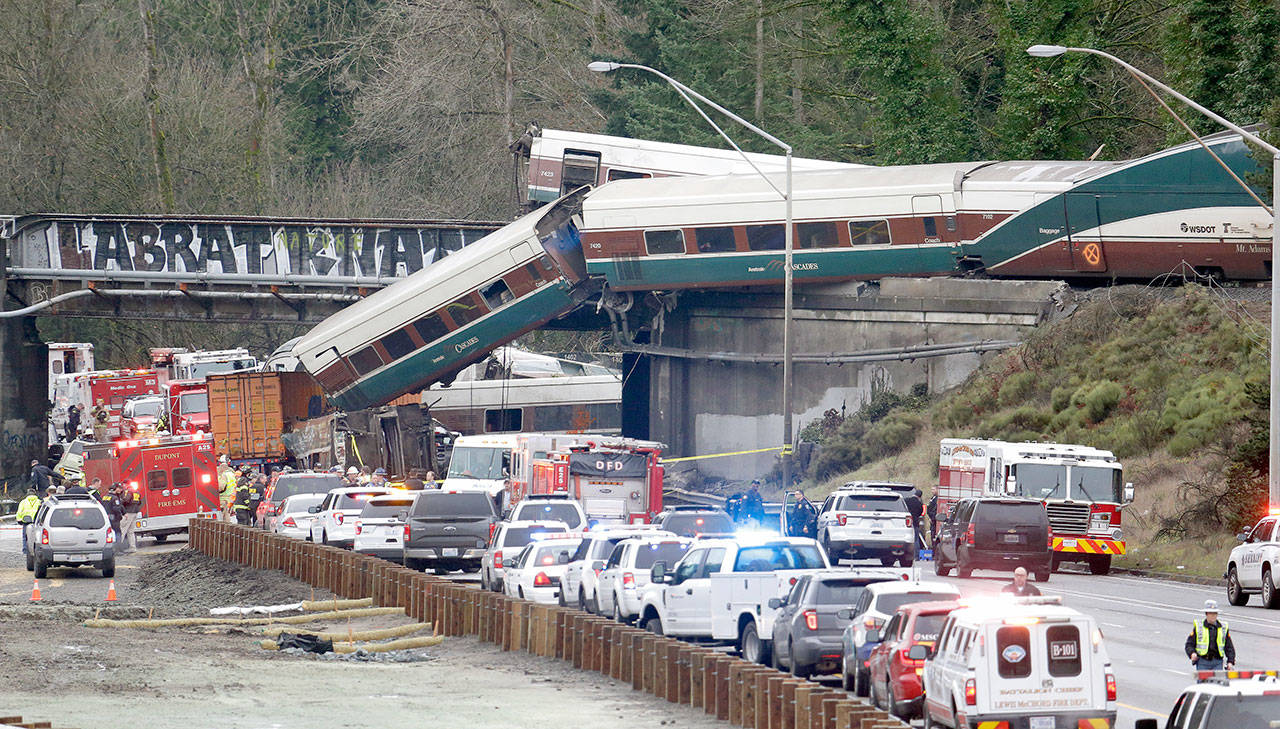
DUPONT — An Amtrak train making the first-ever run along a faster new route hurtled off an overpass south of Seattle on Monday and spilled some of its cars onto the highway below, killing at least three people, injuring more than 100 and crushing two vehicles, authorities said.
Seventy-seven passengers and seven crew members were aboard when the train derailed and pulled 13 cars off the tracks. Authorities said there were three confirmed deaths and more than a dozen people with critical or serious injuries.
An official who was briefed on the investigation said earlier that at least six people were killed. The difference in the numbers could not immediately be reconciled. The official was not authorized to discuss the investigation publicly and spoke to The Associated Press on condition of anonymity.
A website that maps location and speed using data from Amtrak’s train tracker app shows the train was going 81.1 mph about one-quarter mile from the point where it derailed, where the speed limit is significantly lower.
A track chart prepared by the state Department of Transportation shows the maximum speed drops from 79 mph to 30 mph for passenger trains just before the tracks curve to cross Interstate 5, which is where the train went off the tracks.
The chart, dated Feb. 7, 2017, was submitted to the Federal Railroad Administration in anticipation of the start of passenger service along a new bypass route that shaves 10 minutes off the trip between Seattle and Portland.
It wasn’t clear how fast the train was moving when it derailed.
In a radio transmission immediately after the accident, the conductor can be heard saying the train was coming around a corner and was crossing a bridge that passed over Interstate 5 when it derailed. Dispatch audio also indicated that the engineer survived with bleeding from the head and both eyes swollen shut.
“I’m still figuring that out. We’ve got cars everywhere and down onto the highway,” he tells the dispatcher, who asks if everyone is OK.
Aleksander Kristiansen, a 24-year-old exchange student at the University of Washington from Copenhagen, was going to Portland to visit the city for the day.
“I was just coming out of the bathroom when the accident happened. My car just started shaking really, really badly. Things were falling off the shelf. Right away, you knew that this was not something minor,” he said.
The back of his train car was wide open because it had separated from the rest of the train, so he and others were able to jump out to safety. He was at about the middle of the train, either the sixth or seventh car, he said, and was “one of the lucky ones.”
Daniella Fenelon, a 19-year-old from Southern California, was on the train taking a cross-country trip as part of her winter break. She said she was asleep when the accident happened.
“Suddenly there was just a jolt, and I didn’t know what was happening,” Fenelon said. She slammed into the seat area in front of her, and the windows exploded, said Fenelon, who was treated and released from a hospital with a possible concussion.
Dr. Nathan Selden, a neurosurgeon at the Oregon Health & Science University in Portland, said he and his son drove through the accident scene while traveling north to visit Seattle. The doctor asked if he could help and was ushered to a medical triage tent in the highway median.
The most seriously injured had already been whisked away, but the patients he helped appeared to have open head wounds and skull, pelvic or leg fractures, as well as small cuts and neck sprains, he said.
He called it a miracle that an infant child he saw from the scene appeared completely unharmed.
President Donald Trump used the deadly derailment to call for more infrastructure spending in a tweet sent about three hours after the accident. He said the wreck shows “more than ever why our soon to be submitted infrastructure plan must be approved quickly.” The accident happened on a newly completed bypass.
The train was making the inaugural run on the new route as part of a $180.7 million project designed to speed up service by removing passenger trains from a route along Puget Sound that’s bogged down by curves, single-track tunnels and freight traffic.
The Amtrak Cascades service that runs from Vancouver, B.C., to Eugene, Ore., is jointly owned by the Washington and Oregon transportation departments. Amtrak operates the service for the two states as a contractor and is responsible for day-to-day operations.
The Amtrak schedule called for the train to leave Seattle around 6 a.m. and arrive in Portland about 3 1/2 hours later.
Monday marked the first public use of the new bypass built on an existing inland rail line that runs along Interstate 5 from Tacoma to DuPont, near where Train 501 derailed. Track testing began in January and February in advance of Monday’s launch and continued through at least July, according to the Washington State Department of Transportation.
The tracks, known as the Point Defiance Bypass, are owned by Sound Transit, the transit agency serving the Seattle area. They were previously owned by BNSF and were used for occasional freight and military transport.
The mayor of Lakewood, a city along the new route, predicted a deadly crash — but one involving a fast-moving train hitting a car or pedestrian at a grade-crossing, not a train tumbling off an overpass. At a recent public meeting, he called on state planners to build overpass-like rail structures instead of having trains cross busy streets.
National Transportation Safety Board investigators were at the scene.
All southbound lanes of I-5 were closed south of Joint Base Lewis-McChord, and motorists were being warned to avoid the area.
