
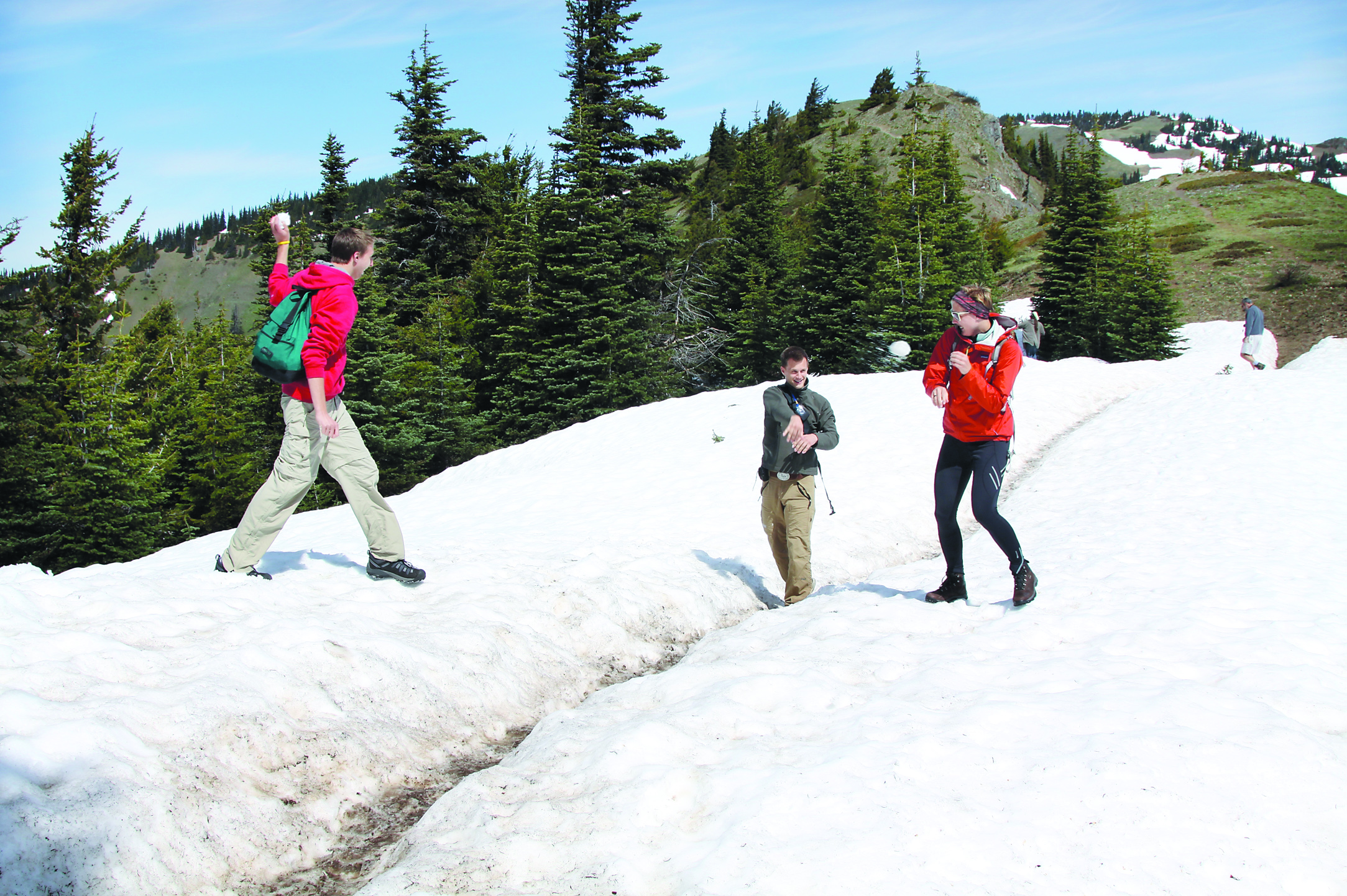
OLYMPIC NATIONAL PARK — Summer visitors to Hurricane Ridge expect the high mountain meadows to be bursting with lupines and other wildflowers, and to see fat herds of deer grazing among the flowers.
Instead, as of this weekend in June, the ridge around the visitor center and walking paths is either covered in snow or is nearly bare ground, with green shoots of grass and other summer flora just emerging from the newly thawed ground.
Visitors to the Ridge are more likely to have snowball fights with the icy, packed old snow than find a flower.
“The south-facing slopes are starting to clear off,” said U.S. Park Ranger Scott Kinghorn, a wilderness ranger at Olympic National Park.
Kinghorn said he expects the wildflower season to begin a few weeks late, in late July, but not as late as in 2011, when the wildflower season was delayed into August.
On Friday, the Northwest Weather and Avalanche Center measured 47 inches of snow at the official measurement station at Hurricane Ridge, up a twisty 17-mile road from Port Angeles.
However, that doesn’t mean the area is still ripe for skiing or even snowshoeing, with most of the snow existing in large, icy snowdrifts and patches interspersed with bare ground.
The Hurricane Ridge Ski and Snowboard Area officially closed for a shortened season the last Sunday in April.
The ski area hadn’t opened until mid-February because of a lack of snow.
Now, there is too much snow for the season.
Generally, the Ridge’s wildflowers, grasses and wildlife are at their summer height in late June, Kinghorn said.
But this year, many of the trails inside the park are still blocked by snow, forcing hikers to climb over the snow or find another route, he said.
Kinghorn said that Saturday morning, a group from Texas applied for a backcountry hiking permit and had to change plans after they learned the route they intended to take requires crampons and ice-climbing skills.
According to National Weather Service records, during the winter of 2011-2012, Hurricane Ridge had a measurement of 167 inches of snow — 123 percent of normal and just 3 inches short of the 2010-2011 official record of 170 inches.
The primary reason for the large snow totals was two consecutive years of La Niña ocean conditions, which typically result in higher-than-average snowfall in the mountains, said Johnny Burg, meteorologist for the National Weather Service.
In 1999, also a La Niña year, the Ridge had extreme snowfall —162 inches — from which the visitor center at Hurricane Ridge didn’t emerge until the first weeks of June.
Lingering effects of La Niña have caused temperatures to remain low late into spring and summer, and to delay snow melt, Burg said.
As of Friday, June temperatures were 2.5 degrees below normal, he said.
During the summer last year, the peak of mountain wildflower season was delayed to mid-August.
The late thaw is affecting camping and hiking throughout Olympic National Park.
The road to Deer Park Campground in the mountains southeast of Port Angeles is still closed, pending the spring thaw, but Three Forks Trail and Deer Park Trail, which are accessed via Deer Park Road, are snow-free, the park reported Saturday.
The park is reporting a number of trails that remain snow-covered or icy in late June.
Kinghorn said to be cautious of snow bridges, which can collapse under hikers.
The Hurricane Ridge to Switchback Trail is still 60 percent covered with as much as 4 feet of snow.
Hikers heading to the higher elevations of Upper Gray Wolf Trail are warned to expect “deep snow and lingering conditions.”
The Grand Valley and Grand Pass Trail still have as much as 4 feet of snow cover on 90 percent of the trail, and Obstruction Point Road remains closed due to snow.
The Obstruction Peak headwall — a headwall is the highest cliff — remains 100 percent snow-covered and dangerous.
The park requires hikers on this route to have self-arrest skills and use crampons and ice axes.
Badger Valley Trail and the Obstruction Point to Deer Park Trail route are affected by the Obstruction Peak headwall.
Cameron Pass Trail above 4,700 feet is 100 percent covered by snow, which is up to 6 feet deep.
Long Ridge and Dodger Point Primitive Trail, in the Elwha Valley area about 15 miles west of Port Angeles, are snow-covered above 3,400 feet.
Aurora Ridge and Aurora Creek trails, in the Lake Crescent area about 35 miles west of Port Angeles, are snow-covered above 4,000 feet.
________
Reporter Arwyn Rice can be reached at 360-452-2345, ext. 5070, or at arwyn.rice@peninsuladailynews.com.
