
PORT TOWNSEND — Phileas Fogg made it around the world in 80 days.
It took Jeanne Socrates about four times longer to travel the globe.
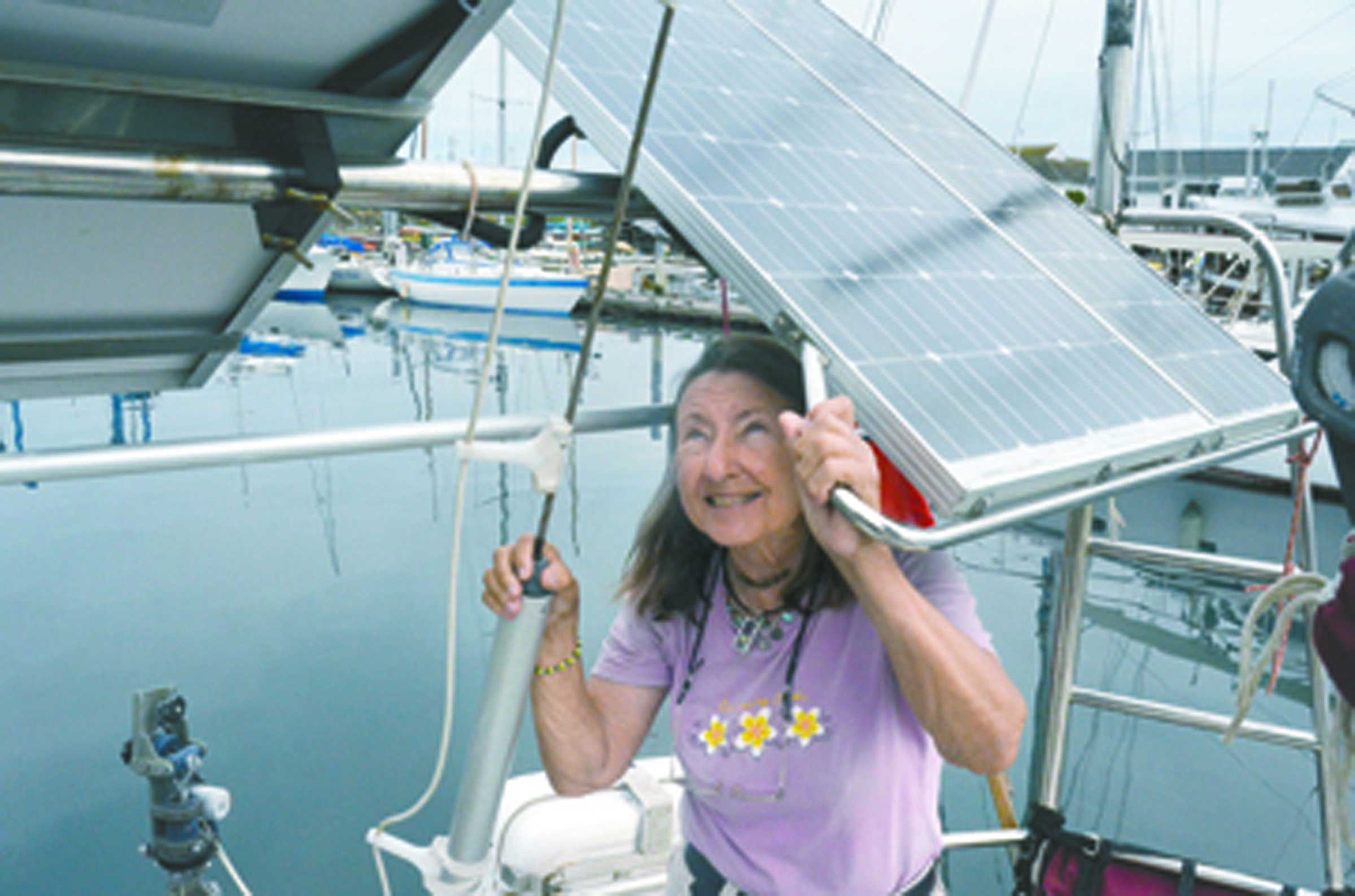
But Fogg, a figment of author Jules Verne’s imagination, traveled in a fictional hot-air balloon, while the very real Socrates, who arrived in Port Townsend last Sunday, sailed around the world in a solo journey on her 38-foot yacht, Nereida.
She didn’t set foot on land during the entire 326 days she journeyed south from Victoria, around Cape Horn in South America, across the Atlantic Ocean, around South Africa and across the Pacific Ocean back to Victoria.
Socrates, a grandmother, is also the oldest woman to succeed in a solo circumnavigation. She turned 70 on Aug. 17, 2012, when the voyage began.
She arrived in Victoria on July 8.
While in Port Townsend, she said, she is “continuing the mending, cleaning and organizing process” on her boat, which was overhauled in Victoria, pulling some possessions out of storage and seeing some old friends.
She plans to leave Wednesday for Orcas Island before setting sail for Mexico to spend the winter.
Socrates finished her round-the-world journey a good two months after she had planned.
“I expected to finish by the end of May, but the fates were laughing at me,” she said.
She was becalmed on several occasions.
“I was almost there, just outside the Strait of Juan de Fuca, but I couldn’t move until I got some wind.”
Others might have turned on the engine when the wind died, but Socrates had something to prove.
She was seeking recognition by the World Sailing Speed Record Council, which placed a clamp on the engine to make sure she never used a motor to get out of the tough spots, and she was not allowed to set foot on land, or it would invalidate the certification, which is pending following her successful journey.
An exception to use of the motor was made for safety reasons.
Socrates lost a life raft three days out and stopped outside San Francisco, but the raft was delivered on a buoy, so she did not set foot on land.
Aside from an occasional lack of wind, there were “loads of other problems, but nothing that I had to pull in for,” she said.
For instance, the instrument at the top of her mast failed and had to be replaced. Socrates climbed up the mast with a replacement but found she couldn’t quite reach the top.
So she had to climb down again and rig a system that allowed her to safely install the component.
As a result, she suffered blisters on her hands that took weeks to heal, she said.
Socrates, who is originally from West London, England, began sailing with her husband, George, after the couple retired in 1997.
After he died of cancer in 2003, Socrates — who had worked in England as a mathematician, teaching secondary school and college students — continued sailing on her own.
Her latest journey was Socrates’ third attempt at circumnavigation and her second try to do it without stopping at all.
In October 2010, after an abortive attempt in 2009, she set out from Victoria with the goal of a solo nonstop circumnavigation of the world, but the goal was shattered 100 miles west of Cape Town in South Africa when the boat was “knocked down” during a particularly virulent storm and had to be repaired.
The repairs on the boat cost 15,000 British pounds, or about $23,000. The cost was covered by insurance, but the stay of several months in Cape Town put the kibosh on the “nonstop” part of what in the end was a successful journey.
While Socrates is in the area, she is meeting new friends as well as old.
One new friend is Bill Morris, a retiree from Shelton who followed Socrates on her blog at www.svnereida.com.
Morris said his wife’s knitting group, which meets at a Shelton tavern, read the blog every day and was disappointed when Socrates landed and the blog ended.
Morris, who had not met Socrates personally before Wednesday when he recognized her boat, said the blog inspired his neighbor, a teenager adrift, to take up sailing.
“I feel like I’m achieving something when I hear stories like that,” Socrates said.
Although Socrates didn’t actually see or touch a human being during her voyage, she said she didn’t feel isolated.
She communicated through email, her blog and through radio, which allowed her to chat with people along the way.
“I didn’t get to see people but was talking to people as I went by where they were,” Socrates said.
“It was very good for me, and it didn’t seem to me that I had been eight months away from people,” she said.
“I didn’t have anyone to touch, but there were a lot of people who were with me in spirit, which was a great feeling.”
Socrates said she was never bored or even idle, even though on this trip, “I did get the time to read a few books.
“I was busy all the time. I was always on the radio getting information about the weather, and when the sea was rough, it did take some time to get from one side of the cabin to another because I had to hold on,” she said.
She spent about an hour each day on her blog, but that became less effective at Christmas, when her satellite phone failed right after she was able to share holiday wishes with her two children.
This failure also made it impossible for her to send photographs to be posted on the blog, even though she was able to send and receive email using a modem and the radio.
Socrates is using her blog to raise awareness and funds for Marie Curie Cancer Care, a British program that provides free home nursing for terminally ill cancer patients.
For more information or details about Socrates’ voyage, visit www.svnereida.com.
________
Jefferson County Editor Charlie Bermant can be reached at 360-385-2335 or cbermant@peninsuladailynews.com.
