
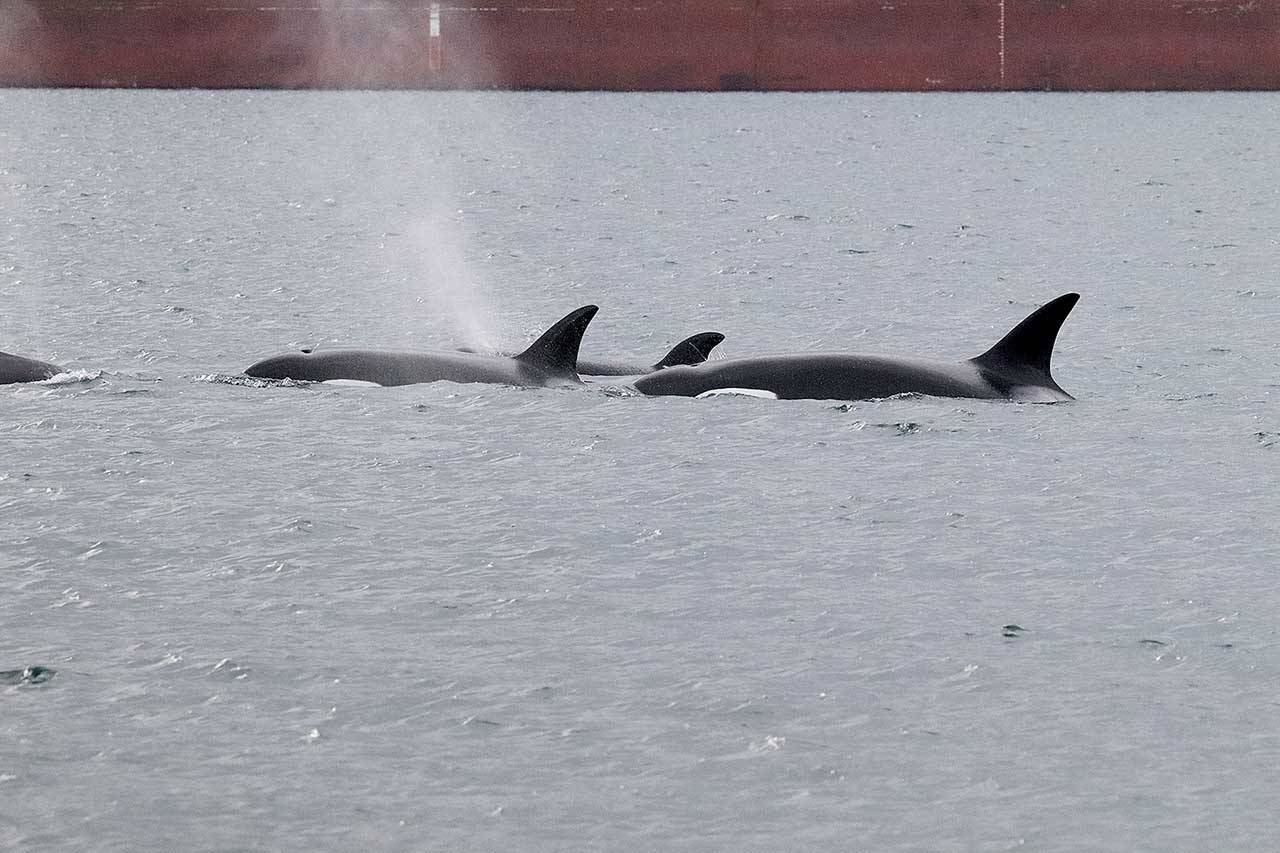
PORT TOWNSEND — Heightened industry regulations set to take effect in the commercial whale watching sector in 2021 to protect Southern Resident orca whales ignore the role tour operators play in conservation, fail to regulate the main producers of marine noise and do nothing to increase salmon production for endangered whales, tour operators said.
According to rules approved by the state Fish and Wildlife Commission earlier this month, commercial whale-watching companies can view Southern Resident orcas during two-hour periods from 10 a.m. to noon and 3 p.m. to 5 p.m. daily from July through September.
The rules restrict the number of commercial vessels to three within a half-mile of a group of whales and include penalties for violations.
- Related

New rules for watching endangered orcas to take effect in 2021Dec 29, 2020
Tours for non-resident orcas, also called transient Biggs Orcas, and for filter-feeding baleen whales, such as humpback, gray and minke whales, are not impacted by the new regulations.
Pete Hanke, operator of whale-watching firm Puget Sound Express out of Port Townsend and Edmonds, said the presence of whale-watching boats guides commercial shipping, recreational and military marine traffic near the Southern Residents.
“It has an effect,” Hanke said during a Senate committee meeting earlier this month. “It slows boats down. It causes boats to divert. They know that something’s happening in the water when they see a whale-watch boat there.
“And to come up with the idea that, by just allowing the whales to swim around the Salish Sea, what they are actually going to do is allow other boaters — inadvertently, for the most part — to run right over the top of these killer whales.”
The Friday Harbor-based Pacific Whale Watch Association tracked the “sentinel actions” of commercial whale-watching tours from July through September this year, logging 293 incidents such as hailing vessels and notifying law enforcement on radio, flagging down boats or, if need be, blocking a speeding vessel from potentially striking whales.
The new rules would have eliminated 71 percent of the sentinel actions performed by tour boats in that timeframe, the association estimates.
Washington already had some of the stiffest whale watching regulations in the world before the new rules, with Gov. Jay Inslee’s Southern Resident Killer Whale Task Force set up in March 2018 to identify ways to protect the population of the orcas, down to 74 at last count.
“Because of the task force and wanting to do something about the whales, they moved us back to 300 yards, about three football fields or the length of an aircraft carrier away,” Hanke said.
Hanke and Island Adventures, an Anacortes-based whale-watching company that provides tours out of Port Angeles, each cited a Port of Vancouver (B.C.) study that attributes 0.6 percent of marine vessel noise to whale-watching boats.
“If we are going to try and quiet the world down for the Southern Residents, they didn’t really do anything to regulate other sound-producing vessels [such as] private boaters, freighters, commercial fishing boats, the ferries or military,” Hanke said.
Hanke also brought up the lack of controls placed on research boats studying the endangered whale population.
Island Adventures lead naturalist Erin Gless cited research by the boater education group Sound Watch that found 71 percent of recreational vessels in the state are not aware of whale-watching regulations regarding distance or speed near whales.
“Whale-watching boats help mark locations and model behaviors for other vessels,” Gless said.
“Other boats can see that we are going slowly, and that quiets the environment. And if they are not there to follow the rules and provide that modeling, it can make for a much more crowded, louder environment.”
Gless called the focus on whale-watching trips “frustrating.”
“In my heart, I believe it’s really hard for the state to go after ferry or fishing or military traffic, and it’s easier for them to regulate the 20 or so Washington whale-watching boats,” Gless said.
She brought up one of the main task force recommendations to protect the Southern Residents, increasing the abundance of chinook, the endangered whales’ preferred prey.
“It might kind of quiet the clamor to protect the whales, but it doesn’t really doing anything for fish,” Gless said. “And when you think of the successes those other whales like the Biggs’ Orcas have had with 100 babies born in the last eight years, or the rise in humpback numbers, those whales are all exposed to the same exact habitat, conditions and marine traffic.”
Hanke said the larger problem remains a lack of chinook.
“It’s about fish, it’s about salmon, and it’s like setting the table for nice dinner party, getting the fancy silver out, but nobody has cooked anything,” Hanke said of increasing salmon production.
Financially, Gless said Port Angeles-based tours are usually for humpback whales, so she didn’t expect much of a disruption in terms of scheduling.
Hanke said the potential economic impact of the new rules is difficult to quantify.
“This time of year we have a lot more occurrences of SRKWs coming into the [Puget] Sound, so it’s more likely we will see them in the fourth quarter of the year, October through December,” Hanke said.
“And there is that question that if we can’t see them in the fourth quarter, is it financially feasible to continue to make trips during those periods? The grays and humpbacks aren’t around. We don’t see a lot of transient orcas either.
“I think it will have a bigger impact on the smaller operators up in the San Juans,” he continued. “They will be precluded from seeing them on tours. And, in the future, I believe companies will need a faster platform to find different whales, to find humpbacks off Port Angeles or grays and go and see them.”
________
Sports reporter Michael Carman can be contacted at 360-406-0674 or mcarman@peninsuladailynews.com.