
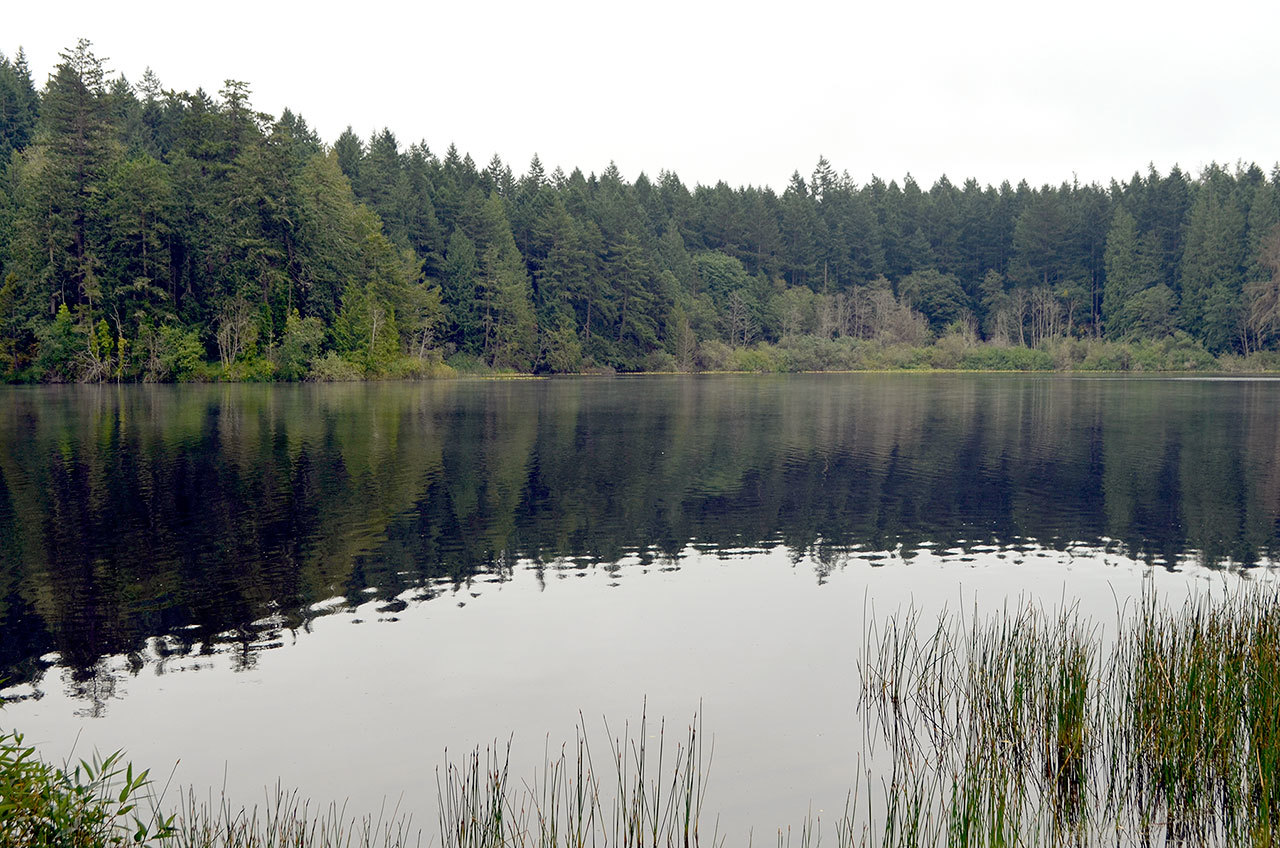
PORT TOWNSEND — Anderson Lake is open for fishing.
The state Department of Fish &Wildlife has extended the fishing season at the lake between Port Townsend and Chimacum to year-round.
On Monday, it stocked the lake with trout large enough to be catchable, said Michael Dawson, lead environmental health specialist for the Jefferson County Water Quality Program, and toxins are down.
The year-round season is to allow recreational use during the winter months when toxins from blue-green algae are less likely to contaminate the water, Dawson said.
The lake in the 410-acre Anderson Lake State Park has been plagued with intermittently high levels of dangerous toxins from blue-green algae since two dogs died after drinking the water on Memorial Day weekend in 2006.
Testing for toxins began in 2007, and the levels — and subsequent closures and reopenings — have yo-yoed each fishing season, which until now was from late April to the end of October.
In 2008, the lake had the dubious distinction of containing the highest level of anatoxin-a, a potentially lethal nerve toxin, ever recorded in the world: 172,640 micrograms per liter.
This year, the bloom on Anderson Lake lasted from April to November, the longest since monitoring by Jefferson County Public Health began in 2007.
But testing was extended for one month more than usual, and the latest tests — from samples taken Nov. 7 — show that, although toxins have been detected in the lake water, both anatoxin-a, a potent nerve toxin that can kill within minutes, and microcystin, which can cause liver damage if consumed over a long period of time, are below recreational limits.
Both toxins were found in concentration of 0.2 micrograms per liter, Dawnson said. The guideline for anatoxin-a is 1 microgram per liter. For microcystin, the threshold is 6 micrograms per liter.
That led Washington State Parks to reopen the lake for recreational use, including fishing — but with caution signs.
Anderson Lake State Park is now closed for the season, so access to the lake is by foot only, with limited parking near the entrance.
However, from now until testing resumes in April, people who use the lake will do so at their own risk.
“We don’t have a monitoring program in the winter,” Dawson said. “We don’t have enough funding to be able to do that.
“So people will have to use common sense and avoid areas of scum if they see it developing on the lake.”
Algae blooms can develop, even in winter, he said.
If a bloom of algae forms, the lake will probably be closed by State Parks, Dawson said.
“The fishing season is contingent on there not being a toxic bloom,” he said.
Not all blooms are toxic, however. Blue-green algae is a natural occurrence and is usually benign. At times, especially during warm weather, it can begin to produce toxins. Researchers still don’t know why.
Toxins can be present only after an initial bloom, Dawson has said; however, a bloom can die off and leave a poisoned lake. Only testing can determine the status of the lake water.
Dawson said the county would visually monitor the lake, especially if informed that a bloom has developed.
“We don’t know what to expect because we haven’t done a year-round season at the lake before,” he said.
“We’re in uncharted territory,” he said. “At this time of year, conditions typically improve, but without us looking at it, we can’t be sure. So we want to make sure people pay attention to the caution signs” and the guidelines listed on them.”
The guidelines are:
• Avoid contact with areas of scum, or water that is green in color. Keep children and pets out of the water.
• Clean fish well and discard the guts. Some algae toxins are known to accumulate in fish tissue.
Blue-green algae has not been spotted in Clallam County, where routine tests are not done.
Report algae blooms in Clallam County by phoning 360-417-2258, while Jefferson County blooms can be reported at 360-385-9444.
For more information about Jefferson County lakes, visit http://tinyurl.com/jeffersonlakequality or phone the office.
________
Executive Editor Leah Leach can be reached at 360-417-3530 or at lleach@peninsuladailynews.com.
