
CHIMACUM — Anglers turned out in droves Saturday morning for the opening of the trout-fishing season at Anderson Lake following last year’s season, when high levels of toxins produced by blue-green algae denied them most opportunities.
Those arriving early at the popular site in Anderson Lake State Park near Chimacum made their limits, volunteer Cheri Scalf said.
“The success rate is high in terms of the fish caught, but [the fish] aren’t as big as last year,” Scalf said.
Most of the rainbow trout fell into the 9- inch to 12-inch-long range, but by 10 a.m., several people had caught trout as long as 18 inches.
Scalf said the number of trout caught would be tallied after the weekend.
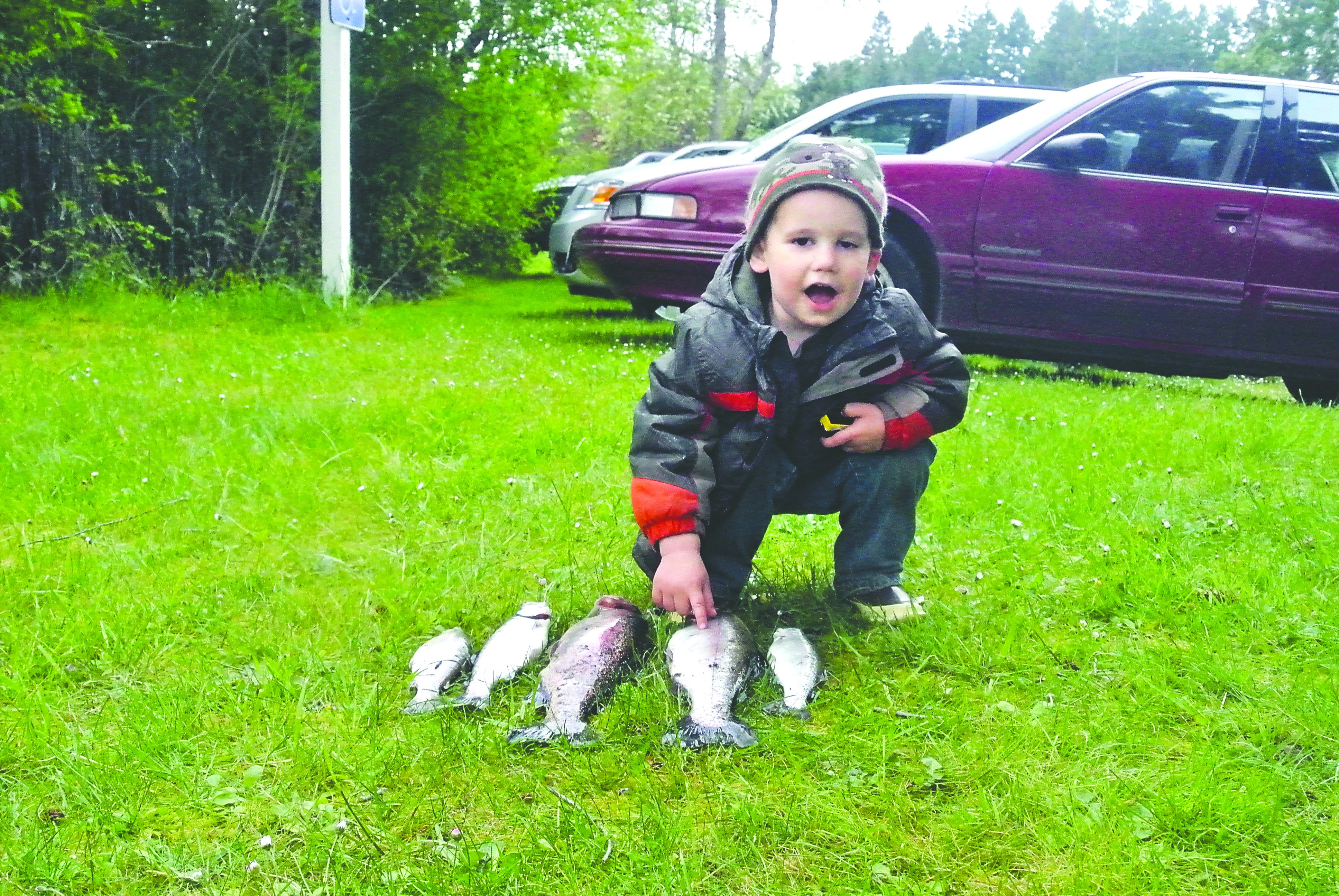
As of 10 a.m. Saturday, the second-largest trout had been caught by 2-year-old Eli Rivera of Port Ludlow.
“We got him a little fishing pole for his birthday last year and told him we’d take him fishing at the next opportunity,” said Carolyn Eyl, Eli’s grandmother.
As of 10 a.m. opening day, State Parks Ranger Aaron Terada reported 33 boats, 25 shore anglers and 60 cars total.
Many anglers left as soon as they caught their five-fish limit, Terada said.
Terada said that though reports of past toxins in the lake may have kept some anglers away, no one had expressed apprehension to him about eating trout that was caught Saturday.
Anderson Lake is a popular fishing lake that has been plagued with high levels of blue-green-algae-produced toxins since 2006, when two dogs died after drinking water from the lake on Memorial Day weekend.
Since then, the lake, a favorite for trout fishing, has been closed periodically to recreation and fishing during the warmest times of the year because of elevated levels of anatoxin-a, a nerve toxin that can kill in four minutes after ingestion, and microcystin, a slower-acting poison that can cause skin irritation if touched and liver damage if swallowed.
In 2012, the lake was open only a few days of the year because of elevated levels of toxins.
It created a world record for the highest level of anatoxin-a in 2008.
The toxins are created by blue-green algae, which is usually benign.
Researchers don’t know why some types of algae will suddenly begin producing toxins.
They know only that warmer weather and longer days tend to fuel the growth of blue-green algae when the lake contains enough nutrients, such as phosphorus.
In the past, the county has tested weekly for toxins beginning two weeks before the final Saturday in April — the fishing season opener — and continuing through September or October.
The state Department of Ecology paid for the tests, which cost $200-$300 each, but this year, as a cost-cutting measure, Ecology officials decided to test lake samples only when an algae bloom is present.
County health officials also will monitor Anderson, Gibbs and Leland lakes for toxic blue-green algae on a monthly basis.
Whether or not the lake is open, the park surrounding it is available for recreation throughout the summer.
Visitors usually need a Discover Pass — either $10 for a day or $30 for a year — to park within Anderson Lake State Park, but this weekend is a free period, and no Discover Pass is required for visitors to state parks.
Passes can be bought at any state park, where hunting or fishing licenses are sold, by phoning 866-320-9933 or by visiting www.discoverpass.wa.gov.
Toxin-producing blue-green algae has not been spotted in Clallam County.
Report algae blooms in Clallam County by phoning 360-417-2258, while Jefferson County blooms can be reported at 360-385-9444.
________
Jefferson County Editor Charlie Bermant can be reached at 360-385-2335 or at cbermant@peninsuladailynews.com.
