
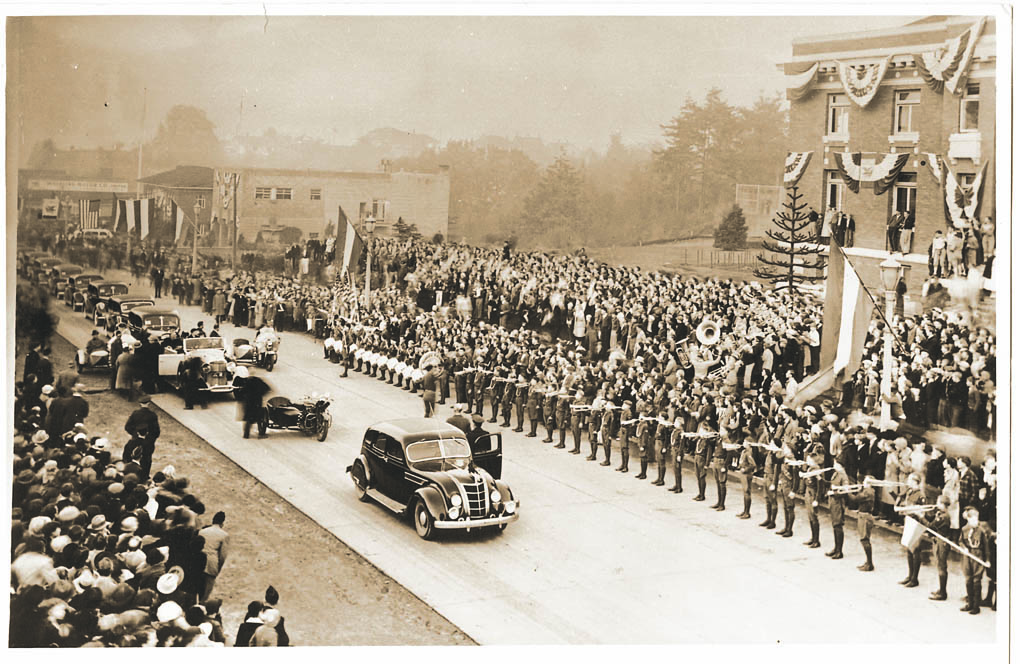
PORT ANGELES — Excitement radiated throughout Port Angeles as plans were formulated for the presidential visit.
North Olympic Peninsula residents, isolated from metropolitan areas, did not often get to see celebrities in those days. Many people didn’t even have cars and never left the Olympic Peninsula.
Franklin Delano Roosevelt’s presidential party arrived in Port Angeles shortly after 5 p.m. Thursday, Sept. 30, 1937, aboard the Navy destroyer USS Phelps, coming from Victoria.
The ship docked where the Port Angeles Boat Haven is now located.
The motorcade left Marine Drive with the president riding in a big yellow Seattle police car.
Port Angeles City Patrolman L.W. “Nick” Carder led the way for the president’s car.
Mayor Ralph Davis rode with the president through downtown to the Clallam County Courthouse.
Area schools had been dismissed early. Buses brought rural students into town to see the president.
An estimated 3,000 schoolchildren were assembled on the courthouse lawn awaiting the motorcade.
It carried President Roosevelt, his son James, daughter Anna and their families, and Cabinet and staff members.
Just as the president’s car came in sight, the courthouse clock tolled 6 p.m.
Stormy weather had delayed his arrival, so the crowd of 5,000 to 7,000 people had waited for several hours.
That did not dampen the excitement, recalled Ron Bayton, a member of the Roosevelt (Port Angeles) High School band, whose members lined Lincoln Street to play the national anthem.
Maxine Jeffrey, the mayor’s secretary, said she and rest of the city staff went out on the corner to watch FDR go by.
FDR winked at her, she recalled.
Mary Lou Hanify, a Clallam County writer who was there, recalled the momentous day in the book Sturdy Folk, authored by Mavis Amundsen.
“As the ship could be seen rounding Ediz Hook, a 21-gun salute was fired from the Coast Guard cutter Samuel D. Ingham, which was stationed in Port Angeles at that time.
“A banner hung across the courthouse building read: ‘Mr. President, we children need your help. Give us our Olympic National Park.’”
Hanify recalled President Roosevelt saying:
“Mr. Mayor and my friends of Port Angeles: That sign is the appealingest appeal I have ever seen in my travels.
“I am inclined to think it counts more to have the children want that park than all the rest of us put together.
“So, you boys and girls, I think you can count on my help in getting that national park, not only because we need it for us old people and you young people, but for a whole lot of young people who are going to come along in the next hundred years of America.”
Indeed, those impromptu remarks and that presidential visit are remembered by those children to this day.
Joan and Beverly McNally recalled being very excited at being bused from Crescent School in Joyce into Port Angeles to sit on the elevated courthouse lawn. Joan was in the second grade, and her sister was in the seventh.
Muriel Lane, then a high school sophomore who recently had moved to Port Angeles, was sitting on the south-side of the courthouse lawn, which faced Sandison’s Bakery across the street.
At the time, she had no idea she would one day marry into the Sandison family.
Bertha Norris, a student at Jefferson Elementary School, said she was too young to really appreciate the significance of the visit — but knew it was something very special: Her brother-in-law, Basil Decker, was in the motorcycle escort that led the procession west to Lake Crescent.
People lined the streets as the motorcade moved up Lincoln Street to Lauridsen Boulevard and onto the Olympic Highway, bearing the newly designated route numbers Primary State Highway 9 and U.S. Highway 101, toward Lake Crescent.
Beverly Morris Davidson and her brother, David, waved small flags from their home on Boulevard, the familiar name for Lauridsen.
Barbara MacNamarra and her sister, Phrania, watched from an embankment along Highway 101 near Herrick Road.
After the presidential party arrived at Lake Crescent Tavern, everyone went to their rooms to freshen up, then met back at the inn’s large dining room.
They were served a fantastic Washington state meal of Dungeness crab, Puget Sound turkey, prime rib from Washington beef and Grays Harbor cranberry sherbet with Olympic blueberry or wild blackberry pie.
The president remained in his wheelchair-accessible cabin (due to his little-publicized disability), where staff brought him a bowl of soup.
The cabin was decorated with miniature red pompon dahlias from Helen Radke’s garden on the Lake Crescent north shore.
FDR held court in his cabin that evening, visited by local spokesmen and state and congressional dignitaries who came one-by-one to persuade him to create the national park.
The weather next morning was overcast, and FDR’s advisers decided to wait until the sun came out to depart.
Breakfast was Beardsley trout, caught by three young boys who were given special permission to fish Barnes Creek at Lake Crescent.
One of those boys was Willis Welsh, son of Port Angeles Evening News Managing Editor William D. Welsh and his wife, Florence.
Some people said the breakfast was at the nearby Rosemary Inn.
Eleanor Tschemperle, age 18, was at her family’s home near Lake Crescent Tavern.
That day, she met Interior Secretary Harold Ickes and his wife coming back from a hike down the Marymere Falls trail.
The presidential party continued west along the Olympic Highway and met along the way with special events — including a tree-topping exhibition by a young Forks logger, Fred Wilson, at LaPush Road.
Schoolchildren lined the streets of Forks and Hoquiam as the motorcade proceeded on the highway loop toward Olympia.
Dick Davidson recalled being bused from Beaver School into Forks, where he joined other waiting students.
Several people who are still living remember being in the courthouse crowd or waiting along the route to see President Roosevelt.
Soon after Congress reconvened in 1938, it passed the long-attempted national park bill authored by U.S. Rep. Mon C. Wallgren, D-Everett, whose district included the North Olympic Peninsula.
President Roosevelt signed it into law. Olympic National Park was a reality.
The events 75 years ago beg the question:
If a president were to visit Port Angeles today, would the visit generate as much excitement and fanfare as FDR’s presidential trip of 1937?
Alice Alexander is a Clallam County historian, author, descendent of an Elwha Valley pioneer family and member of the Clallam County Heritage Advisory Board. Her Clallam history column now appears the first Sunday of every month in Peninsula Profile. She can be reached at bretches1942@gmail.com.
