
By The Associated Press
TWISP, Okanogan County — The latest on the wildfires in north-central Washington:
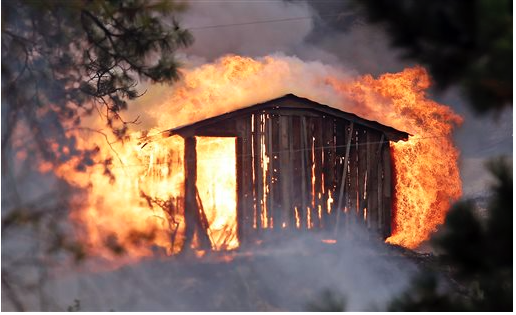
FIRE OFFICIALS HOPE lighter winds today (Saturday) will allow them to get a better handle on severe wildfires that left three firefighters dead and have been so chaotic that crews haven’t been able to estimate how many homes have been destroyed.
Thousands of people in towns across north-central Washington state remained under evacuation orders as winds up to 35 mph blew flames across parched ground on Thursday and Friday.
Winds are predicted to stay at 8 to 12 mph today, but temperatures this weekend are nevertheless expected to be hot.
Resources are so strained that fire officials planned to provide basic fire training today to about 200 volunteers with machinery like backhoes and bulldozers so they can use them to help dig fire lines.
The complex of fires grew more than 100 square miles in a single day. Power outages affected several areas, making it more difficult to notify residents about evacuation orders, and the overall situation was too chaotic to even track how many homes had burned — though officials hoped to make progress of that front Saturday.
Emergency officials ordered evacuations in Okanogan, with 2,500 residents, as well as Tonasket, a community of 1,000 people, and its surrounding area. Officials also began a Spanish-language effort, on social media as well as in printed fliers, to get fire information to immigrant orchard workers.
Not everyone who was told to leave was willing to go.
“I’ve been up for like 40 hours, and I was very nervous, very concerned because (the fire) was going to take everything we have, us and the rest of our friends,” said Al Dodson, who stayed home despite evacuation orders in Twisp, 40 miles west of Okanogan.
Nearly 29,000 firefighters — 3,000 of them in Washington — are battling some 100 large blazes across the drought-and heat-stricken West, including Idaho, Oregon, Montana and California. Thirteen people have died.
There are more firefighters on the ground this season than ever before, and the U.S. government is spending more than $150 million a week on fire suppression, U.S. Agriculture Secretary Tom Vilsack said.
—————————-
MORE DETAILS ARE emerging about the incident in which three firefighters died while battling huge wildfires in north-central Washington.
Okanogan County Sheriff Frank Rogers said Friday a group of firefighters tried to escape the flames in two vehicles and on foot.
One vehicle made it out of danger Wednesday, but the other vehicle crashed and was overrun by flames. That’s the vehicle in which the three firefighters died. Rogers said the four firefighters who were injured, one critically, were among those who had to escape on foot.
Rogers said it is not clear when the county coroner will release the cause of death of the three firefighters.
The Okanogan Complex consists of five wildfires that are burning within what is Washington’s largest county in size. The fires are threatening more than 5,100 homes.
___
OUT-OF-CONTROL blazes in north-central Washington have destroyed buildings, but the situation is so chaotic that authorities have “no idea” how many homes may have been lost.
Okanogan County Sheriff Frank Rogers said Friday that “we have lost them, but I don’t know how many.”
The complex of fires that killed three firefighters earlier this week has blown up, growing more than 100 square miles in a day to 252 square miles.
A National Weather Service warning of extreme fire danger was set to expire at 5 p.m. Friday, which may bring some relief to firefighters.
Despite the growth, mandatory evacuations for the small towns of Twisp and Tonasket have been reduced. Residents of those towns can return to their homes but were warned to be ready to evacuate at a moment’s notice.
—————–
PRESIDENT OBAMA HAS has signed an emergency declaration authorizing federal help for the massive wildfires burning out of control in Washington state.
Obama on Friday declared an emergency and authorized the Department of Homeland Security and Federal Emergency Management Agency to coordinate disaster relief efforts.
The order covers 11 counties in central and eastern Washington as well as the Confederated Tribes of the Colville Reservation, the Kalispel Tribe of Indians, the Spokane Tribe of Indians, and the Confederated Tribes and Bands of the Yakima Nation.
___
THE MASSIVE COMPLEX Of blazes that killed three firefighters in north-central Washington state has grown by more than 100 square miles in a day.
Fire spokesman Rick Isaacson said early Friday that the wildfires have grown to just over 252 square miles since Thursday morning. He says they are largely burning uncontrolled as flames keep jumping fire lines.
Isaacson says officials don’t know how many homes or other buildings have been destroyed. They have ordered the partial evacuation of the town of Okanogan, which has 2,500 residents. Isaacson says even the fire base camp in Okanogan has been told to be prepared to evacuate.
Those evacuations are on top of previous orders to evacuate the towns of Twisp, Winthrop and Tonasket.
The multitude of large wildfires have so overtaxed firefighters that officials took the unprecedented step of calling for volunteers to help fight the flames.
“Coordinators will review citizens’ offers for resources and direct them to where they can be most beneficial,” the state Department of Natural Resources said. Volunteers could start applying Friday at centers in the communities of Omak and Colville.
It is the first time the state has asked for volunteers as an explosive fire season. It comes even after fire managers from Australia and New Zealand were recruited to help combat blazes in the West.
There were 820 firefighters fighting the blazes Friday, two days after flames overran firefighters, killing three and injuring four.
—————
U.S. SEN MARIA Cantwell, D-Wash., is warning of the danger civilian hobby drones have on firefighting efforts.
Already in 2015, the U.S. Forest Service and Department of Interior have had to ground firefighting aircraft 13 times because of drone activity near wildfires.
Cantwell plans to hold a press conference on Friday in Spokane to discuss drone dangers and to call on federal agencies to work closely together to protect air crews and firefighters from interference from drones.
She says a drone colliding with a windshield, engine or flight controls of a firefighting aircraft could be catastrophic.
————
WITH WILDFIRES STRAINING resources, Washington officials say that for the first time in state history they’re coordinating help from residents who have and can operate equipment like backhoes and bulldozers to dig fire lines.
The Department of Natural Resources says its command posts have been inundated with offers.
Public Lands Commissioner Peter Goldmark says his agency appreciates the support, but he wants the fire officers on scene to be able to stay focused on actually fighting fires.
Instead, the agency has set up coordination centers in Omak and Colville, where equipment operators can get training in how to deploy emergency shelters and other basics.
Some 80 equipment operators earned their certification at a training session in Colville earlier this month.
DNR says the centers will direct the citizens to where they can be useful without jeopardizing safety.
Deployment to a wildfire will depend on the availability of professional firefighting staff to escort and direct the volunteers.
The call for volunteers comes in addition to fire managers from Australia and New Zealand being recruited to help combat blazes in the West.
Contact information
Omak: Jay Guthrie
Omak City Hall, 2 Ash St. N
Phone 360-826-2546
email: CRC.Omak@gmail.com
AND
Colville: Julie Sacket
Washington State Department of Transportation
Second Floor, 440 N Hwy 395
Phone 509-675-7847
email: CRC.Colville@gmail.com
Each station will be staffed during posted hours with DNR coordinators who will sign up volunteers and contractors, determine where their assistance will be of most help, and arrange training in wildfire safety, where appropriate.
Phone messages and emails can be submitted and will be reviewed during hours the coordination centers are not staffed.
To expedite the processing service, potential volunteers should contact DNR coordinators at the above phone numbers or email addresses in advance with their desired role, existing fire qualifications, location, and contact information.
