
By Jonel Aleccia The Seattle Times
SEATTLE — When babies in poor countries can’t breast-feed, the results can be deadly, but a trio of Seattle researchers has found an innovative way to help.
Experts at the University of Washington, Seattle Children’s and the nonprofit global health organization Program for Appropriate Technology in Health have spent the past five years developing a small, spouted feeding cup aimed at preventing millions of high-risk infants in the developing world from starving.
“We had this idea and we’ve been waiting for this opportunity,” said Patricia Coffey, an expert in neonatal health technologies at PATH.
Inventors of the NIFTY cup announced at the Women Deliver conference in Copenhagen that they will collaborate with Laerdal Global Health, a nonprofit manufacturer, to put the cups in the hands of hospital workers in Africa by later this year.
“We are quite excited about this partnership,” said Tore Laerdal, the firm’s managing director, who estimated the cups will sell for about $1 apiece.
The partnership is the next step in what’s expected to be widespread use of the NIFTY cup — formally known as the Neonatal Intuitive Feeding Technology — a soft, silicone bowl with a tiny reservoir and spout aimed at helping premature infants and those born with problems such as cleft palate.
“A normal newborn has the developmental skills to suck, swallow and breathe in a coordinated manner,” said Dr. Christy McKinney, an acting assistant professor at the University of Washington’s School of Dentistry.
“A preterm infant developmentally doesn’t have all those pieces in place.”
About 7.6 million preterm babies born in Africa and Asia each year have trouble feeding, PATH experts said.
Babies with cleft palates can’t generate suction because of the disorder and often have trouble using bottles, too.
Families and health care workers in low-income countries typically try to feed such babies using whatever is available — coffee cups, medicine cups, even clean urine-collection cups — with disappointing results.
“Babies often cough or choke on the milk or aspirate,” said McKinney.
“Spillage is a huge issue. Most cups spill about a third of the breast milk.”
With such tiny infants, losing even 2 teaspoons of milk per feeding can make the difference between adequate nutrition and starvation, the experts said.
In contrast, the NIFTY cup’s spout is designed to allow a mother to express breast milk directly into the bowl and then fit it to a baby’s mouth.
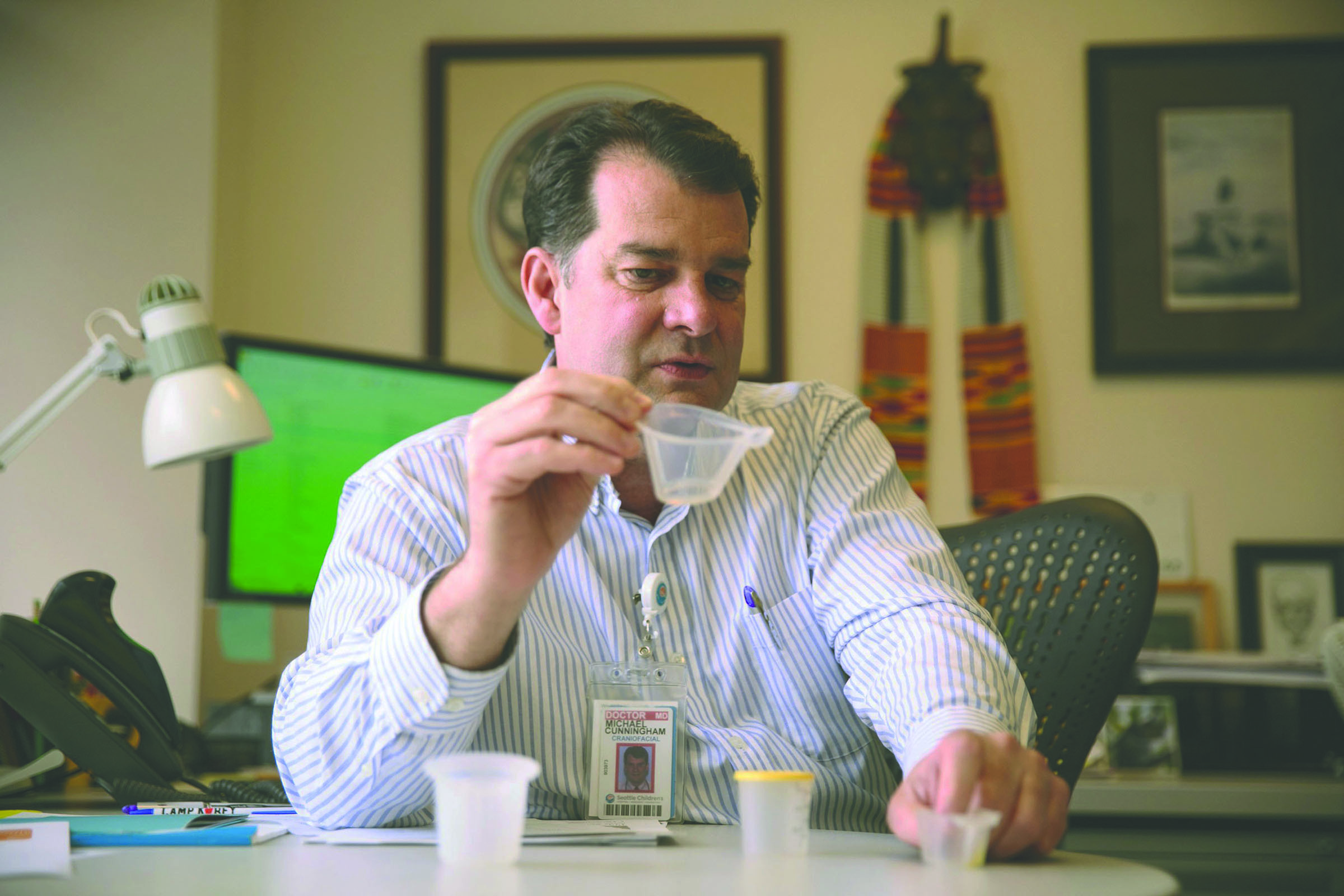
The cup’s reservoir and spout allow the infant to control the pace of the feeding, suckling almost normally, said Dr. Michael Cunningham, director of the craniofacial center at Seattle Children’s.
“The cup was designed for what babies do,” he said.
Cunningham had the idea for the NIFTY cup back in 2007, during a trip to Ghana with Partners in African Cleft Training, a program that educates African surgeons and other health care providers to treat the disorder.
Malnutrition
Cunningham said he was shocked to see newborns with cleft palates suffering from malnutrition because they couldn’t eat.
“I could not believe it,” he recalled. “I saw two babies die of starvation.”
Oro-facial cleft is the most common craniofacial birth defect in humans, occurring in 1.2 of every 1,000 live births worldwide.
When he returned to Seattle, Cunningham met with McKinney, a former Peace Corps volunteer whose doctoral thesis focused on craniofacial problems. The two approached PATH with the idea and Coffey joined in.
Other feeding cups have been developed, including the Foley Cup Feeder, a small plastic cup with a spout created by a Michigan father.
Cunningham took hundreds of the Foley cups back to Africa on a subsequent visit, where they were snapped up by health providers and parents.
“You handed it to the mother and she knew what to do,” he said.
The NIFTY cup is an improvement, Cunningham said. It’s bigger, 40 milliliters, and made of silicone, a material durable enough to be boiled and sterilized in an autoclave over and over.
The Seattle-designed cup has been tested in a pilot study in India, where 20 babies were successfully fed.
A large clinical trial is pending in Ethiopia, but the inventors are quick to acknowledge there’s been no formal evaluation of the cup’s use.
That’s fine with Cunningham, especially when there are so few alternatives to keeping babies from starving.
“It doesn’t take much to know something works,” he said. “We know it works.”
