
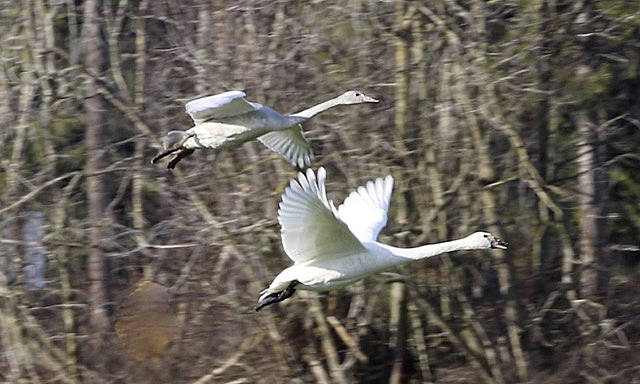
SEQUIM — Twenty-four volunteers are working to monitor the Sequim trumpeter swan population, which has increased to as many as 200 birds from the four that were counted in 1982, according to the Olympic Peninsula Audubon Society.
Volunteers with the Olympic Peninsula Audubon Society (OPAS) study the swans weekly each winter in a community science project and report swans’ daytime foraging areas, injuries and deaths to regional and national monitoring programs, said Judith White, OPAS president.
Their efforts are mirrored in groups across the nation, with encouraging results.
“The population of swans is increasing throughout the country,” White said.
Through giving the swans protected status, conserving habitat and, in some areas, reintroduction, “people are working very hard to increase the swan population,” she said.
“It’s a big success story for conservation.”
An update on the OPAS trumpeter and tundra swan study will be presented from 7 p.m. to 8:30 p.m. Feb. 19 during the OPAS membership meeting at the Dungeness River Audubon Center, 2151 Hendrickson Road.
The meeting is open to the public.
Historically abundant, trumpeter swans — the largest native North American waterfowl — were hunted for feathers and skins until 1935. By then the known U.S. population numbered only 69 swans.
Since then, the national census has increased to an estimated 63,000 individuals in the latest count, according to the Trumpeter Swan Society.
The numbers are expected to have risen when another wide-ranging count is conducted next year, White said.
The Pacific Coast population of 24,200 breeds in Alaska and winters on the Pacific Coast, arriving on the North Olympic Peninsula around Thanksgiving and staying through March.
Although the Sequim Dungeness Christmas Bird Count started in 1975, the first trumpeter swan sighting on the count wasn’t until 1982, when four swans were found.
They have been recorded every year since 1989, White said.
The count topped 50 swans in 2008, and passed 100 in 2016.
Since the winter of 2011-12 — when lead poisoning mortality sparked the effort — OPAS has worked with the state Department of Fish and Wildlife and presently, the Northwest Swan Conservation Association, to conduct a swan survey in the Sequim-Dungeness area.
The trained volunteers count trumpeters and watch for their smaller relatives, the tundra swans, surveying from Three Crabs south to Happy Valley and from Port Williams to Agnew.
The biggest hazard to the swans now is collision with live power lines, OPAS says on its website at olympicpeninsula audubon.org.
Volunteers identified the power lines directly in the swans’ flight paths — primarily through finding dead swans under the lines, White said.
Clallam County Public Utility District installed reflective power line bird diverters “which has mitigated the issues in most cases,” according to the OPAS website.
The swans generally travel in family groups.
Larger flocks forage in agricultural fields, pasture and wetlands around Sequim.
Trumpeter swans live about 25-30 years and have single broods. Sexual maturity takes several years, so population growth takes time, White said.
The young remain with their parents in family groups until forming monogamous pair bonds of their own, usually at 3 or 4 years old. Males may not re-mate after losing their partner.
Swans are most vulnerable as cygnets.
Adult swans have few predators and suffer mainly from collisions with power lines, and lead poisoning from ingesting lead birdshot, White said, although some populations remain at risk from poor quality breeding habitat and continued loss of wintering habitat.
For more information, see olympicpeninsula audubonsociety.org.
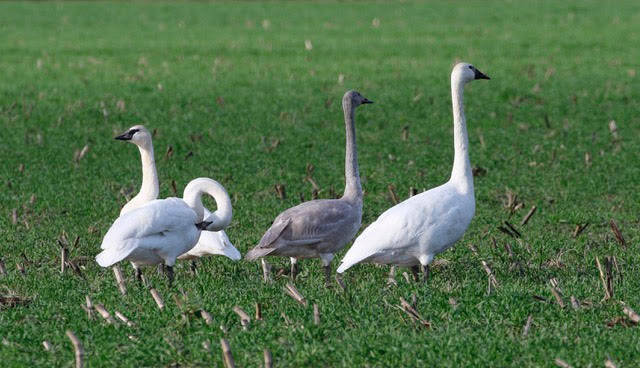
Wintering trumpeter swans are seasonal residents of the North Olympic Peninsula. ( Judith White/Olympic Peninsula Audubon Society)
