
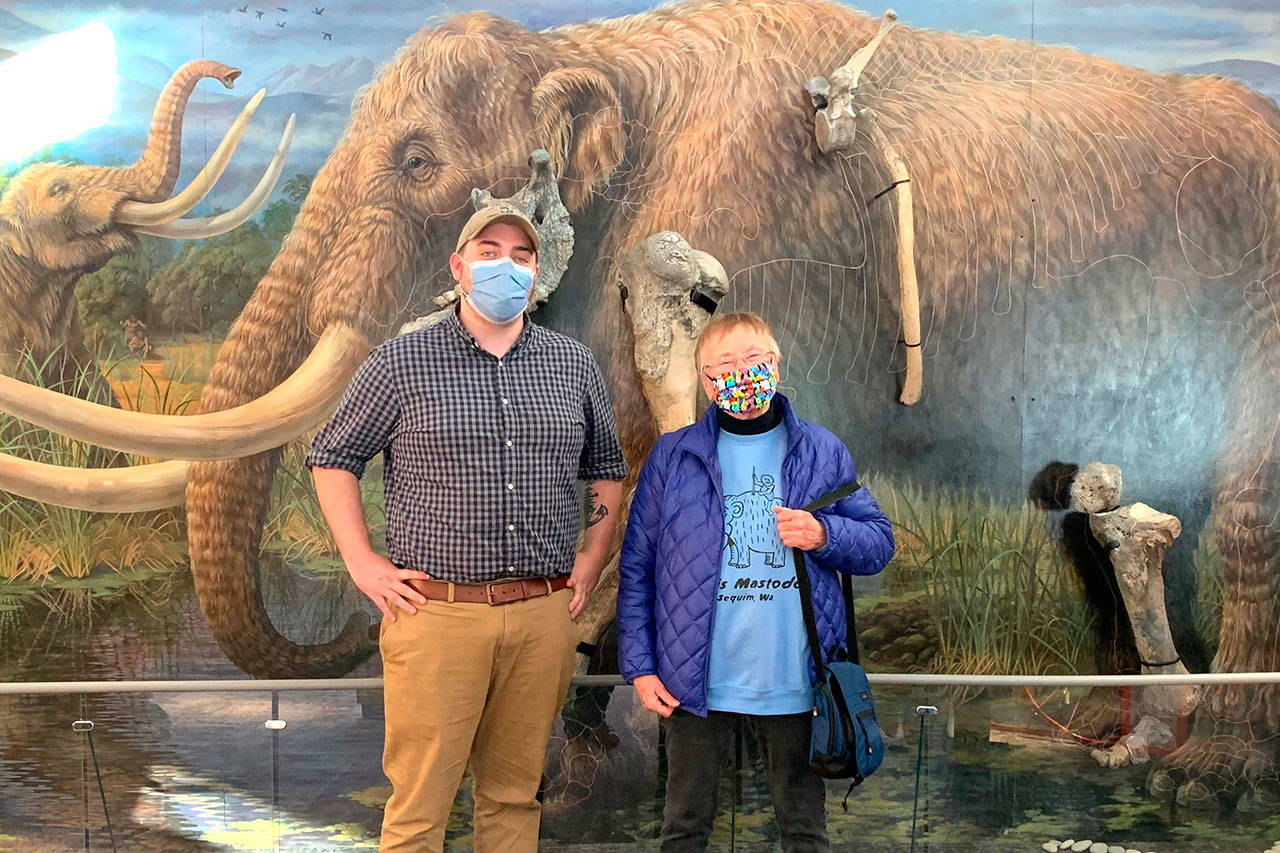
SEQUIM — New research from Texas looks to cement just when early indigenous man came to the area, thanks to the Manis mastodon.
Last week, Zachary Newell, a doctoral candidate and researcher at the Center for the Study of the First Americans at Texas A&M University, visited the Sequim Museum & Arts to see parts of his subject up close.
Newell has worked about 600 hours in the past year reconstructing a digital replica of a blunt object found in the mastodon’s rib.
He and center founder Michael Waters authored a research paper currently in peer review, one that shares their belief the object was man-made and likely was used to kill the mastodon.
“It’s redefining the earliest dates we see people in this region (the upper Northwest Pacific Coast),” Newell said.
He said where the mastodon was found in the summer of 1977 by Sequim resident Emanuel “Manny” Manis “shows some proposed routes people may have migrated.”
The paper looks to reaffirm Waters’ research that the mastodon and object date back about 13,800 years, compared with earlier research that puts it at about 13,000 years old.
“It predates the date we thought was possible,” Newell said.
Researchers looked at concerns, critiques and potential gaps from previous investigations to backup the date of the object and mastodon, Newell said. They anticipate publishing in fall 2021 at liberalarts.tamu.edu/csfa.
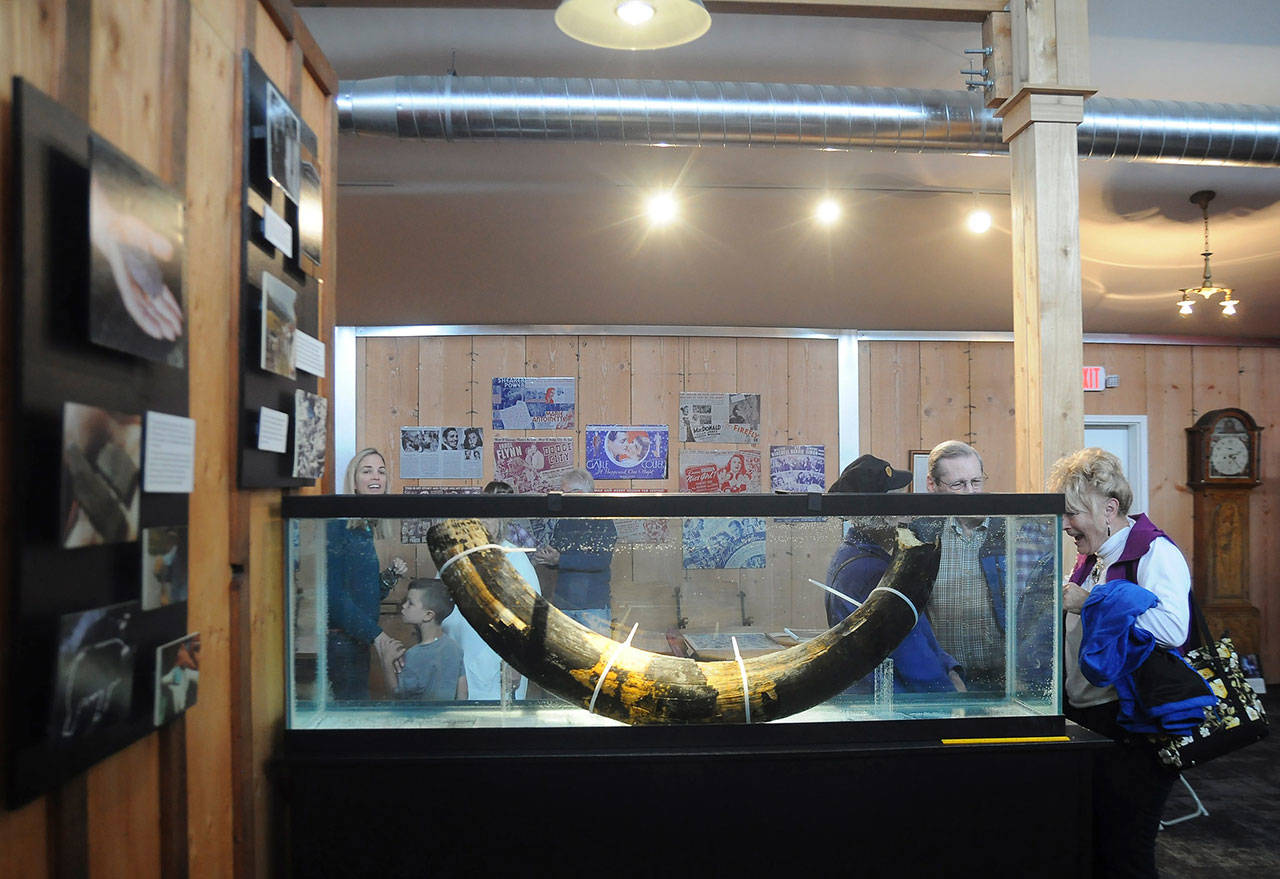
Sequim Museum & Arts remains open by appointment to see the Manis mastodon tusk, as seen here at the center’s grand opening in July 2019. (Michael Dashiell/Olympic Peninsula News Group file photo)
Spearheading project
Since its excavation, fossil finds at other sites have researchers creating their own chronologies, Newell said.
“It’s taken a while for the community to warm up to (our ideas),” he said.
“In terms of the community that studies the Americas, this has potential to be paradigm-shifting. We wanted to clarify the credibility of the find — find some definitive evidence for this being a product of human life.”
The digital reconstruction produced promising results, Newell said.
“We can say it was a spearpoint (made of bone, possibly ivory or some other bone material) … and how it compared to other bone contact points,” he said.
He and Waters were primary investigators on the paper and collaborated with some biomechanical engineers at Texas A&M to produce an air cannon that would re-create velocities to replicate the same incident of a spear hitting the mastodon’s ribs.
“(The mastodon and spearhead) are a significant achievement and find for the field of archaeology, setting how people came to colonize or inhabit the western hemisphere,” Newell said.
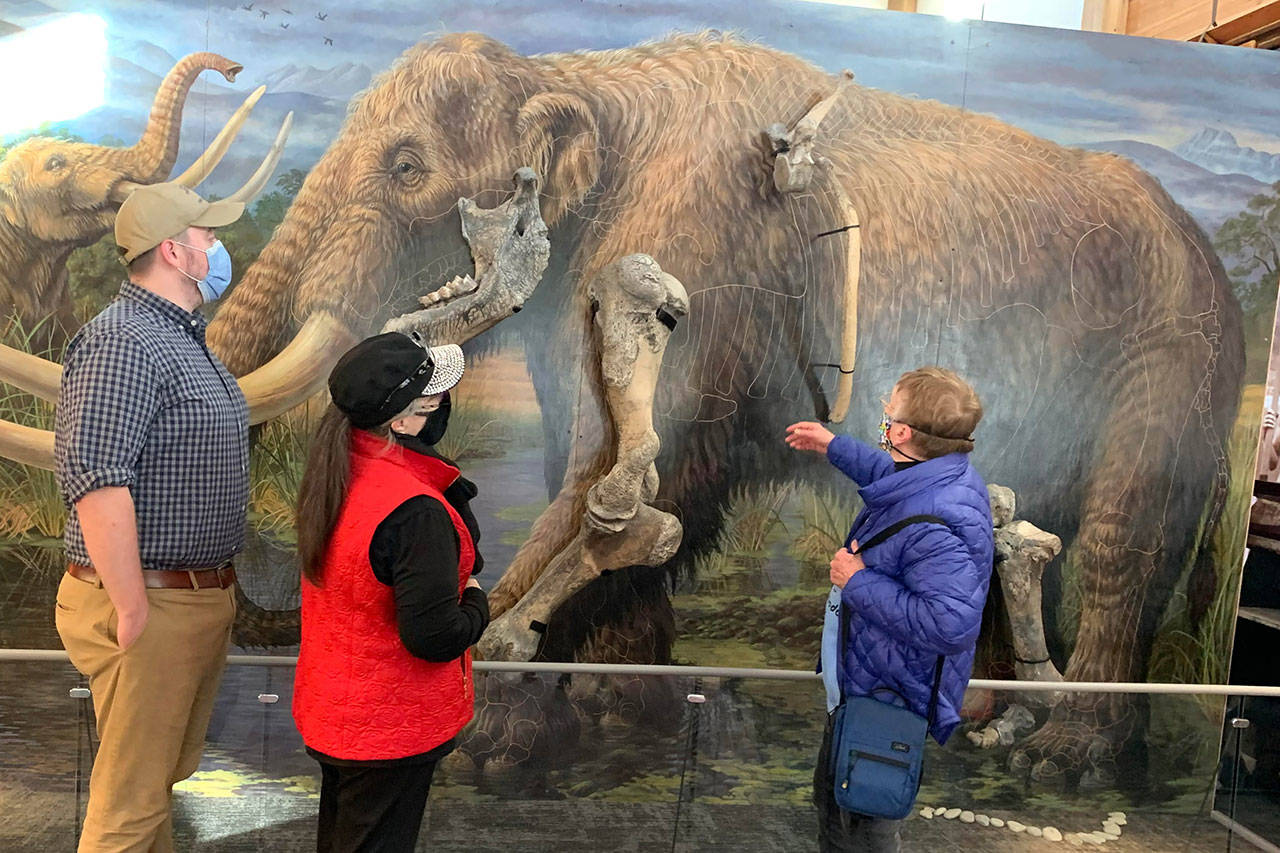
Next fall, researchers at the Center for the Study of the First Americans at Texas A&M anticipate releasing a paper that details how a spearhead found in the Manis mastodon in Sequim dates the first indigenous people to the area about 13,800 years ago. Last week, Zachary Newell, a researcher at the center, met with Judy Reandeau Stipe, executive director, of the Sequim Museum, and Clare Manis Hatler to discuss the mastodon and its discovery. (Photo courtesy of Zachary Newell)
Firsthand encounter
On his day trip to Sequim, Newell met with Clare Manis Hatler, Manny’s wife, and Judy Reandeau Stipe, volunteer executive director of Sequim Museum & Arts, to view the mastodon tusk and discuss Hatler’s experience with the archaeological find.
“It was fantastic; you don’t get this opportunity to see tusks like that intact,” Newell said.
“With it being displayed in an aquarium helps protect its structural integrity. I personally hadn’t seen anything like that. It was a neat experience.”
He said talking with Manis Hatler was far better than reading site and academic reports.
“It was interesting to speak with Claire and get her life experience and about the active site,” Newell said.
“You don’t often have that personal touch.”
Reandeau Stipe said any time more research comes out about the mastodon and its significance, it “creates more interest in the gem we have here.”
“Our intent was to be part of everything in our small town that would enhance education,” she said.
“It’s exciting to me to learn something from someone like (Newell).”
Reandeau Stipe said that the two large aquariums that tusks are displayed in were funded by a Port of Port Angeles grant, and the base was made by her husband, Bob Stipe.
Sequim Museum & Arts, 544 N. Sequim Ave., is open by appointment by calling 360-681-2257 or emailing to SequimMuseum@olypen.com.
New exhibits are being worked on, too. For more information, visit sequimmuseum.com.
________
Matthew Nash is a reporter with the Olympic Peninsula News Group, which is composed of Sound Publishing newspapers Peninsula Daily News, Sequim Gazette and Forks Forum. Reach him at mnash@sequimgazette.com.
