
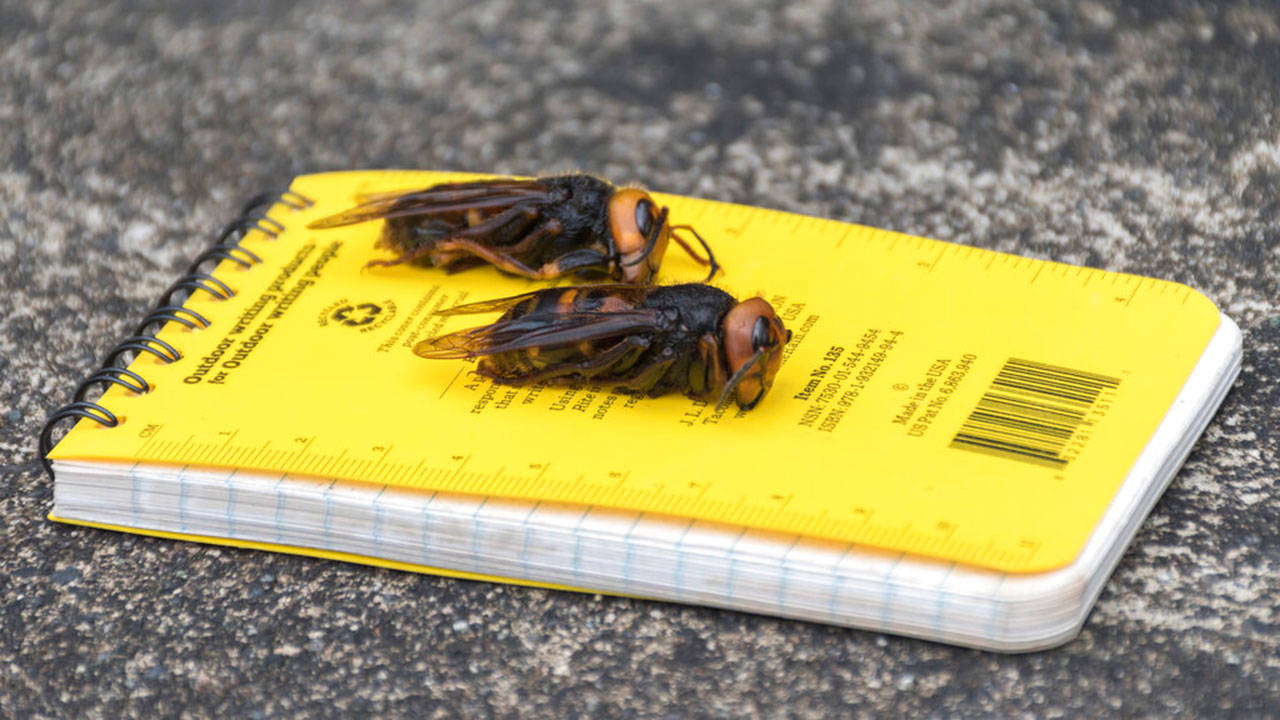
In this April 23, 2020, photo provided by the Washington State Department of Agriculture, dead Asian giant hornets sit on a researcher’s field notebook in Blaine. The world’s largest hornet, a 2-inch long killer with an appetite for honey bees, has been found in Washington state and entomologists are making plans to wipe it out. Dubbed the “Murder Hornet” by some, the Asian giant hornet has a sting that could be fatal to some humans. It is just now starting to emerge from hibernation. (Karla Salp/Washington State Department of Agriculture via AP)

In this April 23, 2020, photo provided by the Washington State Department of Agriculture, dead Asian giant hornets sit on a researcher’s field notebook in Blaine. The world’s largest hornet, a 2-inch long killer with an appetite for honey bees, has been found in Washington state and entomologists are making plans to wipe it out. Dubbed the “Murder Hornet” by some, the Asian giant hornet has a sting that could be fatal to some humans. It is just now starting to emerge from hibernation. (Karla Salp/Washington State Department of Agriculture via AP)

‘Murder Hornets,’ with sting that can kill, land in the state

Insects most destructive in the late summer, early fall

  • Associated Press
  • Monday, May 4, 2020 8:23pm
  • Life

By Nicholas K. Geranios | Associated Press

SPOKANE — The world’s largest hornet, a 2-inch killer dubbed the “Murder Hornet” with an appetite for honey bees, has been found in Washington state, where entomologists were making plans to wipe it out.

The giant Asian insect, with a sting that could be fatal to some humans, is just now starting to emerge from winter hibernation.

“They’re like something out of a monster cartoon with this huge yellow-orange face,” said Susan Cobey, a bee breeder at Washington State University.

“It’s a shockingly large hornet,” said Todd Murray, a WSU Extension entomologist and invasive species specialist. “It’s a health hazard and, more importantly, a significant predator of honey bees.”
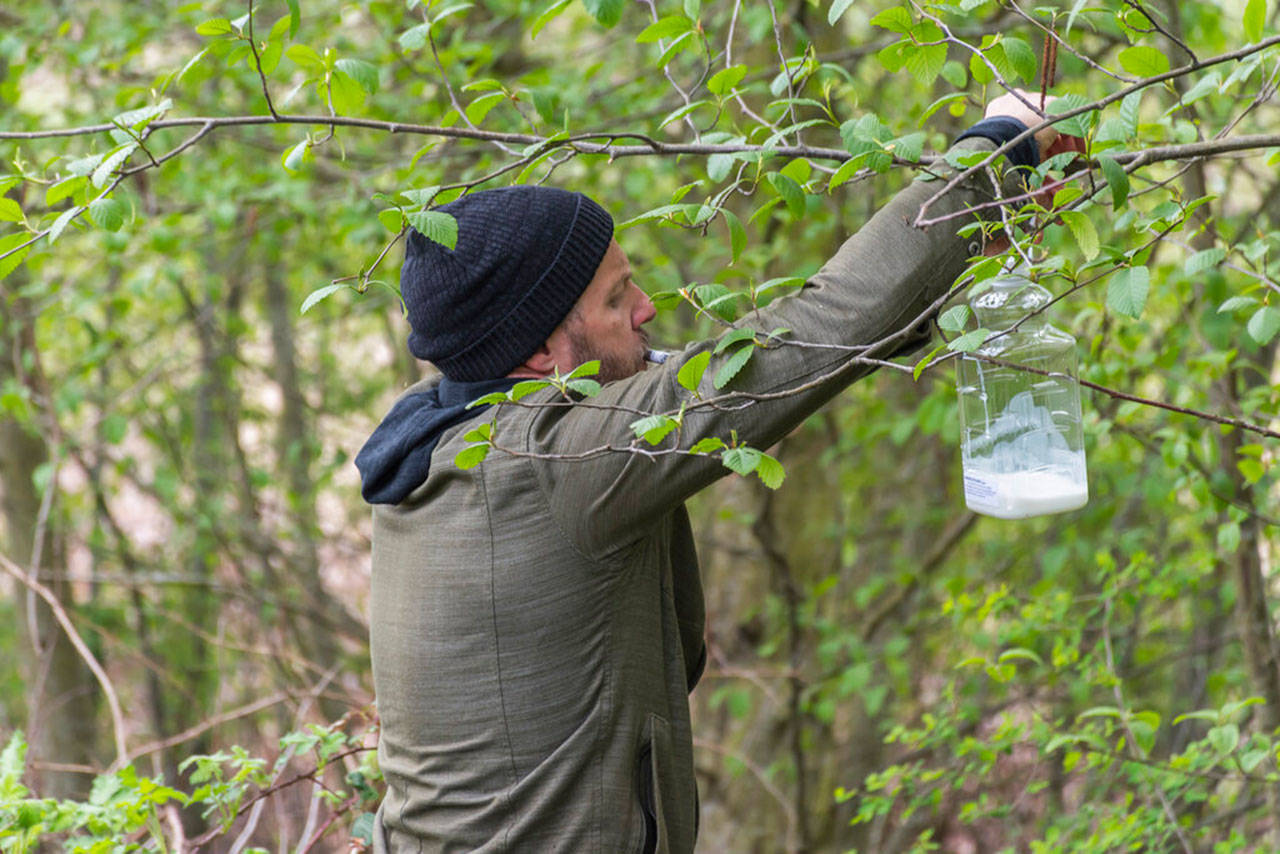
In this April 23, 2020, photo provided by the Washington State Department of Agriculture, Chris Looney, a Washington State entomologist, places a trap used to search for the Asian giant hornet in Blaine. (Karla Salp/Washington State Department of Agriculture via AP)

In this April 23, 2020, photo provided by the Washington State Department of Agriculture, Chris Looney, a Washington State entomologist, places a trap used to search for the Asian giant hornet in Blaine. (Karla Salp/Washington State Department of Agriculture via AP)

The hornet was sighted for the first time in the U.S. last December, when the state Department of Agriculture verified two reports near Blaine, Wash., close to the Canadian border. It also received two probable, but unconfirmed reports from sites in Custer, Wash., south of Blaine.

The hornet can sting through most beekeeper suits, deliver nearly seven times the amount of venom as a honey bee and sting multiple times, the department said, adding that it ordered special reinforced suits from China.

The university said it isn’t known how or where the hornets arrived in North America. It normally lives in the forests and low mountains of eastern and southeast Asia and feeds on large insects, including wasps and bees. It was dubbed the “Murder Hornet” in Japan, where it is known to kill people.
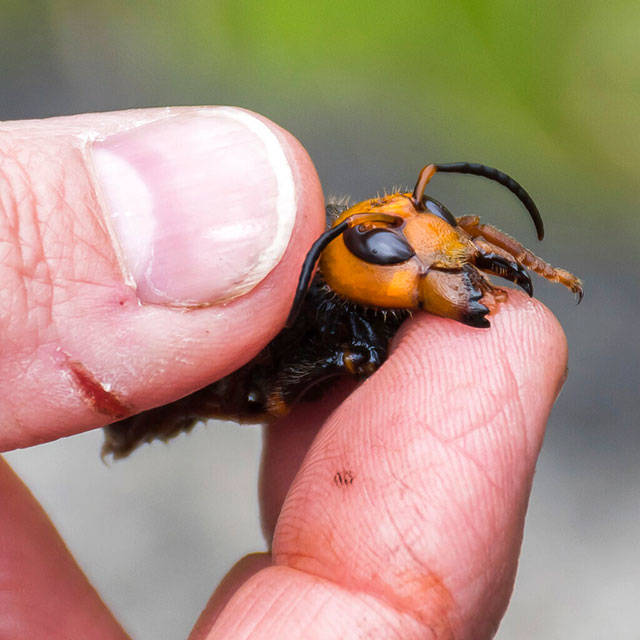
In this April 23, 2020, photo provided by the Washington State Department of Agriculture, a researcher holds a dead Asian giant hornet in Blaine. (Karla Salp/Washington State Department of Agriculture via AP)

In this April 23, 2020, photo provided by the Washington State Department of Agriculture, a researcher holds a dead Asian giant hornet in Blaine. (Karla Salp/Washington State Department of Agriculture via AP)

The hornet’s life cycle begins in April, when queens emerge from hibernation, feed on plant sap and fruit, and look for underground dens to build their nests. Hornets are most destructive in the late summer and early fall. Like a marauding army, they attack honey bee hives, killing adult bees and devouring larvae and pupae, WSU said.

Their stings are big and painful, with a potent neurotoxin. Multiple stings can kill humans, even if they are not allergic, the university said.

Farmers depend on honey bees to pollinate many important northwest crops such as apples, blueberries and cherries. With the threat from giant hornets, “beekeepers may be reluctant to bring their hives here,” said Island County Extension scientist Tim Lawrence.

An invasive species can dramatically change growing conditions, Murray said, adding that now is the time to deal with the predators.
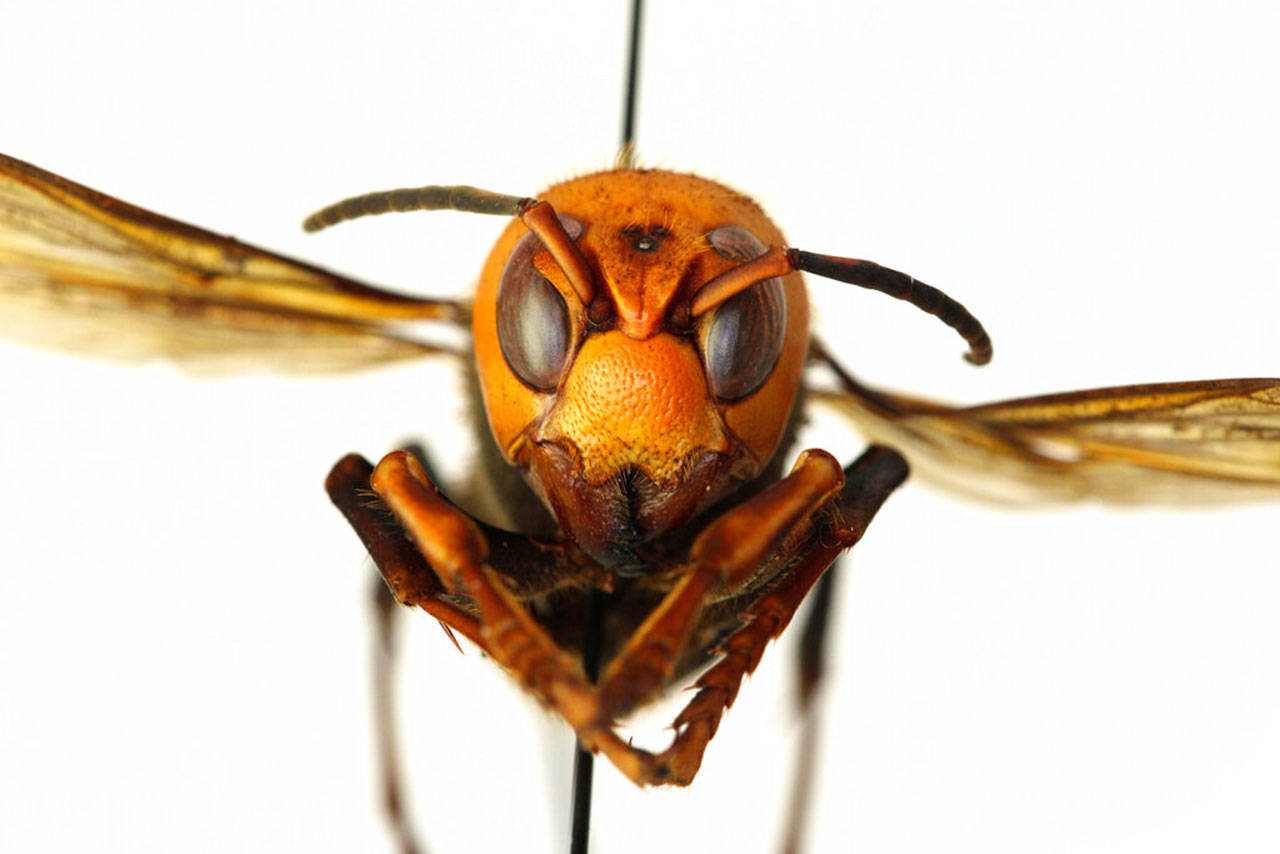
In this Dec. 30, 2019, photo provided by the Washington State Department of Agriculture, a dead Asian giant hornet is photographed in a lab in Olympia. (Quinlyn Baine/Washington State Department of Agriculture via AP)

In this Dec. 30, 2019, photo provided by the Washington State Department of Agriculture, a dead Asian giant hornet is photographed in a lab in Olympia. (Quinlyn Baine/Washington State Department of Agriculture via AP)

“We need to teach people how to recognize and identify this hornet while populations are small, so that we can eradicate it while we still have a chance,” Murray said.

The state Department of Agriculture will begin trapping queens this spring, with a focus on Whatcom, Skagit, San Juan and Island counties.

Hunting the hornets is no job for ordinary people.

“Don’t try to take them out yourself if you see them,” Looney said. “If you get into them, run away, then call us!

More in Life

Cheryl Grey.
Author’s fiction novel addresses healing of Elwha River valley

Story connects biology with tribe following the removal of dams

Calla lilies as tall in January as they would normally be on May 1. Native to Central America,  it is unheard of to see callas so advanced this time of year. (Andrew May/For Peninsula Daily News)
A GROWING CONCERN: There’s too much spring in our step

THIS spring weather! As a very good old Wisconsin… Continue reading

ISSUES OF FAITH: Not too late to make better choices

RECENTLY, I SHARED a story with my family at the dinner table,… Continue reading

M.E. Bartholomew
Unity speaker slated for weekend service

M.E. Bartholomew will present “You Have a Choice” at… Continue reading

The Rev. Bruce Bode
Bode scheduled for OUUF weekend program

The Rev. Bruce Bode will present “Follow Your Bliss”… Continue reading

The Rev. Pam Douglas-Smith
Program planned for Sunday service in Port Townsend

The Rev. Pam Douglas-Smith will present “Barefoot on Holy… Continue reading

A GROWING CONCERN: Seven reasons to prune your plants

THE WONDERFUL WARM weather, although a great treat for us, is not… Continue reading

a
HORSEPLAY: Ponies: Little packages with lots of personality

THEY’RE BOTH sugar and spice, naughty and nice! I just… Continue reading

Rev. Ben Nicodemus
New pastor to be installed Saturday

There will be an installation ceremony for Rev. Ben… Continue reading

Doug Benecke will be joined by Sallie Harrison for special music at 10:30 a.m. Sunday.
Program set for weekend service

The Rev. Doug Benecke will present “The Little Things… Continue reading

Gate city ladder crew.
BACK WHEN: Port Angeles, still the Puget Sound’s Gate City

IN THE EARLY days of Port Angeles, civic leaders had a vision… Continue reading

ISSUES OF FAITH: Imagine a new world

WITH THE HOLIDAYS behind us, after we have sent gifts, well wishes… Continue reading