
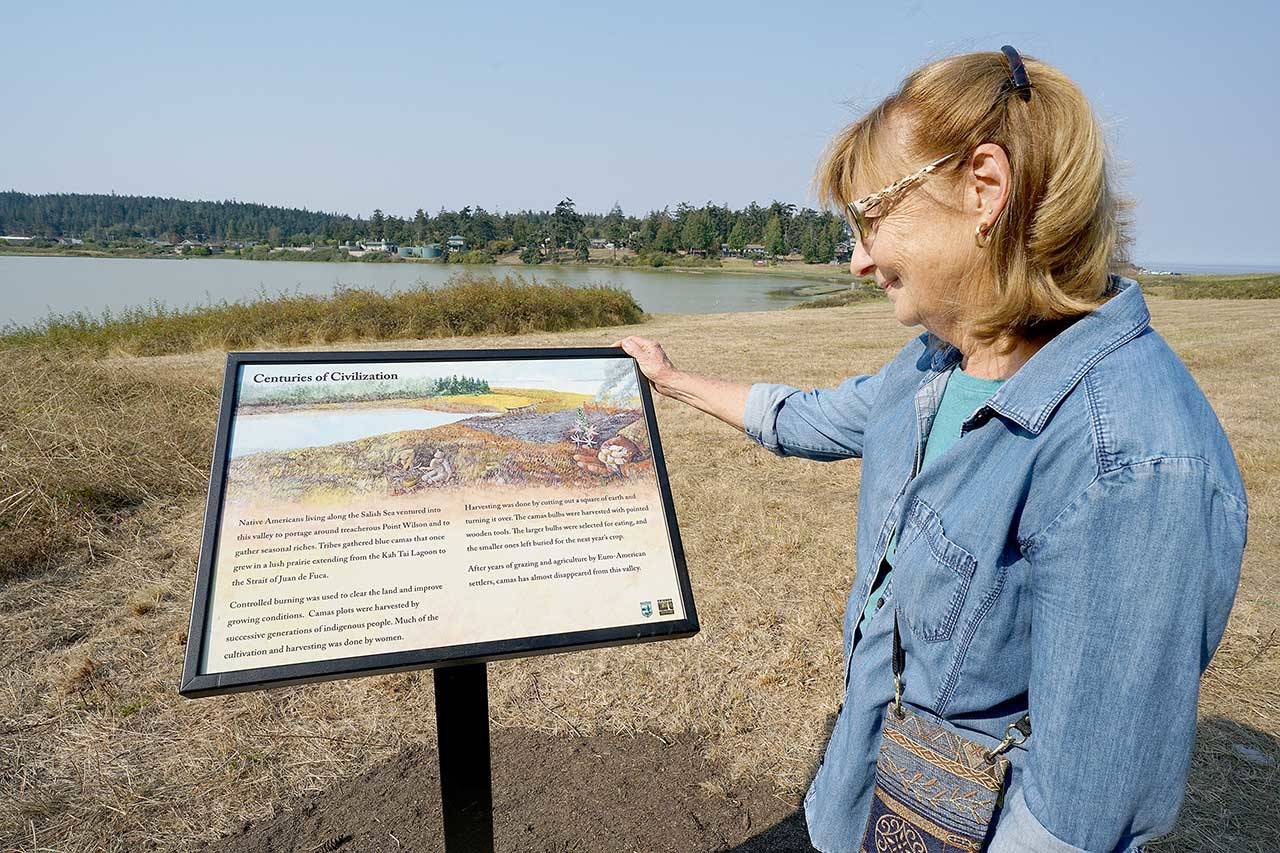
PORT TOWNSEND — “Where are the gardens at Chinese Gardens?”
That was the most common query Zan Manning and her husband, Claude, received last August while taking THING Festival attendees on guided hikes through an often-overlooked, 12.5-mile system of trails spread across the 432-acre Fort Worden State Park in Port Townsend.
“We had to explain that the name is an historical reference and that, in fact, there are no gardens,” said Manning, who recently completed a three-year project of researching, planning and installing five interpretive panels on a short stretch of trail along the east side of the Chinese Gardens lagoon, which sits at the west end of Fort Worden near North Beach County Park.
“The purpose of the interpretive trail is to tell the story of that area — not only its natural history but its cultural history, as well,” she said.
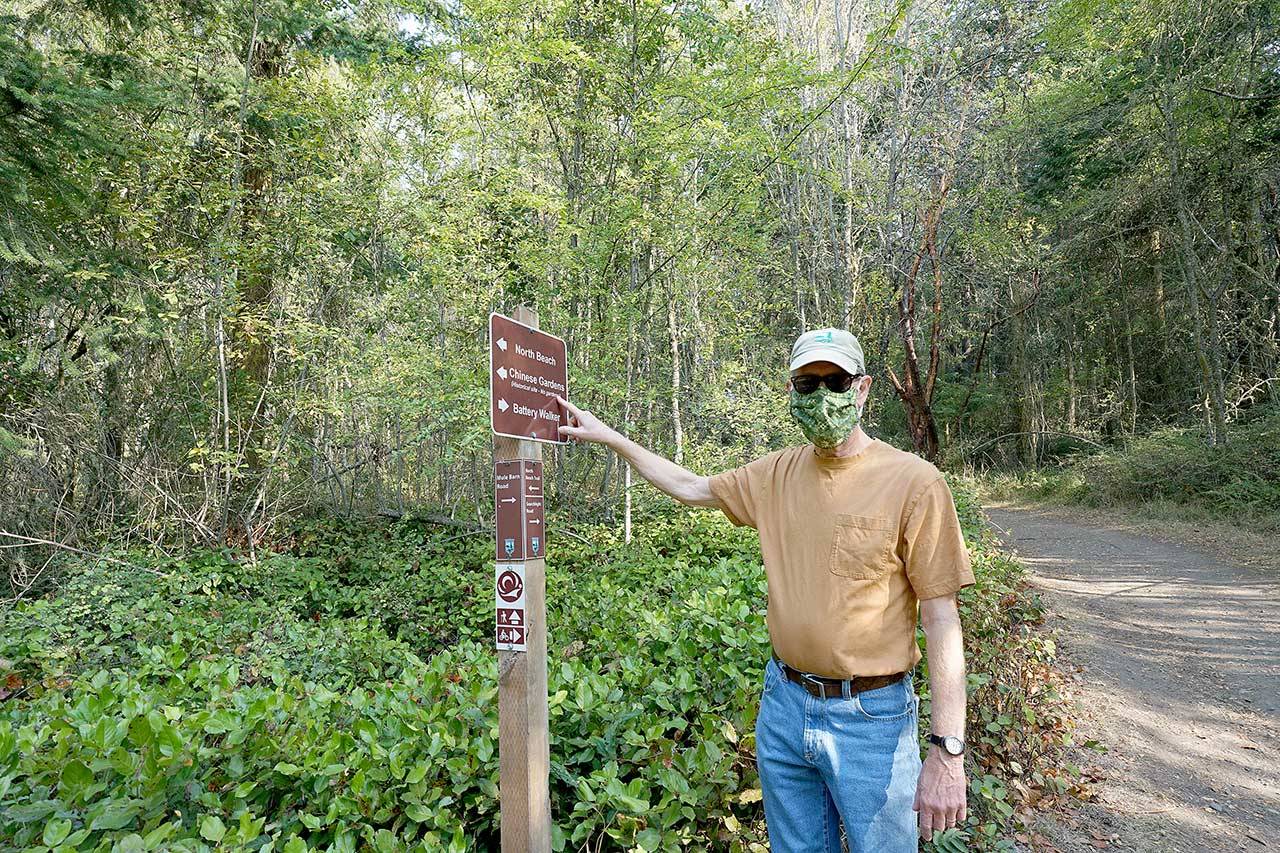
Claude Manning points out a wayfinding post Thursday that directs passersby to Chinese Gardens and clarifies in parentheses that there are, in fact, no gardens to be found there. (Nicholas Johnson/Peninsula Daily News)
Originally, the dedicated volunteer and former president of Friends of Fort Worden State Park planned to focus on the area’s natural history — the rich biodiversity resulting from what’s called the edge effect, where different ecosystems overlap, such as forests, farmland, wetland and shoreline, all of which are found in the Chinese Gardens area.
“But, as I researched, I got more and more interested in the cultural history of the area,” some of which is rather elusive, she said, especially the history of the area’s namesake: a period lasting from the late 1800s through the early 1900s when Chinese immigrants tended vegetable gardens in the basin of the then-drained lagoon, selling their produce both locally door-to-door and as far away as Seattle.
Although she’s quick to point out she’s not a trained historian, Manning pored over old newspaper articles, studied the diaries and oral histories of Euro-American settlers, and conferred with the Jamestown S’Klallam Tribe’s historic preservation officer, David Brownell.
“David said Native peoples have been using that area since the glaciers receded,” she said, explaining that Native peoples would carry their canoes from North Beach to Kah Tai Lagoon and into what is now Port Townsend Bay to avoid treacherous rip currents off Point Wilson.
Along the way, they would collect the bulbs of blue camas flowers from a lush prairie, which they referred to as Happy Valley, stretching between the Chinese Gardens lagoon and Kah Tai Lagoon, she said. When settlers arrived, they cleared and burned the prairie to make way for pastures and farms.
The settlers later constructed ditches, tide gates, drainage systems and cisterns, transforming the Chinese Gardens lagoon into the productive farmland used by Chinese immigrants, she said.
As best Manning could determine, the Chinese population peaked at about 500 just before the Chinese Exclusion Act of 1882, after which the population declined, she said.
“Still, we don’t really have accurate population data because of their ingenious use of identity swapping,” she said. “People thought these were always the same people, but in fact it seems new immigrants came in as others moved on to other areas.”
Because Manning was limited to 75-100 words per interpretive panel, her brief historical summaries “just scratch the surface,” she said.
But, thanks to longtime Port Townsend resident and prolific American wilderness painter Larry Eifert, illustrations on each panel bring Manning’s words to life.
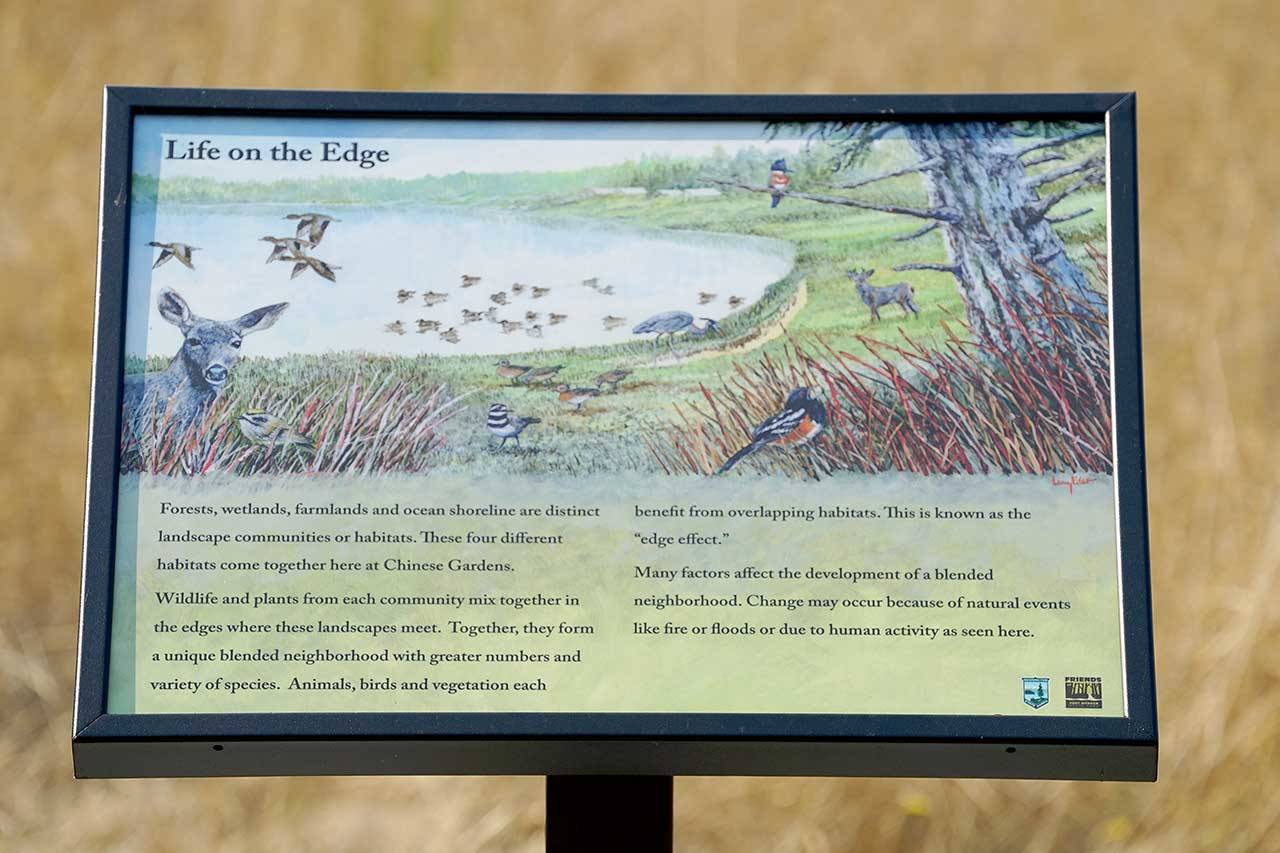
The first of five new interpretive panels on a trail along the Chinese Gardens lagoon describes the edge effect in which different ecosystems overlap, resulting in a rich diversity of plants, trees, animals and birds. (Nicholas Johnson/Peninsula Daily News)
Since the 1990s, Eifert has illustrated countless interpretive panels found along trails and painted many murals on visitor-center walls for the national and state park systems, with much of his work found throughout Puget Sound and the North Olympic Peninsula.
“I enjoy going to, say, Fort Townsend State Park and walking by my own art,” he said Thursday in an email, “and I expect I’ll do that often at Fort Worden, as well.”
The new interpretive panels at Fort Worden aren’t exactly the first — many older panels detail the area’s history as a military defense outpost — but they are unique in their style and focus.
Sam Wotipka, State Parks exhibit development coordinator — with whom Manning worked closely to develop the panels — described the project as “a small but important first step in telling the whole story of Fort Worden.
“To date, the interpretive focus of the park has largely been coast defense history,” Wotipka said Thursday in an email. “Indeed, the fort is a nationally-significant historic site, but the land that it is set on has other stories, as well.”
Within the next couple of weeks, a short video about Chinese Gardens will appear on the Friends of Fort Worden State Park website. And at 1 p.m. Sept. 26, the Friends will host a ribbon-cutting ceremony to celebrate the project’s culmination.
Both Manning and Wotipka said they’re eager to expand the interpretive offerings at Fort Worden.
For now, though, Manning said she’s excited to see more people walking what’s been dubbed the Chinese Gardens Interpretive Trail and pondering both the natural and cultural history of where they stand.
“The more people understand what we have here at Fort Worden, the more they will be inclined to protect it for future generations,” she said. “I just hope people enjoy this as much as I’ve enjoyed working on it.”
________
Jefferson County senior reporter Nicholas Johnson can be reached at njohnson@peninsuladailynews.com.
