
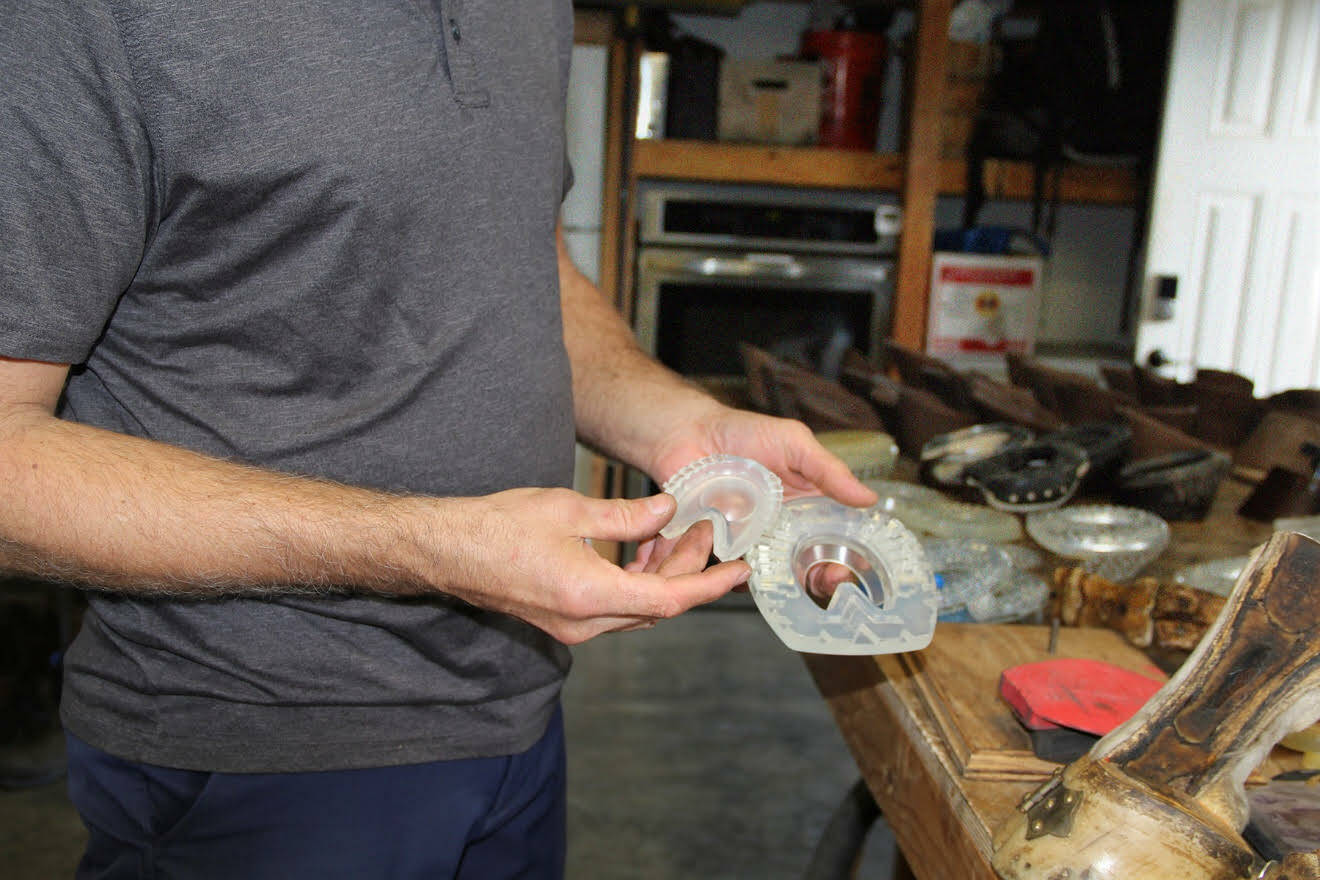
DID YOU EVER think you’d see horses wearing plastic shoes? It’s true, more horses can be seen wearing lightweight plastic polyurethane composite horseshoes in competitions and trail rides, as well as helping to heal from lameness issues. They’re lighter weight than the traditional steel, provide cushioning on hard surfaces and are simple to modify for a custom fit. The glue-on-only versions can be easily applied to the hoof by horse owners and farriers.
And here, in our quiet little town of Sequim, long-time farrier Chris Niclas’ passion for modern-day horseshoeing products and techniques has placed him on EasyCare’s (one of the largest distributors in the U.S.) Top 10 list of composite horseshoers in the nation.
If knowledge is power, then Niclas has shown he is happy to share his with all who are willing to learn. He’s a traveling clinician, former vice president of the Equine Lameness Prevention Organization (ELPO), a top source for advanced education, scientific and field research for professionals and horse owners.
Recently, he presented his glue-on shoe techniques for farriers, a hands-on clinic at McKinley & Peters Equine Hospital in Newman Lake, Wash.
“I learned a lot while traveling and teaching, and benefited from having conversations with professionals around the world, which gave me a much a broader perspective,” Niclas said.
When a horse is having hoof, gait or lameness issues, Niclas becomes single-minded in creating ways to improve the horse’s movement and health. His preferred method of problem solving is to work with a veterinarian and use a radiograph to get a clearer picture of any structural problems within the lower leg and hoof.
“My ability to form and create my own specialized composite shoes has allowed me to think out of the box,” Niclas said. “I can do so many other things with composite than I could with steel. I can probably name at least 21 firsts for the industry with products or applications I’ve come up with that no one has ever done.”
One of his “firsts” was traveling to Cheyenne Mountain Zoo in Colorado Springs, Colo., in 2017. There, he made customized rubber shoes for Twiga, a giraffe with a fractured pedal bone. (Featured in the May 10, 2017, Sequim Gazette, Twiga’s small miracle).
Did you see the 2005 animated movie Robots? This young idealistic robot likes to invent and create. His follows the motto “See a need, fill a need.” Those words played on a loop in my mind as I followed Niclas explain some of the processes he uses to design and create — anything and everything better.
One such product is a plastic plug that fits in the center of EasyCare’s Versa Grip Shoe to prevent snow, ice and mud from building up under the hoof.
For better traction on winter ice and slick surfaces, Niclas uses a hot knife as a siping tool to slice thin grooves on the bottom of composite shoes.
Made from a lightweight polyurethane polymer, these shoes are as durable as skateboard wheels. Gone is the need to fire up a hot forge to soften the steel and then setting it on an anvil to pound it into shape with a hammer, a process repeated until the desired size and shape is attained.
Steel shoes also tend to reverberate with high-frequency vibrations felt from the ground up in their hooves and lower legs when walking on hard surfaces like concrete, asphalt and rock. It’s a non-issue with composites.
Constructed out of polyurethane, contact and interaction between the horse’s hoof, frog and ground are maintained, giving the horse a similar feeling to walking barefoot, yet the hoof is protected from sharp, hard and penetrating surfaces. They also incorporate lateral and vertical flexion, which allows the hoof to expand and contract with each step. Each is easily customized for horses with specific hoof or medical issues.
For some, the higher cost of composite shoes prevents them from trying them. A pair of plastic shoes can be 3 to 4 times more expensive than steel. On top of that is the cost of glue, possibly a pad and hoof packing material, including an anti-fungal clay to prevent thrush that’s applied to the hoof frog and sole before installing the shoe.
Yet, Niclas has seen a huge improvement in the health of every horse he’s switch from steel to plastic shoes. He’s also helped many horses that were deemed too lame to ever be rideable again by a veterinarian become rideable again.
Grinders, sanders, a jigsaw and plastic welding are tools he uses to help shape, mold and fit the hoof. Shoes are attached to the hoof with glue, hoof nails or both.
Beginning
At 14, Niclas began shoeing horses. His first 20 years as a farrier, he was a journeyman honing his craft of building and shaping steel horseshoes of a vastly different types of hooves. Then he decided to attend Mission Farrier School so he could start attaining official certifications of expertise.
“I learned a lot more than just the basics,” he said. “Mission Farrier School founder Mark Plumley has been a longtime mentor for me since I first started. It proved to be a valuable learning experience.”
In my one-plus hour with Niclas, I learned a considerably greater amount of knowledge about the horse hoof, it’s biomechanics, causes of lameness and diseases and ways to balance the hoof than I’ve learned in my lifetime of horse ownership.
A skillful teacher, as I listened, I found myself having several “Ah ha!’ moments, as if a lightbulb in my brain was turned on, I suddenly had more clarity of the inner workings of lower leg and hoof anatomy.
Sorry to say I lack the space to share everything I learned in that interview. Look for part 2 of hoof care with Niclas in a future column. Following that, I may even add parts 3 and 4. Stay tuned.
In the meantime, you can follow Niclas on his Facebook page and view his How-to videos on YouTube.
________
Karen Griffiths’ column, Peninsula Horseplay, appears the second and fourth Saturday of each month.
If you have a horse event, clinic or seminar you would like listed, please email Griffiths at kbg@olympus.net at least two weeks in advance. You can also call her at 360-460-6299.
