
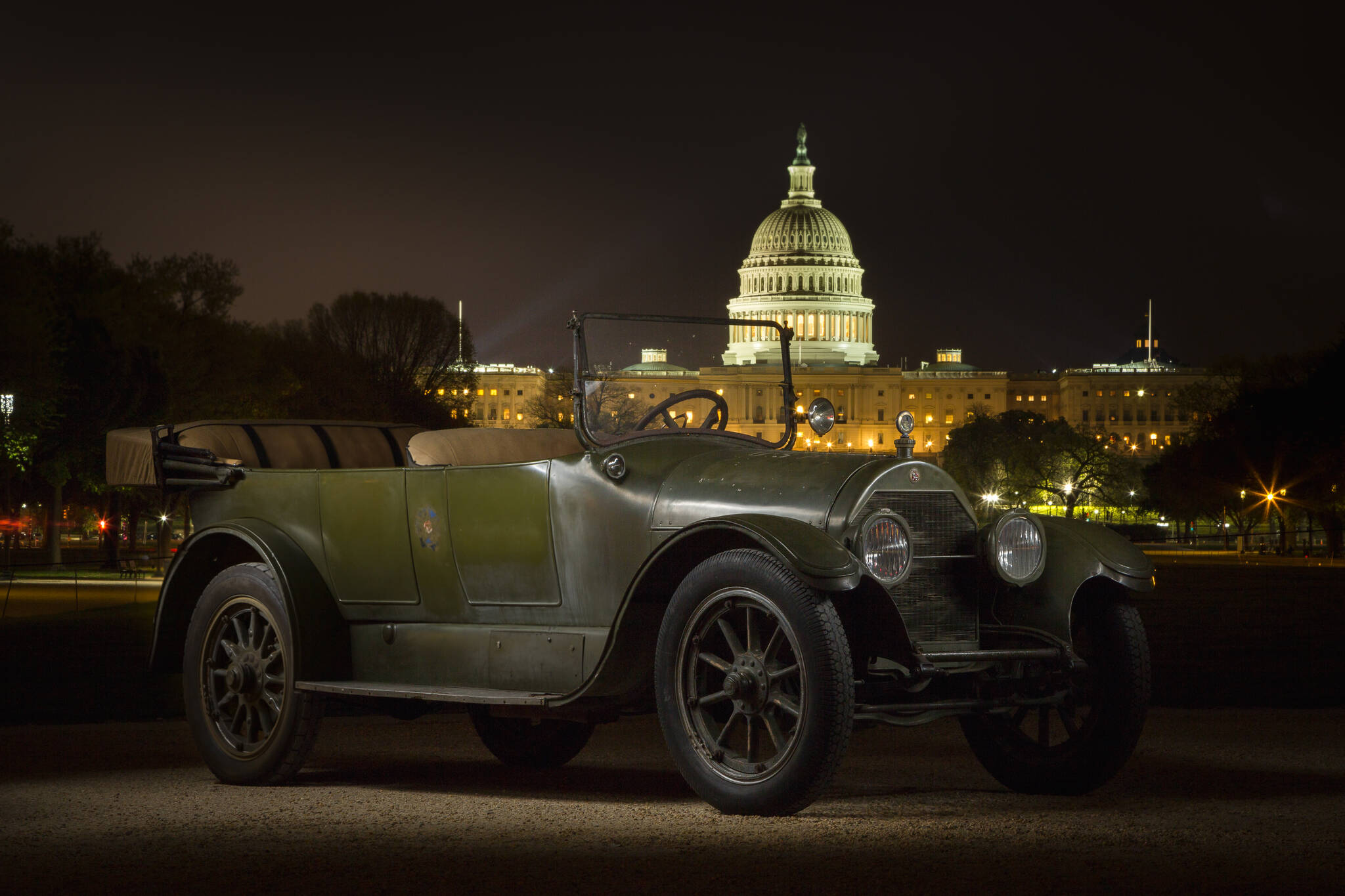
GARDINER — A 1918 Cadillac Type 57 owned by Marc Lassen of Gardiner is starting the New Year in the spotlight at the nation’s largest indoor-outdoor historic museum.
The now-classic automobile with many miles and history in tow is on display at The Henry Ford in Dearborn, Mich. — a massive complex visited by 1.7 million people annually.
The rotating exhibit is part of a partnership between The Henry Ford and the Hagerty Drivers Foundation to display cars from the National Historic Vehicle Register, helping to tell the story of the automobile in American history.
On display at The Henry Ford through July 2024, the vehicle is the only known Cadillac to have participated in World War I with a documented service record. It was the fourth vehicle added to the National Historic Vehicle Register and archived in the Library of Congress (2014).
Lassen, who has owned the vehicle since 2005, said the spot at The Henry Ford came as a bit of a surprise. The Cadillac spent a couple of years at LeMay-America’s Car Museum in Tacoma during the COVID-19 pandemic — “We just left it there,” Lassen recalled — and more recently at the Hershey Antique Auto Museum in Hershey, Penn.
But the partnership between the Hagerty Drivers Foundation and The Henry Ford this fall led to its new home through July 2024, and it has increased interest in the vehicle.
“I’m starting to deal with World War I groups outside of the country (who) want to do podcasts with me,” Lassen said.
“It’s not just about the United States; it’s about world history.”
Lassen, a car enthusiast who’s been buying, fixing and trading them since he was 15, said he hopes to see it part of the Armistice Day vehicle parade in France.
“I want to take it across the pond; it needs to go to France,” he said.
Before then, he and wife Christie plan to see the Cadillac at its temporary home in Dearborn at The Henry Ford — a museum listed on the National Register of Historic Places and designated a National Historic Landmark.
About the Cadillac
Known by its United States military designation (U.S. 1257X), the Cadillac was the 257th passenger car to arrive in Europe among some 20,000 that would eventually serve, and it was utilized as a support vehicle for the American Expeditionary Forces (A.E.F.) and Young Men’s Christian Association (YMCA) efforts during World War I.
The Cadillac was used to support French and American troops at the front during the Second Battle of the Marne, known as a key turning point that led to the end of the war on Nov. 11, 1918 (now known as Armistice Day and which Americans celebrate as Veterans Day).
Built in the summer of 1917, the vehicle was purchased on Aug. 9, 1917, by the Rev. Dr. John H. Denison, a Presbyterian minister and member of a wealthy Massachusetts family. Denison gave the car to the YMCA, along with his services as a driver, to support the United States’ efforts in World War I.
While in service for the YMCA, Denison chauffeured Eleanor Butler Roosevelt, the wife of Theodore Roosevelt III, who led women’s involvement in war efforts.
Most of the United States military vehicles that remained in Europe at war’s end — about 100,000 in all — were sold at auction or included in a bulk sale to France, but this Cadillac was not — possibly because Denison continued to serve in France after the armistice.
Diamond in the rough
After the war, Denison served with the vehicle throughout France for two years until returning to New York in August 1919. He had the car sent back to the United States and toured several National Parks.
A 2014 New York Times article notes that Major M. C. Bradley, a military vehicle collector, purchased the vehicle and owned it for more than four decades.
After Denison’s passing, the Cadillac’s history was temporarily lost.
Lassen said the car passed through a number of owners before he bought it in 2005 and uncovered its story through research.
In a 2014 Sequim Gazette article, Lassen noted he came upon the car while seeking a taillight for a 1929 Cadillac.
Though the car had been stored in a shed for a decade in Spokane — it had a dented fender, holes in the running boards, cracked and missing leather on its front and back seats and what appeared to be a bullet hole — it surprisingly had been spared from corrosion. Even the V-8 engine turned freely with good compression.
“I was told by one military expert that none of these World War I Cadillacs survive, and without the proven military history, ‘I just had a neat green car and I’d never be able to prove it’,” Lassen said in the 2014 interview.
He worked for nine years to uncover the Cadillac’s rich history.
The vehicle may be the only complete and largely unrestored example of a Word War I military Cadillac that survived among the 2,100 that General Motors shipped overseas.
“It’s lucky that it survived and came back to the U.S.,” Lassen said, noting that more than 99 percent of U.S. military vehicles were scrapped in France after the war.
He dubbed the vehicle the “Liberty Cadillac” and has since exhibited it across the country.
“It was in service for another 20-plus years and was preserved for almost 80 years without anybody messing with it,” Lassen said. “It’s a perfect time capsule.”
________
Michael Dashiell is the editor of the Sequim Gazette of the Olympic Peninsula News Group, which also is composed of other Sound Publishing newspapers Peninsula Daily News and Forks Forum. Reach him at editor@sequimgazette.com.
