
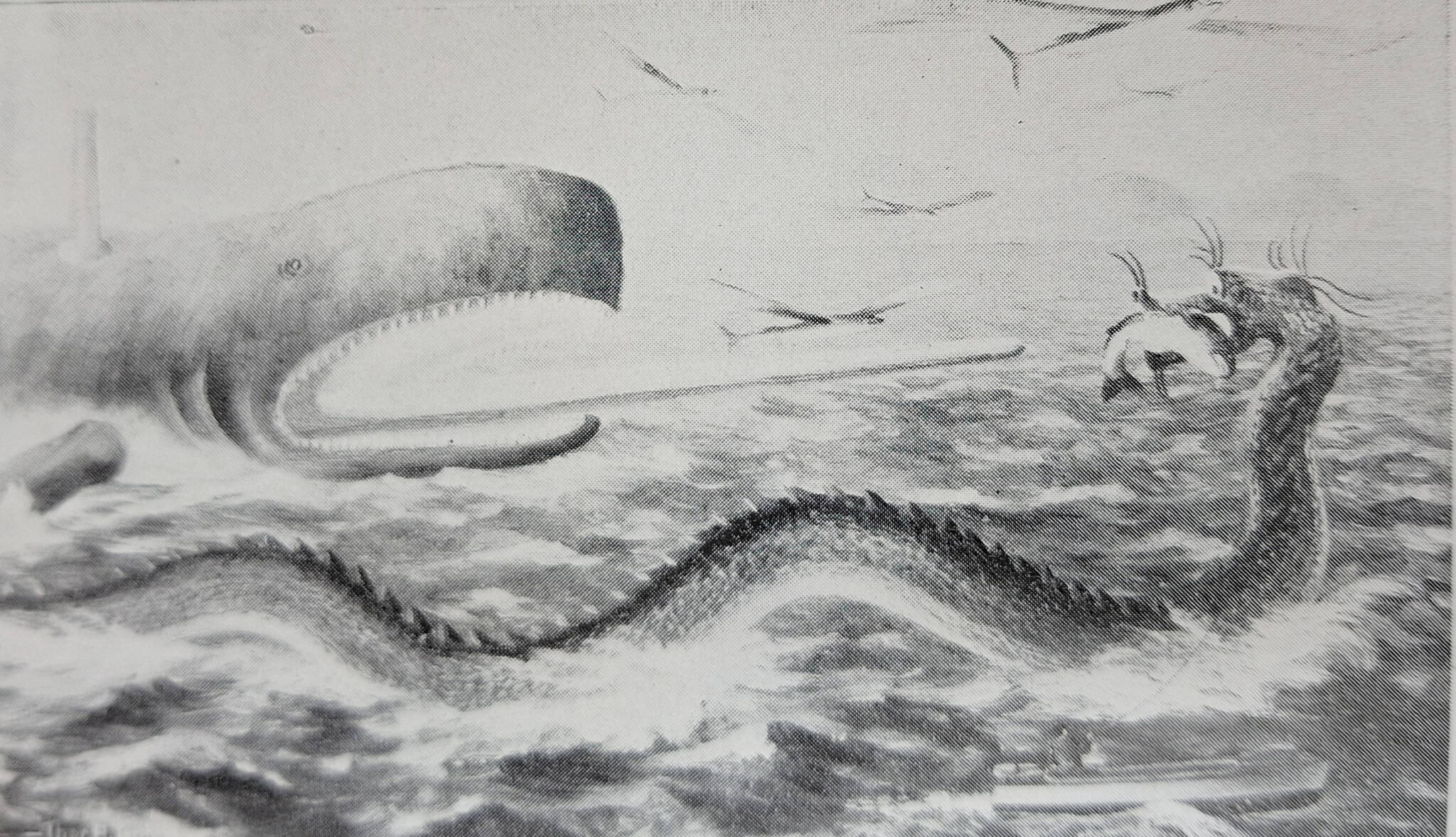
ON FRIDAY, JAN. 26, 1934, the Port Angeles Evening News ran an astounding story. The story was so big, I cannot understand why it was relegated to page 8.
The telling of events was by Charles D. Lewis, a noted Port Angeles fisherman. Lewis was the manager of the J. C. Penney store. Here is the story as Lewis told it.
“I had hooked a 75 pound black mouth salmon inside the harbor Wednesday. I was using an eight ounce pole, five pound test line and had played the big fish for four hours and 37 minutes when I saw what looked like a long series of cork floats on a fisherman’s net come rushing toward the boat. As the object came nearer I saw that it was Hiaschuckaluk, the sea serpent, and what I thought were cork floats were wart-like growths along the monster’s back. I got a good glimpse of the serpent for a deadly instant, saw his green, yellow-tinged eyes and just then he grabbed my salmon in his mouth.”
“Never slacking his pace, the serpent with the salmon between his teeth, hit for the high seas and as I held on to the pole, he carried the boat with him. We swept around the point of Ediz Hook at the speed of a racing automobile. My boat, ‘Filakaloo Bird’ was being taken for a ride such as she never had before.”
“We had got past the three mile limit in the strait when there was a heave like a tidal wave and a whale, as big as an island, came out of the sea, opened its mouth, and the sea serpent swam inside and with one snap of its ivory white teeth the whale snapped my line. It is this line that I have for evidence. Looking close on the frayed end of the fish line, the marks of the whale’s teeth may still be seen.”
“I was bout to start the motor for the return trip, bemoaning my hard luck in losing such a fine big salmon, when there was a blow and a belch, the whale opened its mouth, and out came Hiaschuckaluk, minus the salmon. But that is not all, the whale ran out its tongue, snow white in color and resembling the ramp-like deck of the plane carrier Lexington and launched a fleet of six huge flying fish, each one as large as a Ford Monoplane.”
“Away swam the sea serpent and the flying fish fleet winged up into the air. The flying fish and the serpent seemed to be working in unison. The winged fish scouting for salmon signaled to the serpent when they discovered a school, and the serpent at once rushed in to the spot, caught its prey and returned to the whale.”
How could anyone doubt Mr. Lewis’ story? After all, he was a noted fisherman whose veracity has never been successfully disproved. Have you ever known a fisherman to exaggerate the facts?
Sea serpent stories were nothing new. The Dec. 20, 1883, edition of The Vancouver Independent recounted an 1848 sighting near the Isle of Wight. It had to be true since it was told by the Rev. Mr. Highton.
In 1889, the Seattle Post Intelligencer reported that Captain Paul Boyton may have caught a sea serpent. It was said to be 63 feet long with a head like a horse and eyes like saucers. That fits the description of a giant ribbon fish or an oarfish.
On May 2, 1933, the Inverness Courier told of the sighting of a sea monster in Loch Ness. The Loch Ness Monster story has lived on for generations.
It is not unexpected that, in early 1934, a local sea monster story might immerge. Everyone’s interest always spikes when sightings of UFOs or Sasquatch are made. Technically, this may be called confirmation bias. Google it.
As Paul Harvey would say, “Here’s the rest of the story.” Lewis story was simply a fun marketing tool. 1934 marked the first salmon derby sponsored by the Port Angeles Salmon Club. In the early years of the derby, there was a qualifying round of fishing to determine who was eligible to fish in the final derby.
In concert with the salmon derby, the Salmon Club also held an Ananias Derby. I think this was a word play around the story of Ananias and Sapphira in Acts 5. Ananias had lied to God. Of course, he dropped dead immediately afterwards. The Salmon Club wanted to reward a fun tall tale of fish. After all, “every fisherman in the city is qualified for this contest.”
The Salmon Club knew there would be hard luck in the derby because of “the one that got away.” To qualify for the Ananias Derby, it was only necessary to tell a whopper of a story. “So as a prize for the finest fish story of the season, one that need not be spoiled by the truth. The prize was a framed and autographed picture of that Prince of Liars, Baron Munchhausen.” Jack Henson, the Wandering Scribe for the Port Angeles Evening News, would judge the winner of the contest.
Lewis’ tall tale has given our community a lasting legacy. Local artist, poet, and writer Thomas Guptill took brushes and paint and put Lewis’ sea serpent on canvas.
Guptill started with a sketch of the sea serpent, the whale and the flying fish. That sketch appeared in the 1934 Salmon Derby booklet. We do not know where this sketch is, if it still exists. We do know Guptill painted it by February 1934. It was displayed in the window of the Port Angeles Evening News’ office.
Guptill later painted a version of the story with only the sea serpent. The beast was known as Ediz Gigantis or “Bid Eddy.” Post cards of his painting were available at local drug stores.
It is fun to realize that sometimes our fun stories take on a life of their own. What whale of a tale do you have?
________
John McNutt is a descendant of Clallam County pioneers and treasurer of the North Olympic History Center Board of Directors. He can be reached at woodrowsilly@gmail.com.
John’s Clallam history column appears the first Saturday of every month.
