
“HOP — O — MAZING”
The hop for its profit I thus do exalt,
It strengtheneth the drink and it flavorith malt,
and being well-brewed, long kept it will last,
and drawing abide, if ye draw not too fast.
— Thomas Tusser, circa 1557
ON THE RETURN to Pasco, closing the trip to “The Great American Eclipse,” I stumbled onto a horticulture bonanza.
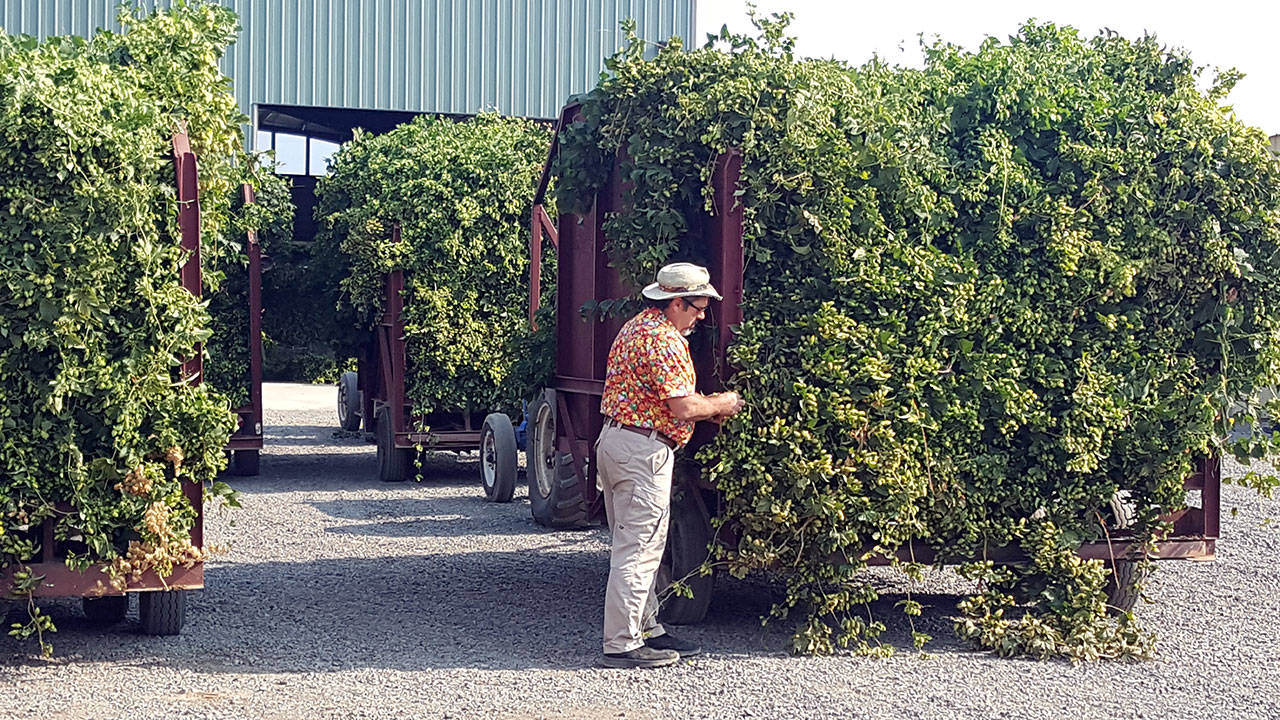
Just about 10 miles east of Moxie, we spotted a tractor trailer overflowing with fresh-cut hops.
We had been admiring for miles and miles the acres and acres of hopfields.
Washington state is the No. 1 producer in America of hops, an incredibly vigorous, herbaceous (i.e., dies back to the ground come frost), very hardy perennial vine, and right in front of us was a 1,000-acre hop farm just beginning to gear up for the harvest.
It will take them seven full weeks, 35 days without a break, working two full shifts to bring in this crop.
They will then mechanically separate strobils or seed cones from the massive vines and dry them in huge warehouses using propane heated air (135 degrees F) and humongous squirrel cage fans.
Washington set a new record in cultivation this year, up 16 percent to 37,444 acres, which was up 17 percent the year before.
This phenomenal growth has propelled the Evergreen State into the No. 1 growing region in the world. We now produce more hops than all of “beer-famous” Germany.
In just Washington, Oregon and Idaho alone, 80.2 million pounds of hops, which is 42 percent of the world’s production, was produced in 2016. (This year’s harvest is estimated to be even larger.)
So there is a huge agriculture boom for Washington state as well as the Pacific Northwest in hop farming.
The oldest brewery in the world is in Weihenstephan, Germany, brewing beginning in 1040, although there is historical evidence of beer being brewed in 5th-century B.C. Iran.
A 3,900-year-old Sumerian poem honors the patron goddess of brewery, Ninkasi.
And the chemical test on pottery suggests more than a 5,000-year-old tradition of cask beer production in ancient China and Mesopotamia.
(Hey, good things tend to last long.)
It was the introduction of the hops, the flowers head of the plant Humulus lupulus, that really got beer going. Early beer before hops, which is used as a flavoring and stabilizing element in fermentation, was brewed with Gruit, a concoction that included numerous bitter herbs, medicinal flowers and perennials, even heather and ground ivy.
The key to hops was twofold.
Hops have beneficial antibacterial properties that suppress harmful micro-organisms.
The direct result of this antibacterial benefit is that beer brewed with hops lasts longer. It stores much better.
Hops also have the great balancing act of matching aroma and bitterness against the very pungent and sweet malt, also used as a key ingredient in beer.
Early hop production became so important in medieval Europe that even Charlemagne’s father was willed a hop garden.
Taxes were being levied against Gruit but not hops so hop production quickly spread throughout Europe.
In 1876, Yakima Valley growers shipped 80 bales of hops out of New York, which boosted the first American production, started by Charles Carpenter in 1868.
Today, it is one of Washington’s premier and ever-expanding agriculture crops.
Hops can grow right here on the Olympic Peninsula. They love a soil rich in boron and can grow in both sandy or clay soils but prefer a loamy profile.
Hops want to be in a well-drained soil with a pH of 6.0 to 6.5, so lime will be needed here on the Olympics.
The more sun the better if you are looking for production, but a shady area will suffice for ornamental value to hop vines, making a perfect cover on a trellis or old fence.
Either way, get “non-productive” sterile varieties so they do not germinate all over the neighborhood, and make sure to train them.
Hops want long lines or trellis to grow on or a tall wire structure. The vines must grow over 15 feet long before growing the hop flower producing side shoots.
So why not get happy and give this old and libatious plant a try today?
________
Andrew May is an ornamental horticulturist who dreams of having Clallam and Jefferson counties nationally recognized as “Flower Peninsula USA.” Send him questions c/o Peninsula Daily News, P.O. Box 1330, Port Angeles, WA 98362, or email news@peninsuladailynews.com (subject line: Andrew May).
