
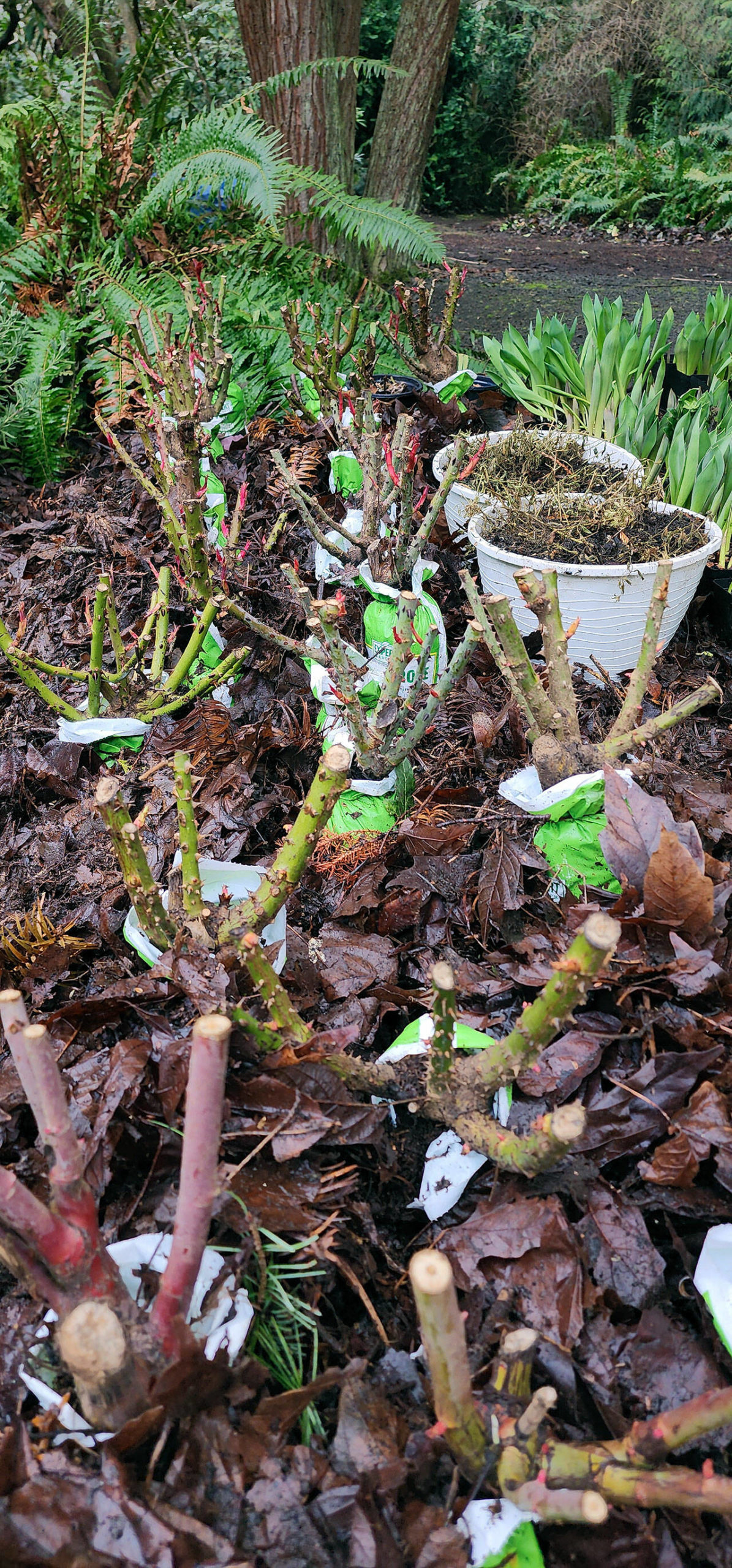
LAST WEEK, WE discussed bare-root items and why they are perfect to plant now. The week before that, we went over how now is the time to transplant most woody ornamentals and perennials.
That means I had better give you a list and definition description of the various forms or grades of plants.
Bare-root
It’s the best value, offers fast results and is the easiest to grow and care for.
The next 6 weeks are bare-root season, and remember, most of the packaged roses, trees and ornamentals you find now are bare-root items packaged in plastic and wood chips.
Whips
These are basically straight, sticks with very small side branches. They are economical and easy to plant as well. They are young plants — two-, sometimes three-years-old, so they take a few years to grow into an appreciable plant, which is why they are inexpensive.
Saplings and seedlings
These are the babies of the family — one year or 18-months-old. They are the least expensive of the lot but take the longest to grow into sizable plants. They are also the easiest to plant because the holes are the smallest.
Like bare-root items, saplings need to be planted very soon because it is hard to keep them watered well once the dry weather of summer arrives.
B and B
This is an abbreviation for bald and burlapped plants.
These nursery items are dug up and the root ball is wrapped in burlap to stop the soil from crumbling away from the roots.
Because they are freshly dug, their root system is small and thus requires lots of water and mulch around them so the ground stays cool and moist throughout the summer. The earlier you plant, the better.
Containerized
This group of plants usually starts as saplings or whips that are placed into a container when they are very young and are grown until they are sold in that pot. They have a well-established system and can often be root-bound — meaning when you take them out of the pot to plant, you need to rough up the roots or cut away the bottom few inches because of how intertwined the roots are.
Wire-caged
These are very large B and B plants that a specialized machine digs up and then wraps in burlap and places into a heavy wire basket.
Caged trees have more of a root system and allow for larger plants to be dug up and shipped. They are large and heavy, so tractors are required in most cases to move them and dig the hole.
With largely dug planting holes, make sure you add fertilizer, then put in a few inches of soil, flood with water and repeat. By adding soil in levels and watering well, you insure proper planting moisture and allow the plant to settle in.
Transplant
This is the plant you dig up in your yard or your neighbors, then move around or tow to your yard. It’s best you first pre-dig the hole it is to be placed into, then immediately dig up and transplant said plant to that hole.
Generally, a transplant item is a semi bare-root plant, so water well and transplant now.
Peat pots
This plant’s advantage is that it is grown in a biodegradable pot. That means you can plant it — pot and all — straight into the ground. Because the pot is degradable, the plant has not been in that container very long and so it is not root bound.
Also, the pot rots away and adds organic material to the soil while retaining and absorbing moisture around the roots.
So go out now and buy … and please, stay well all!
________
Andrew May is a freelance writer and ornamental horticulturist who dreams of having Clallam and Jefferson counties nationally recognized as “Flower Peninsula USA.” Send him questions c/o Peninsula Daily News, P.O. Box 1330, Port Angeles, WA 98362, or email news@peninsuladailynews.com (subject line: Andrew May).
