
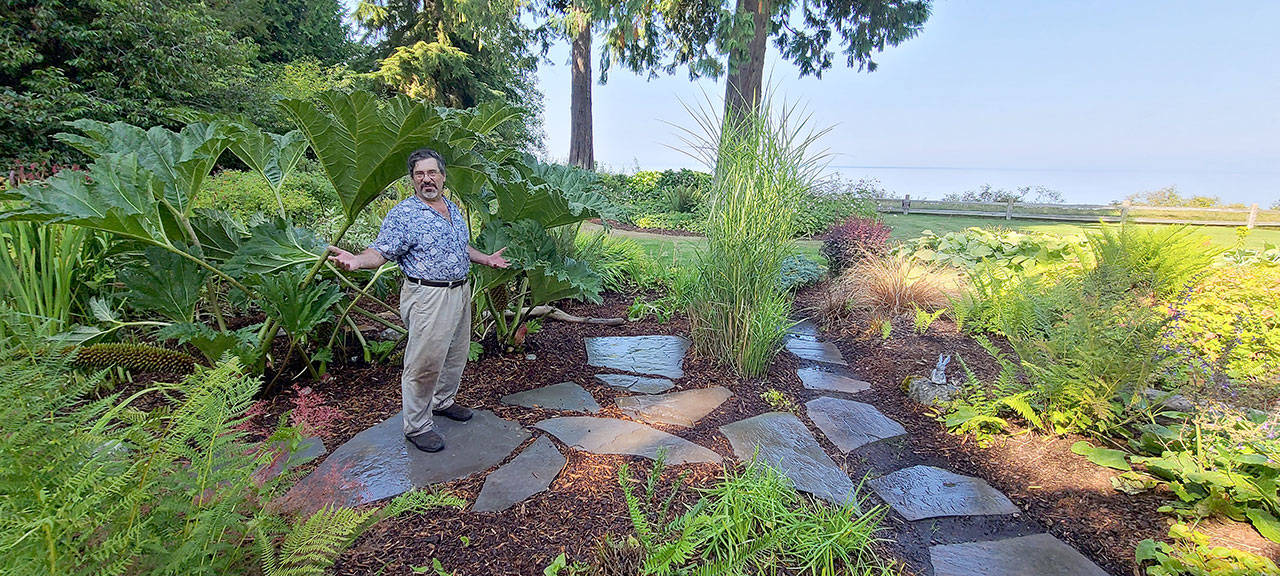
Q. WHEN IS A Chilean rhubarb neither?
A. When it is the most asked about plant in all of Colette’s Bed and Breakfast’s magnificent perennial garden — our very own “dinosaur plant,” Gunnera tinctoria.
Gunnera tinctoria is known by many horticulturist as “giant rhubarb” or “Chilean Rhubarb.”
It is an interesting, flowering plant with huge leaves, but is not actually related to rhubarb at all.
In fact, Gunnera is known to be about 150 million years old. When combined with its spiky (yet rubbery) stems and massive leaves up to 5 foot in diameter, and a 9 foot height — it is indeed a dinosaur plant.
It is native to Southern Chile and neighboring Argentina, but this South American perennial is not in the rhubarb family.
It is eaten in similar ways, whereas the stalks can be eaten fresh or cooked and can be reduced into jams, jellies and cordials.
From a distance, Gunnera looks very similar to rhubarb — just way bigger. And since it is from Chile and is edible, it is used in preparation of a regional dish — curanto, which consists of vegetables, meat and seafood, cooked in the ground. Each layer is embedded around Gunnera leaves. Yum, yum.
However, in the garden, as a weird, wacky, look at me plant, it is amazing.
Without question, of all the questions I receive in the garden column inquiring about this or that plant, the Gunnera plant is asked about more than all the others combined. And again, with good reason.
Gunnera does not like freezing temperatures, so some winter cover is required.
In early spring, it slowly starts to emerge as we peel away that protective, evergreen branch, mulch covering.
Once the covering is removed, amazing stout coral flower spikes emerge and will grow to seed pods bearing spikes 2- to 3-inches long, with hundreds of cone-shaped inflorescences which may contain up to 250,000 seeds.
These seed pods mature to an orange color and add to the “otherworldly” look of the plant.
However, the real intrigue is its leaves.
They first come out of this bizarre pinkish-red lacy conglomerate, which in itself is extremely interesting.
They grow massive amounts per week and eventually become 4- and 5-foot in diameter.
A clump of leaves can cover a 30- by 30-foot area.
It is big and bold.
What is so great about Gunnera, is that it adores moist and damp conditions where many other perennials will fail or produce poorly.
Gunnera can also grow in light conditions that range from full sun to partial shade, which adds to its garden usages.
So as we look forward to the arrival of autumn this week, let’s look back prehistorically to an interesting plant that may just have a unique usage in your garden.
No matter what you are using, though, make sure to stay well all!
________
Andrew May is a freelance writer and ornamental horticulturist who dreams of having Clallam and Jefferson counties nationally recognized as “Flower Peninsula USA.” Send him questions c/o Peninsula Daily News, P.O. Box 1330, Port Angeles, WA 98362, or email news@peninsuladailynews.com (subject line: Andrew May).
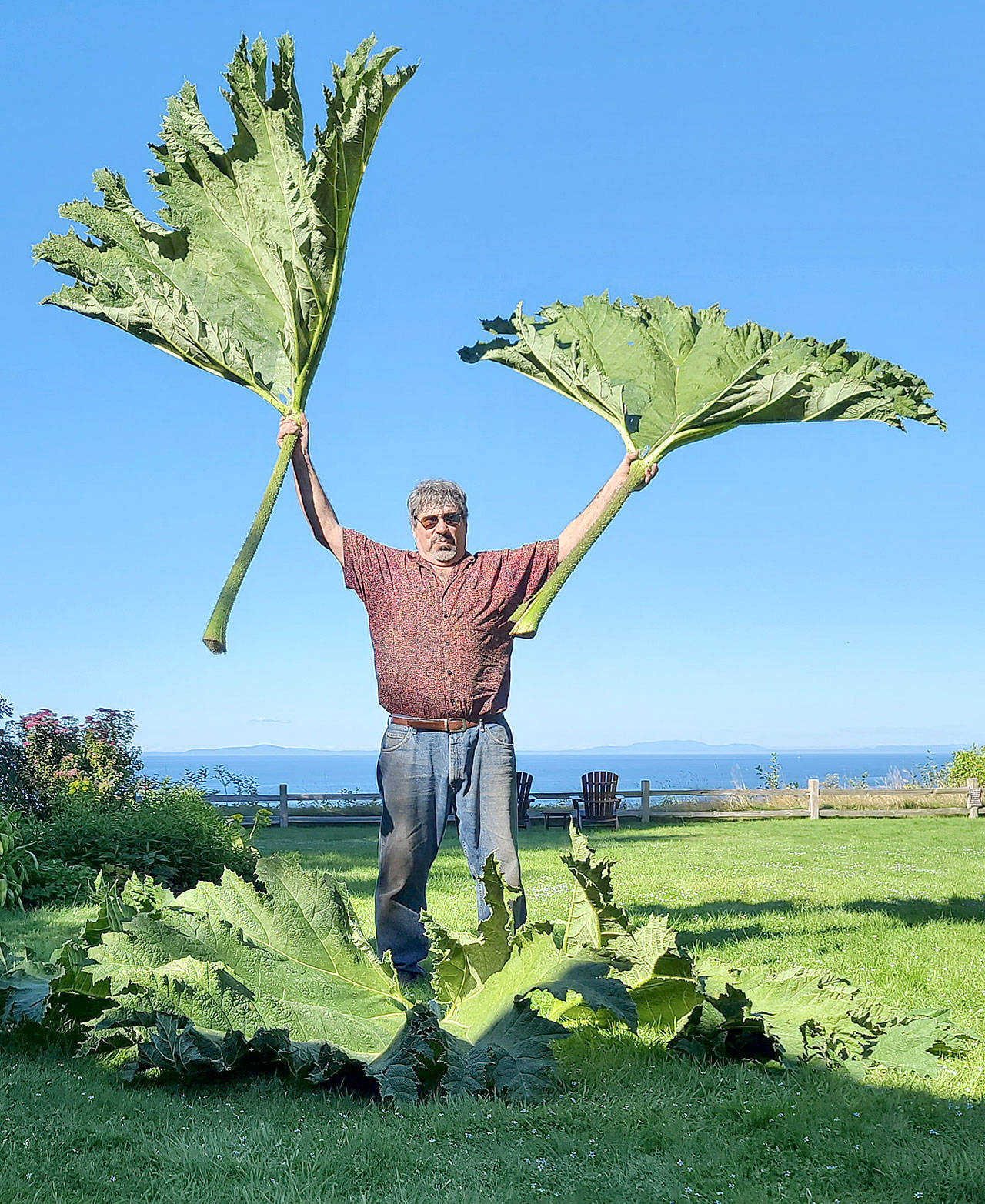
Leaves of a Gunnera plant, that we affectionately call the “dinosaur plant,” in the garden of Colette’s Bed Breakfast. (Andrew May/For Peninsula Daily News)
