
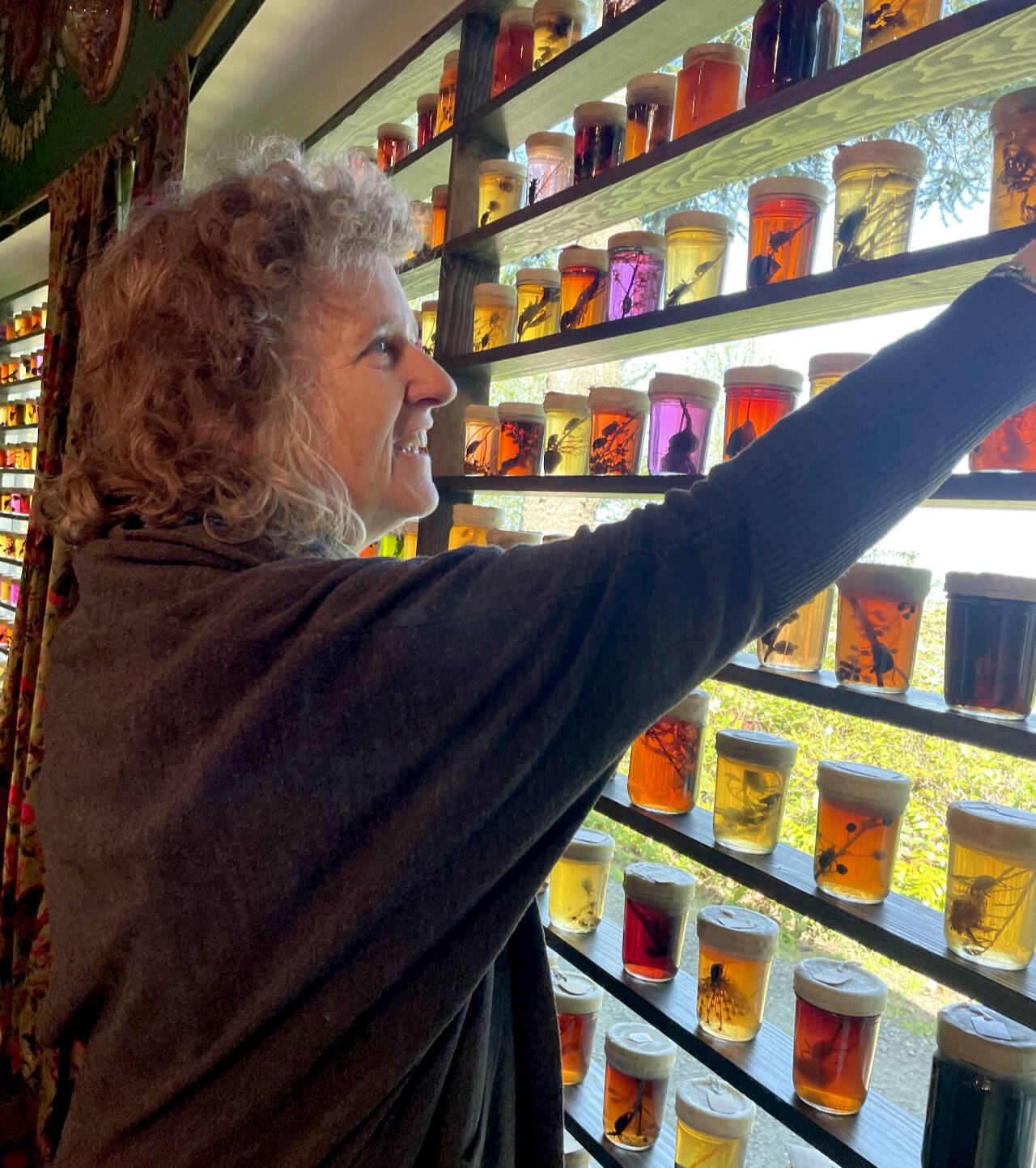
PORT ANGELES — If you imagine you’re being observed when you visit Jennifer Angus’ installation Hidden World at the Port Angeles Fine Arts Center, you might be right.
There are eyes everywhere. Used as emblems in the roundels that cover the walls of the Esther Webster Gallery, looking down at you by the deer trophies mounted near the ceiling and incorporated into the wallpaper Angus designed specifically for the space.
Then there are the more than 2,000 insects, each hand-pinned and artfully arranged by Angus and installation assistant Emma deVries that adorn the walls.
If the insects aren’t watching, they certainly remind visitors that they’re not alone — and we overlook them at our peril.
Angus’ site-specific installations blur the lines between science, art and nature, inverting complacent human dominion by immersing the visitor in an environment in which we are the subject — not the other way around.
Angus was born in Edmonton, Alberta, and received her bachelor of fine arts degree from the Nova Scotia College of Art and Design and master of fine arts degree at the School of the Art Institute of Chicago. She is currently a professor in the design department at the University of Wisconsin-Madison.
She came to her interest in insects in a roundabout way: while on a research trip to northern Thailand, she saw for the first time the singing shawls of the Karen tribe, which are embellished with fringe made out of hard beetle wings that make a sound when they move. The unexpected beauty and ingenuity of the garment caught her attention, as well as what she calls her “magpie tendencies.”
Angus has been using insects in her work for more than 20 years.
There are no butterflies or moths in the exhibit, partly because Angus learned early on that they are too fragile to withstand the rigors of travel and repeated pinnings, also because they are also obvious examples of what most people consider beautiful in the insect world.
Angus wants people to recognize the inherent beauty and importance of the millions of insects that, as she says, “don’t get respect.”
Angus obtains the insects for her work through dealers who specialize in exotic specimens sought by collectors and reuses them repeatedly. So often, in fact, that she can recognize certain individuals, like a cicada with a tiny bit of paint on it that was exhibited at the North Dakota Museum of Art in 2003.
“They have an extended afterlife most of their species don’t have,” she said.
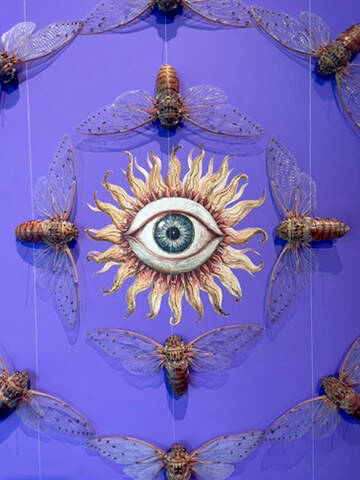
Some of the of the 2,000 insects used in Hidden World: Jennifer Angus on the wall of the Esther Webster Gallery at the Port Angeles Fine Arts Center. (Paula Hunt/Peninsula Daily News)
Cicadas feature prominently in Hidden World: black (Tosena albata); blue (Tosena splendida); white (Ayuthia spectabilis); and black and clear wing (Cryptotympana aquila) from Thailand, and clear wing (Pompoina imperatorial) from Malaysia whose wingspan is 8 inches across. Thorny stick males and females (Heteropteryx dilatata) and the giant leaf insect (Phyllium giganteum) come from Malaysia as well. There are also blue and purple grasshoppers (Titanacris albipes) from French Guyana.
Elements in the exhibition strongly hint at the Victorian era and its fascination with the natural sciences as well as the industrialization that would have such a negative impact on the natural world. Heavy, ornate velvet drapes touch the floor, and the walls are painted a vivid “arsenic green,” as Angus calls it, to resemble the color created with real arsenic in the 19th century.
Bell jars and domed picture frames contain displays of insects and dried flowers. Even the era’s affinity for taxidermy is represented with a tableau of animals seated around a dinner table. A ring-neck pheasant, beaver, badger, raccoon, mallard, seagull and heron share a meal.
“In the Victorian era, man was a consumer of nature and saw nature as a commodity,” Angus said. “Here there’s a party with predator and prey working out their differences. Something that we could learn from.”
We should not dismiss insects and the vital work they do in pollination, decomposition and natural pest control. Without them, we are literally nothing, she said.
“They are these amazing creatures, and the role they play in our environment is essential,” Angus said.
The PAFAC’s is using Angus’ work as a springboard for its Blooming Artists Creative Start Program in the Port Angeles School District. Fourteen classrooms at Dry Creek, Franklin and Jefferson elementary schools each will receive lessons integrating art, science and garden activities that adhere to state K-12 science learning standards, and they will get to visit Hidden World. Students will learn the basics of scientific illustration by drawing insect specimens and creating replicas out of sculpture clay.
In 2015, Angus was one of nine artists featured at the Smithsonian American Art Museum show, Wonder, that celebrated the reopening of its Renwick Gallery.
The opening reception for Hidden World will be held tonight from 5 p.m. to 7 p.m. It is free and open to the public, with donations encouraged. Entrance for the remainder of the exhibition will be by donation on a pay-what-you-wish basis.
Funding for Hidden World: Jennifer Angus comes from the city of Port Angeles’ Lodging Tax Fund, a state Arts Commission Creative Start Project Grant, as well as donors and gift sales.
Exhibit hours
Hidden World: Jennifer Angus, from 11 a.m. to 5 p.m. Thursdays through Sundays, April 25 through July 6 at the Port Angeles Fine Arts Center, Esther Webster Gallery, 1203 E. Lauridsen Blvd.
To learn more about the exhibition and upcoming PAFAC events, go to pafac.org/programs/events.
Community education classes
Peninsula College will offer two Community Education classes in conjuction with the Port Angeles Fine Arts Center’s Hidden World exhibition.
• Art & Entomology, from 5:30 p.m. to 8 p.m. May 6-8 (three sessions). Learn entomology illustration using real specimens with local entomologist Richard Lewis and scientific illustrator Robin Bundi. Instruction will cover watercolor techniques, specimen handling and basic insect anatomy. Held at PAFAC and Peninsula College. Course fee: $179. To register, go to tinyurl.com/kpm9f54r.
• Insect Collection, Pinning and Preservation Methods, from 10 a.m. to 1 p.m. May 31 and from 5:30 p.m. to 8 p.m. June 4 (two sessions). Learn how to identify, collect and preserve insects with local entomologist Richard Lewis. Held at PAFAC and Peninsula College. Course fee $99. To register, go to tinyurl.com/bddb2vep.
________
Reporter Paula Hunt can be reached by email at paula.hunt@peninsuladailynews.com.
